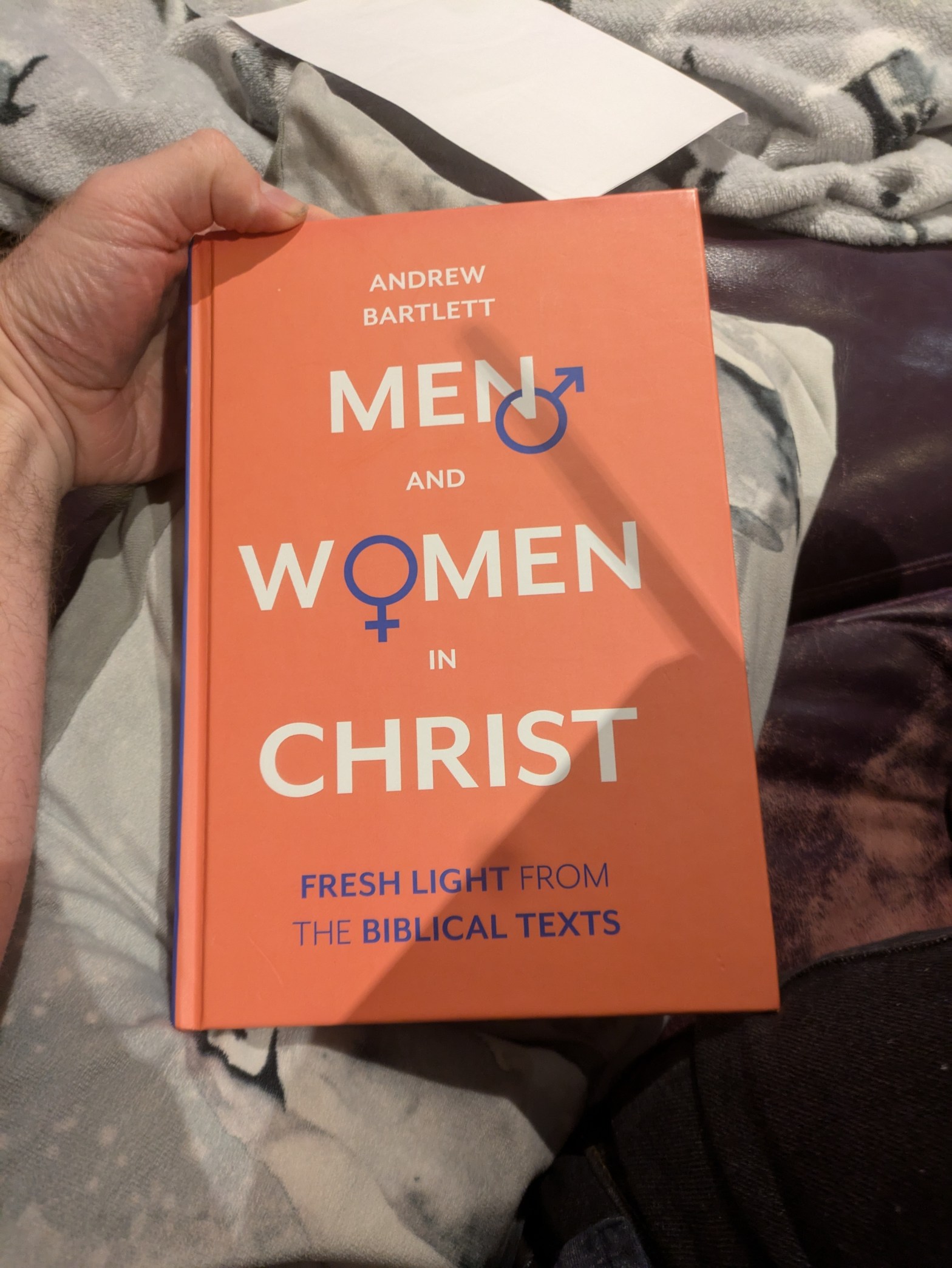
I’ve responded to this question briefly before in response to claims made on social media that Complementarianism is novel. I want to return to it again here in response to Andrew Bartlett’s book because one of his starting arguments is that both complementarianism and egalitarianism are novel positions.
Bartlett, offers a necessarily brief survey of history to show that “the traditionsl majority Christian view was robustly patriarchal. Women were inferior to men both in rank and nature. Men were the leaders in all spheres of life. As compared with men, women were regarded as inherently defective being less intelligent, more prone to sin and unfit for the kinds of eadership which men were able to provide.”[1]
Bartlett offers a number of examples including: Clement of Alexandria, Augustine of Hippo, Aquinas, Luther, Calvin, Hodge.[2] For example Celement of Alexandria says:
“The mark of the man, the beard by which he is seen to be a man, is older than Eveand is the token of the superior nature.”[3]
Aquinas says that:
“As regards the individual nature, woman is defective and misbegotten.”[4]
The other quotes follow in the same vein.
When Bartlett talks about the novelty of Complementarianism and Egalitarianism this is not intended as a jibe at either position and perhaps distinguishes his argument from that made by those in competing camps. Rather Bartlett argues that both complementarians and egalitarians may be bringing helpful insights that need to be heard together. He says that:
“Whilst we should always approach with humility the writings of those who preceded us in the faith, on this particular subject a substantially new start was needed because of the impact of traditional patriarchal culture upon biblical interpretation. When the waning of that culture made it possible to hear the teaching of Scripture more accurately the rejection of the doctrine of women’s innate inferiority required new thinking. Both sides of the current debate have arrived to their new positions through the efforts of capable, devout and conscientious scholar. It should be no surprise if we need to combine insights from each.”[5]
I think it is worth making three crucial observations here. The first is that I would agree with Andrew that there are voices and insights to be heard from both sides of the debate. This applies not just to scholars, though we do well to pay attention to both Carson and Fee but also to those who function more in the sphere of applied praxtioners and so we need to hear pastoral voices from both sides.
It is also the case that contemporary theologians and pastors may be free from certain blind spots, especially when those blind spots were created by the failures of past, sinful culture. However, we also need to be alert to the ways in which our own cultural blind spots may skew our reading of Scripture too. Not only that but they may well skew our reading of one another and of people from the past. This is particularly so when what we are often dealing with is fragmented quotes without context. I appreciate that Bartlett’s own book does not have time to dig into the history because it is not where his focus is. In the same way, my own, even briefer MTh dissertation was focused on Biblical study and application and so my own survey of history was necessarily brief. However, even in that short study, I did begin to see that our reading, from both sides of the divide may over assume a clear-cut situation throughout history when the reality was in fact messier.
Thirdly, if we can be over optimistic about our own ability to read Scripture rightly, freed from past cultural prejudices, we can also be overly pessimistic about the ability of past scholars and pastors to gain an accurate reading and application of God’s Word despite being hindered by culture. Theologically, this point is important because we want to recognise both the power of God’s Word and the power of the Holy Spirit at this point.
With those points in mind, one thing I would encourage those involved in the conversation to do is to keep going back to the history and finding out what those cited writers said. That’s why in a previous article, I spent a little bit of time looking at a fuller quote from Augustine. On Genesis 127 he says:
“Some people have suggested that it was now (Gen 1:27) that the human mind was made, while the human body came later, when scripture says, ‘And God fashioned man from the slime of the earth’ (Gen 2:7); so that where it says ‘he made’ (1:26), it refers to the spirit, while ‘he fashioned’ (2:7) refers to the body. But they fail to take into account that male and female could only be made with respect to the body. While indeed it may be acutely argued [as by himself, in On the Trinity, XII; EH] that the human mind, in which the human being is made to God’s image and which is a kind of rational life, has two functions: the contemplation of eternal truth and the management of temporal affairs; and that thus you get a kind of male and female, the one part directing, the other complying; it is still the case that the mind is only rightly called the image of God in that function by which it adheres in contemplation to the unchangeable truth. It is to symbolize or represent this point that the apostle Paul says that it is only the man who is the image and glory of God; ‘but the woman’, he says, ‘is the glory of the man’ (1 Cor 11:7).
“Thus while that which is to be observed in the one mind of the interior person is symbolized by two persons who are outwardly of different sex in the body; still the woman too, who is female in the body, she too is being renewed in the spirit of her mind, where there is neither male nor female, to the recognition of God according to the image of him who created her (Rom 12:2, Eph 4:23, Col 3:10, Gal 3:28). Women, after all, are not excluded from this grace of renewal and the refashioning of God’s image, although their bodily sex symbolizes something else, which is why only the man is called the image and glory of God. In the same way too, in the original creation of the human race, because the woman too was human, she obviously had a mind and a rational one at that, in respect of which she too was made to the image of God.”[6]
Augustine distinguishes the physical body from the mind and soul, he sees a higher and a lower part of humanity. It is in regards to the physical body that he sees a difference between men and women and it is in that regards that he considers the female sex, subordinate. However, in terms of mind/soul, he doesn’t see a difference but rather a unity between male and female. In that respect, in the mind, male and female were created to reflect the image of God and in that respect, they both, equally have the possibility through salvation to see that image restored.
In many ways, we might regard John Calvin as Augustine’s heir. Indeed, there is a tendency among the Reformed tradition to see the medieval period as a diversion, a cul-de-sac if you like. I have written previously about how Calvin holds to a form of mutual submission in his interpretation of Ephesians 5. On Genesis 2:18-24, he comments on “I will make him a help.”
“Some suppose that a distinction between the sexes is in this manner marked and it is thus shown how much the man excels the woman. But I am better satisfied with an interpretation which, though not altogether contrary, is yet different; namely since in the person of man the human race had been created, the common dignity of our whole nature was without distinction , honoured with one eulogy when it said “let us make man;” nor was it necessary to be repeated in creating the woman, who was nothing else than an accession to man.”[7]
So, here Calvin is insisting that the first man was complete and not lacking in terms of the image of God. It wasn’t that God needed to create woman as well. He goes on:
“Now since God assigns the woman as a help to the man, he not only prescribes to wives the rule of their vocation, to instruct them in their duty, but he also pronounces that marriage will prove to men the best support in life.” [8]
Here he emphasises that marriage has value, it is a good thing, not, as he notes some have implied “a necessary evil.” If there is value in marriage, then there is dignity in the role that a wife brings to it.
“The vulgar proverb, indeed, is that she is a necessary evil; but the voice of God is to be heard, which declares that the woman is given as a companion and an associate of the man, to assist him to live well.” [9]
It is worth noting that for Calvin, “to live well” is to be godly. That is the help needed. We can observe too that Calvin is not so bound by his culture as to be unable to challenge it and to insist that Scripture says something different to the worldview and norms of his day. If there is an evil experienced in marriage relationships, then for Calvin, the cause is sin. [10]
Calvin observes here that there is mutuality between husband and wife, just as he does on Ephesians 5. The mutuality is asymmetrical, she is his helper and he is her head.[11] However, because she is “like him, he understands that “Moses intended to note some equality.”[12]
One of the most prolific, Biblical commentators was Matthew Henry. It was he who famously said on Genesis 2.”
“That the woman was made of a rib out of the side of Adam; not made out of his head to rule over him, nor out of his feet to be trampled upon by him, but out of his side to be equal with him, under his arm to be protected, and near his heart to be beloved.
Yet Henry will also argue that in marriage, husbands and wives fulfil different roles or duties, that there is mutual submission between each other as believers but an asymmetrical relationship.
“The duty prescribed to wives is submission to their husbands in the Lord (Eph_5:22), which submission includes the honouring and obeying of them, and that from a principle of love to them. They must do this in compliance with God’s authority, who has commanded it, which is doing it as unto the Lord; or it may be understood by way of similitude and likeness, so that the sense may be, “as, being devoted to God, you submit yourselves unto him.” From the former sense we may learn that by a conscientious discharge of the duties we owe to our fellow-creatures we obey and please God himself; and, from the latter, that God not only requires and insists on those duties which immediately respect himself, but such as respect our neighbours too. The apostle assigns the reason of this submission from wives: For the husband is the head of the wife, Eph_5:23. The metaphor is taken from the head in the natural body, which, being the seat of reason, of wisdom, and of knowledge, and the fountain of sense and motion, is more excellent than the rest of the body. God has given the man the pre-eminence and a right to direct and govern by creation, and in that original law of the relation, Thy desire shall be to thy husband, and he shall rule over thee. Whatever there is of uneasiness in this, it is an effect of sin coming into the world. Generally, too, the man has (what he ought to have) a superiority in wisdom and knowledge. He is therefore the head, even as Christ is the head of the church. There is a resemblance of Christ’s authority over the church in that superiority and headship which God has appointed to the husband. The apostle adds, and he is the Saviour of the body. Christ’s authority is exercised over the church for the saving of her from evil, and the supplying of her with every thing good for her. In like manner should the husband be employed for the protection and comfort of his spouse; and therefore she should the more cheerfully submit herself unto him. So it follows, Therefore as the church is subject unto Christ (Eph_5:24), with cheerfulness, with fidelity, with humility, so let the wives be to their own husbands in every thing – in every thing to which their authority justly extends itself, in every thing lawful and consistent with duty to God.”
Now, in each of these examples, there will be moments when modern readers, whether egalitarian or complementarian will wince. This isn’t the exact match of equality that we would understand today. I suspect that there would be much, even of contemporary conservative evangelical culture that they would not recognise. However, it is important to recognise three crucial things.
- That whilst their on cultural outlook does constrain them and affect their view, they are not completely entrapped by it. They are able to see through their culture to some degree and indeed to challenge it.
- That there are the distinctions of roles and duties found throughout which are found in modern complementarian thinking
- That although we would not use the same language and would still disagree with a lot of their commentary, we can recognise that there is a sense of equality between men and women in what they write.
This means that, no, you cannot find an exact, unbroken tradition that completely matches with modern complementarianism. However, I do not believe that this is what is meant, or can be meant when we insist that complementarian is not novel. First, the primary point is that complementarians consider their interpretation the best fit with Scripture. That of course will be what we go on to debate. Secondly, it is that the position is not without historical precedent. Of course, you would expect there to be differences between a reformer position and what has come before, just as you might observe on other reforming moments, whether that’s the Doctrine of the Trinity, The abolition of the slave trade or the protestant reformation itself. It might be argued that each of those movements and moments had n element of novelty if we mean by that a break with the tradition. However, each of hem could demonstrate roots in and continuity from tradition in so far as that tradition sought to engage with God’s Word.
This does not mean that complementarians are definitely right. To assess that, we must turn to Scripture itself.
[1] Bartlett, Men and women in Christ, 4-5.
[2] Bartlett, Men and women in Christ v5-7.
[3] Clement, The Instructor 3.3. Cited by Bartlett, Men and women in Christ, 5.
[4] Aquinas, Suma Theologia, Part 1, Question 92, Article 1, Reply to Objection 1). Cited by Bartlett, Men and women in Christ 8.
[5] Bartlett, Men and women in Christ, cited by Bartlett, Men and women in Christ14,
[6] Augustine, Literal Commentary on Genesis, III.22.
[7] Calvin, The Book of Genesis, 129.
[8] Calvin, The Book of Genesis, 129.
[9] Calvin, The Book of Genesis, 129.
[10] Calvin, The Book of Genesis, 129.
[11] Calvin, The Book of Genesis, 130.
[12] Calvin, The Book of Genesis, 131.
 Faithroots