Readers may recall that I responded to an article in Evangelicals Now by Bill James where he talked about “the problem with Empathy”. Well, James has offered a brief response in this month’s EN.
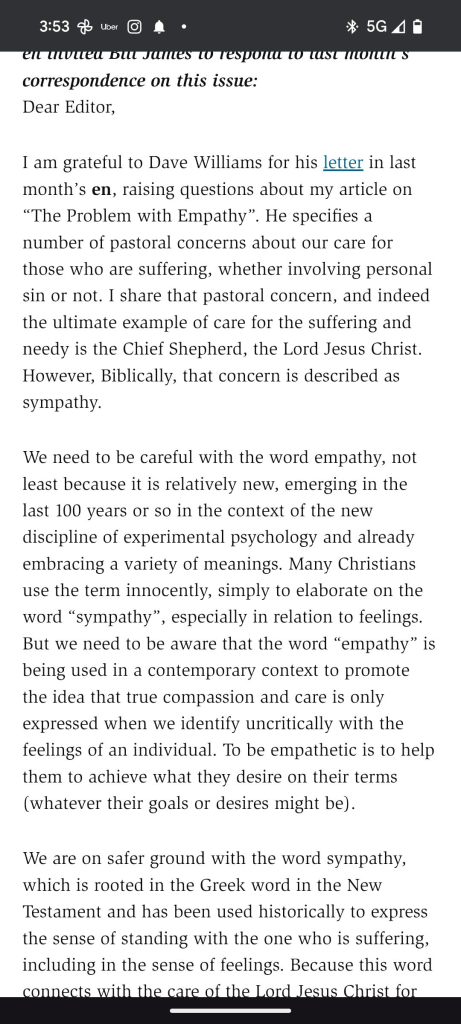
I am afraid that I was rather disappointed by James’ response. First of all, he does not really engage with the concerns I raise beyond to say that he shares those concerns. However, my point was that the approach he argues for on empathy itself risks selling us seriously short on some crucial issues.
To be clear, the debate here is not merely about finding the right word. Indeed, in the original article, James says:
“in our culture today ‘compassion’ is expressed as the affirmation of someone’s experience without challenge or criticism.”[1]
In other words, the issue is not merely about choosing the right word given that here James expresses an issue with how the word “compassion” is applied. It is not enough to simply claim to share concerns when challenges have been raised about how your own approach/argument creates those concerns.
In James’ response he repeats assertions from his first article, similar to the kinds of claims made by Joe Rigney and others. Specifically he says:
“But we need to be aware that the word “empathy” is being used in a contemporary context to promote the idea that true compassion and care is only expressed when we identify uncritically with the feelings of an individual. To be empathetic is to help them to achieve what they desire on their terms (whatever their goals or desires might be).”
This claim is contestable. The concept of empathy is used in a wide range of contexts. I guess it is potentially the case that some people might interpret it as meaning that you are to “identify uncritically” or that you are to “hep them to achieve what they desire on their terms.” However, in my experience of engagement with secular therapeutic approaches this has not how the word is understood. Whilst the language of being £non-judgemental in our approach may be used, this is not the same as being uncritical, nor does it require that we just allow people to do and say what they want unchallenged. Rather, the term “non-judgemental” is about not allowing your own prejudices to colour the relationship or to set yourself up as “holier than thou”.
James suggests that “we need to be careful with the word empathy, not least because it is relatively new” and so argues that:
“We are on safer ground with the word sympathy, which is rooted in the Greek word in the New Testament and has been used historically to express the sense of standing with the one who is suffering, including in the sense of feelings. Because this word connects with the care of the Lord Jesus Christ for us, it excludes any sense of condoning sin. The word sympathy has served the church well in exercising pastoral care long before the word empathy was invented.”
I must admit to being rather surprised to hear such arguments made as that simply isn’t how Biblical interpretation, theology or linguistic development works.
The word “sympathy” is rooted in a Greek compound which we find used just the once in the New Testament. Hebrews 4:15 says:
“For we do not have a high priest who is unable to sympathize with our weaknesses, but one who in every respect has been tempted as we are, yet without sin.”
However, as I’m sure Bill James knows well, if we, on that basis argue that our English word “sympathy” means today, what the Greek root used in Hebrews meant, we fall victim to a root fallacy.
Furthermore, we cannot presume that the word sympathy means the same today as it did even 50 or 60 years ago. Words change in meaning quickly. Indeed, note that the word “quick” is not likely to mean the same to modern ears as it did to readers of the King James version. If we talk about God judging “the quick and the dead” we do not mean that he is comparing zombies’ athletic abilities to Olympic sprinters. We may also observe how the word “woke”, against the protests of people like me, has moved from being a positive word with a narrow focus on race, to being a pejorative term describing a range of progressive ethical positions.
We also need to be careful about labelling some words as “Biblical” words and others as not. Consider two examples. We know that the word “Trinity” is not found in the Bible, it is however very much a Biblical term as it sums up how the Bible describes who God is. The word “sanctification” is even more interesting. Although it is based on a term found in Scripture, the term seems to refer more to a position or status of being considered holy than to a progressive process of increased holiness. However, we do not consider its usage to describe such a process as unbiblical because that is something that Scripture does describe and command.
We should therefore be able to recognise, as indeed do some Bible translations, that the word “sympathy” tends to refer in contemporary parlance to pity or concern for someone and therefore is not the best translation of Hebrews 4:15. Jesus doesn’t merely send us a “thinking of you” card. The word empathy as understood in everyday language better reflects both what Hebrews 4 and wider Biblical teaching on empathy is getting at.
[1] https://www.e-n.org.uk/features/2025-03-the-problem-with-empathy/

