You’ll hear a lot of criticism of Twitter, or X as it is now known. However, my view has been that the same problems exist on other social media platforms like Facebook. The reason is that the problem is not the medium but human interaction generally. With that in mind, I’ve picked up on some of those challenges on the new social media site, Threads recently.
In one example, the original poster made some comments dismissing Penal Substitution on the basis that it doesn’t appear in the parable of the Prodigal son. He also has recently posted, quoting someone claiming that they wished that Paul had got that the Gospel was about love instead of “turning the movement into a Greek religion focused on the cross and resurrection.” At some point I may pick up on both his arguments in a little more detail. However, I responded briefly to his threads disagreeing.
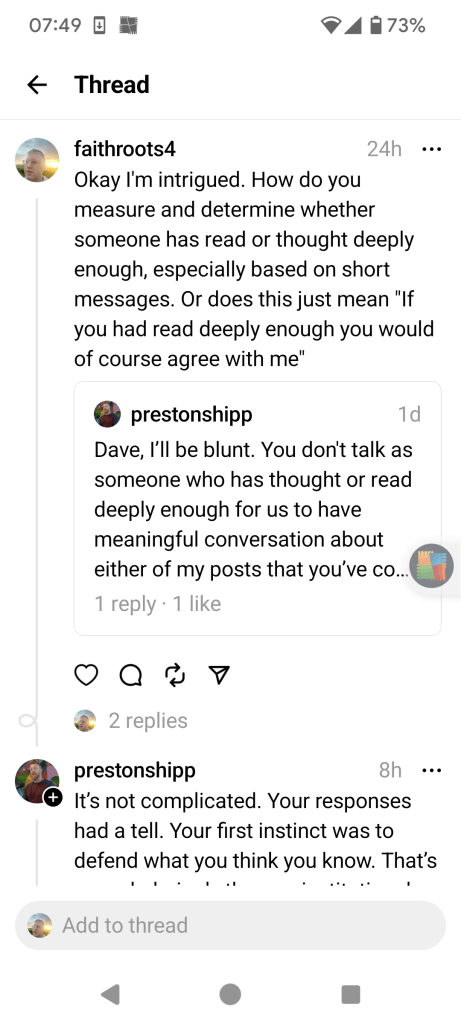
His response was this.
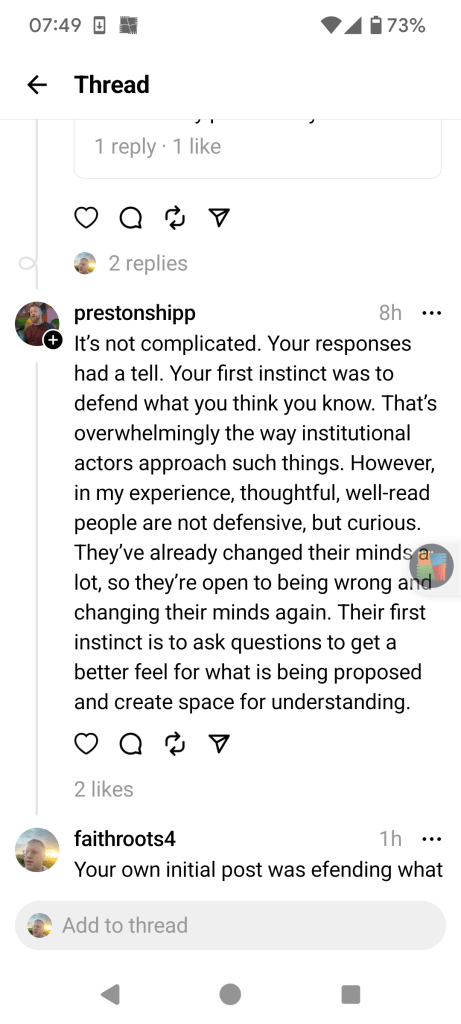
Later, when I asked how it was possible to make such an assessment from a brief comment, he responded with.
It’s worth pointing out first of all that the normal way in which conversation, debate and discussion work is that someone advances a proposition. If someone else disagrees, then they will usually offer a counter proposition and that’s when the teasing out can begin. I would expect the following conversation to include both parties offering reasoning and evidence for their own conclusions along with challenges and rebuttals to the other side and yes, I would expect plenty of questioning. However, the conversation has to start somewhere.
The thing is, that it takes two to tango. Preston’s own response to me was to attack me, note the ad-hominem nature of his response. His focus is on me as a person and what he believes to be my own personal failings and limitations. Apparently, he has assessed me as unworthy of debate and conversation with him, in much the same manner as Richard Dawkins used to decide who he would debate with. There is no questioning on his part.
The result is that he jumps to conclusions and makes assumptions of me. Now, some of the questions you might expect to see in such a conversation is “How have you reached your conclusions? What have you read? Why have you reached conclusions?”
In this case, if he had asked me, I’d have been able to explain that I’d significantly engaged with the debate about Penal Substitution, the last time round that it had a serious outing during the Steve Chalke, Loat Message of Jesus controversy. I’d have been able to tell him that I’d read Chalke and Mann’s book and followed up with some of the other works they relied upon and critiqued. I’d read Aulen’s Christus Victor, I’d also gone back and read Anselm too. I’d read some of the essays on “redemptive violence.” Alongside that I’d also taken time to dig into some of the older works from the early church including Athanasius.
Now, even at this stage admittedly, I’d be cautious about making definitive claims about whether or not I was curious and had pursued the depth of reading and thought needed. It is possible to read widely but shallowly. Of course, you could, if that mattered asked further questions to test my level of curiosity. The thing is, just because someone is curious, doesn’t mean they are curious about everything. There are things I have no interest in because they have next to no discernible impact on my life. I’m also unlikely to be persuaded into curiosity iby being lectured on my intellectual failings. There are other things that I was curious about once but have come to a settled position. Can I also suggest that if you have lost all curiosity then you are in trouble but if there is nothing that you have come to a confident and settled position on by your 50th year then you are also in a bit of trouble too. In some cases I’ve reached a settled position having changed my mind completely at some point, in other cases I’ve modified my view and in others I’ve concluded that my original assumptions were right. There are other issues where I still am working out what I think and may still be until I see Jesus face to face and all questions are answered.
Note too, the demands made on me. In order to be welcome, to have a seat at the table, to be permitted into the conversation, I must meet his standards. I must be curious, willing to change my mind and ask questions. I must not challenge and disagree. He is the one who gets to decide whether or not I’m curious, whether or not I’m thoughtful, whether or not I make the grade.
To be clear, I wasn’t particularly curious in relation to the original statements. Why would I be. The propositions are old hat. Sure, I looked into those claims when I first came across them (the stuff on Paul nigh on 30 years ago and it was already old and pretty much discredited by then). I’ve got a feeling that Luke 15 and PSA came up in a doctrine exam question. This doesn’t mean that I’m not curious about the broader subject matter. I’ve just recently written a teaching resource on James and the relationship of Paul to the rest of the NT came up in that. I’ll covering the Atonement as part of the stuff I’m writing on the Doctrine of Humanity. However, the specific points made and then the follow up comments didn’t awaken my curiosity. I might add here that you don’t owe your curiosity to anyone and no-one owes you their curiosity.
However, it should not really matter whether or not I am personally lacking in terms of intellectual ability, depth of thought, education and curiosity. If I lack those things, surely, you still want to help me out, especially if you are concerned to see others grow in faith. Or even if you are not worried about me, surely I provide a useful foil to help you convince others looking on. The point is that it should be possible to focus in on the actual content of the argument, to show where I’m wrong and where you are right. It should not be necessary to resort to ad-hominem argument.
So, historically ad-hominem, like playing the man instead of the ball in football (soccer). You shouldn’t need to do it, it’s considered bad form if you do. However, I get the impression that it is increasingly commonplace.
It struck me recently that to some extent, this reflects the postmodern culture where all truth is subjective and never final. If each of us can have “my truth” and if all truth is relative, then he actual content of an argument is inconsequential. Instead, what matters is whether or not I am someone who is entitled to a view, am I allowed to have my truth. So, we attack the person instead of the argument. At its extreme, this leads to cancel culture.
Is this really a healthy basis for conversation or a good foundation for friendship, fellowship and community?
 Faithroots