
This weekend is often associated with the feast of Epiphany, the culmination of Christmas and the wisemen’s journey to Bethlehem. We spend so much time these days pointing out that they were not kings and we don’t know if there were three of them that we can miss out on the things the text in Matthew 2 has to say.
Reading the passage again, I was struck by these words in response to the wisemen arriving in Jerusalem looking for the new born king.
“3 When King Herod heard this he was disturbed, and all Jerusalem with him.”
Calvin observes that Herod is not just worried about a new political threat. He was steeped in Jewish traditions, he would have known the prophecies and of course it was to the religious teachers he turned to confirm what Scripture said. The coming of the Messiah, of God’s reign being introduced was good news for Jerusalem. Yet, because it was not good news for him personally, Herod explicitly rejected the Messiah.
Now, we might understand Herod’s desire to cling to power at all costs but why was the rest of the city troubled? The term will have been used not necessarily to mean that every single citizen was troubled but to show the extent. Some of those troubled will have been Herod’s household and officials. No doubt the Temple priests and Levites are included too but the suggestion seems to be that it extends to the common people.
Calvin again is helpful here, suggesting that the people will have experienced frequent trouble and upheaval. They may well have been fearful about more uncertainty and just longed for a peaceful, stable future. The thing is that they too knew the prophecies and there were people like Simeon and Anna witnessing to them. They will also have been familiar with the events surrounding John’s birth to Elizabeth and Zechariah. So, the good news of great joy should have overtaken any sense of trouble.
One possibility is that they realised that the coming Messiah would purify his people. There would be a call to renewed and deeper holiness. Jesus would turn their world upside down.
Perhaps too we can see Christ as a disruption. I wonder how many of us think of the Second Coming as a distant theoretical hope but would be disturbed if it interrupted our lives now?
What about Christ’s work in our lives now. Do we want a safe Jesus? Are we happy with him bringing peace but less keen on the disruption that he might bring to our lives if we really allowed the Gospel to work among us?
The challenge for us is whether we prefer our own comfort, stability, security, identity and status over the good news of the saviour king.
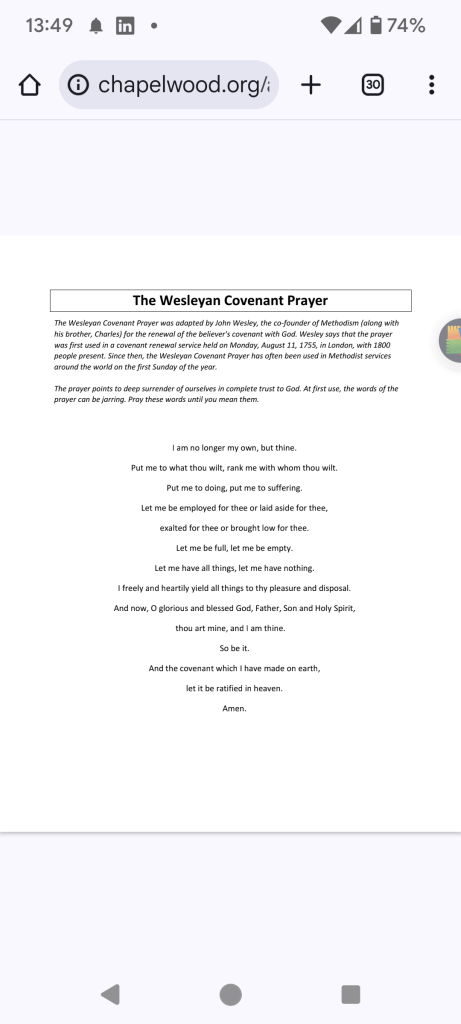
Some churches have a covenant renewal service at the start of the New Year and use words similar to the ones that John Wesley used. Perhaps we could use them at the start of our new year.
 Faithroots