
I’m planning to come back shortly to the questions raised by Robert Gagnon’s approach to the current political debate in the US. My plan is to address the specific questions about US politics, with a friendly outsider’s perspective. However, before I do, I thought it was worth addressing two other things. First, why should I as a Brit be interested in and talking about US politics. We will come back to that in another article.
In this article, I wanted to pick up on something to do with how we have these conversations and I wanted to respond to one of our interactions on social media. In case you missed it, here it is.
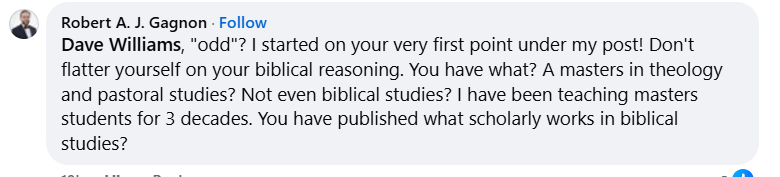
Now, I responded at the time with the written equivalent of a chuckle and an eye roll. However, there were a couple of ways in which I could have responded. I guess one way I could have responded was to defend my qualifications in the field. To be sure, I don’t have a Phd, something I once considered pursuing but have found I have little interest in doing as I grow older. Doctorates have their benefits but in terms of a measurement of ability and competency they focus in on two narrow a field of enquiry to overplay them.
However, whilst Gagnon’s comment was dismissive of my MTh, I don’t know if he assumed it was just a one or two year programme, the reality is that it was the qualification at the end of four years study at Oak Hill. That it is in Theology and pastoral studies means that I’ve covered a things including Systematic Theology, Church History, Ethics, Pastoral Counselling etc, all of which are relevant to tackling the question we were discussing and all things that it is helpful for someone focusing on Biblical studies to be alert to as well. At the same time, a four year MTH with a UK seminary like Oak Hill means that in addition to Old Testament and New Testamentr studies, you are likely to have covered at least one of the Biblical languages, I studied both over a four year period. You will also have covered areas of biblical literature in more depth. In my case, that included Deuteronomy, John’s Gospel and the General Epistles. I covered two dissertations, a short dissertation on the abolition of slavery dealing with historical theology and its implications for contemporary ethics (relevant to the discussion at hand). My long dissertation was a deep dive into Ephesians 5, in effect a Biblical Studies focus in order to provide ethical and pastoral application.
I could have defended my qualifications and I think there is a case for doing so. I am concerned when people are quick to dismiss others and in effect mock them. It doesn’t set up for good conversation, it gives me the impression that I’m not likely to be listened to and in return I’m less likely to listen to and treat the other person seriously. It also plays into a few logical fallacies, an appeal to authority and an ad-hominem attack combined.
I did not take that approach. Alternatively though, I could have responded and said “You’ve got me there. I don’t have your qualifications. I don’t lecture in a theological seminary and I’ve not had academic papers published.” And then, I might have gone on to explain why. That’s not been my focus and nor is it my interest in this particular issue. I haven’t been getting post grad qualifications and publishing papers because I’ve been pretty busy pastoring churches and helping raise up and equip new planters and pastors. I might at that point note that because of the type of pastor I am, this means I teach through God’s Word and to do that I spend a lot of time getting into the detail of what Scripture has to say. We may study and teach Scripture in different contexts but that doesn’t mean I know it any less well.
Another possible approach might be for me to challenge the way the relationship seemed to be set up. Not for the first time on social media, an academic guy was making it very clear that he was putting the silly, little, pathetic, church pastor in his place. Who did I, Dave Williams think I was to challenge the mighty Dr Gagnon over what God’s Word says.? I say “not for the first time” because I’ve been on the receiving end before and I’ve seen others treated that way too. Now, to be honest it doesn’t really matter to me too much. A good pastor advised me as I was setting out into ministry to take God seriously but not to take myself or the views of others about me too seriously. However, I think it bears observing that this kind of attitude is unhealthy. Christian academia is there to serve local churches, not the other way round.
However, I didn’t take any of those approaches. Why? Well, because in the end, it doesn’t matter whether Dr Gagnon or Dave are more qualified. What matters is whether on the specific issue in hand we are ready to let God’s Word speak.
 Faithroots