
If like me you have dodgy eye-sight, and spend a lot of time at the Opticians. You’ll be familiar with the question “better here …or better here” and then “okay, now try again with the last line you can read.” The optician is working hard to finally tune the prescription for your spectacles so that you can see clearly and sharply. Note that this concern for focus is not just on how big the print is that you can make out, it is about that sharp clarity which makes all the difference.
We often, rightly, think of our responsibility as elders as like shepherds, that’s perhaps one of the most familiar Biblical images. Shepherds, among other things, keep a watch out for danger from outside, wolves, robbers, that kind of thing. I remember that one of Mike Ovey’s concerns at Oak Hill was to help pastors be able to spot the wolves, the danger, not when it was right on top of the church but at a distance. Perhaps we, with the help of our academic theologian friends have got better at this.
However, I want to suggest that if we, both the pastors/elders and the pastor-theologians are to carry out our responsibilities well, then we need the ability to do what the optician does as well, to help people see clearly and sharply. You see, particularly when it comes to things like “The Trinity” we often find that Christians are not captive to erroneous ideas. They don’t think of three gods but they do know that the one God is three persons. However, it can all seem a little out of focus, a little shaky. So I can hear Christians both talking about the Father, the Spirit and the Son but also at another point speaking about God in a way that could sound a little modalist.
I recently picked up on an article by Graham Shearer where he took issue with the statement that God is “a united family” from Lee McMunn’s “Essentials”. It seems to me that Shearer approached it like the guy looking out for the wolves. (and don’t get me wrong, we need to be doing that), he saw possible dangers in what Lee was saying that looked a bit like the wolf over the hill which we call “Social Trinitarianism”
Now, we have got a hold of McMunn’s quote and can see a bit more of the context, we can get a bit more of a feel for what he is saying. Notice first, that Lee has a couple of concerns. He sees how people tend to think about God, especially those who don’t know the gospel yet and he wants to show that they’ve got their view of God wrong if they think those things. Specifically, Lee does not want us to think of God as “a lonely individual” or an impersonal force.
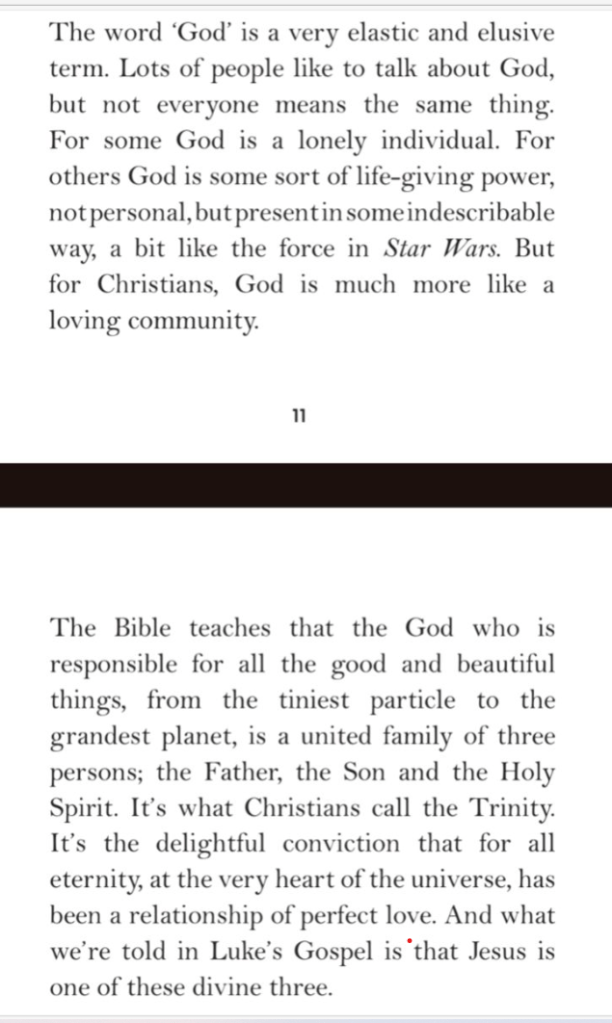
Both of those concerns are significant and ones that we want to address. If we think of god as a “lonely individual”, then we can end up thinking that God needed to create this world to fill a gap. God becomes dependent on us. We might also sing the Hillsong lyric “You didn’t want heaven without us” and think of heaven as a bit lifeless and empty until we bring the party. Instead, we are meant to think of God as the one who is self sufficient, maximally alive, maximally love so that love flows out and drenches us. Heaven is already full of his glory and goodness, full of joy. It’s not that he needs us to make the party happen if you like, it’s that he isn’t going to let us miss out on the party.
What McMunn is doing, is in effect adjusting the lenses to get things a little sharper. However, there are challenges with that. My own optician has reached the stage where he cannot adjust my close up reading vision without affecting my distance vision. At some point, I’m probably going to have to bite the bullet and get some variable-focals or reading glasses. Adjustments in one place have consequences in others. I think we have seen the same in other debates such as over desire and temptation or the EFS debate.
McMunn’s risk here is that he so wants to emphasise that God is love, that God does not depend on us and so the three-ness that he has dropped down the focus on God’s oneness.
Now it is important to emphasise here that Lee does not make the mistake of denying the oneness of God. He doesn’t turn God into a social trinity. God may be “like” a family ut it is God who is like that, the Trinity is not a “family of gods.” That’s why it is important to note that he talks about God as singular.
However, there is still the need to do some correcting to get the balance and focus right, to get things sharper. I think that in this case we would need to do a few things.
First, Lee says that God is “more like a loving community”, we need to fill out what we mean by “like”. We want to be clear that this is not exhaustive language about God and that it is in fact analogous. Indeed, we do better to say that a united family, a loving community is “a bit like the Trinity.”
Secondly, we also want to identify the ways in which the Trinity is more than that and so God is also “unlike” a family or community. This means that we really want to sharpen up the oneness. Yes we can rightly talk about how God “is love” and so this unites Him but not just through loving relationships. Rather, God is simple so that “love” is one perspective on his nature or essence. God is one because he is of one substance and so has one will. This means that the Triune God is unlike a loving united family because whilst families unite the wills together for a common purpose, they can still disagree and still fall out. That is impossible with God.
I hope that this image of the optician at work will prove helpful not just in this example but when we think about other cases where the language we use about god and the Gospel needs sharpening.
 Faithroots