
Tim Dieppe of Christian Concern has written to the Spectator about antisemitism within Islam. Dieppe is responding to an article which talks about the theological underpinning of antisemitism in Islam and Christianity.
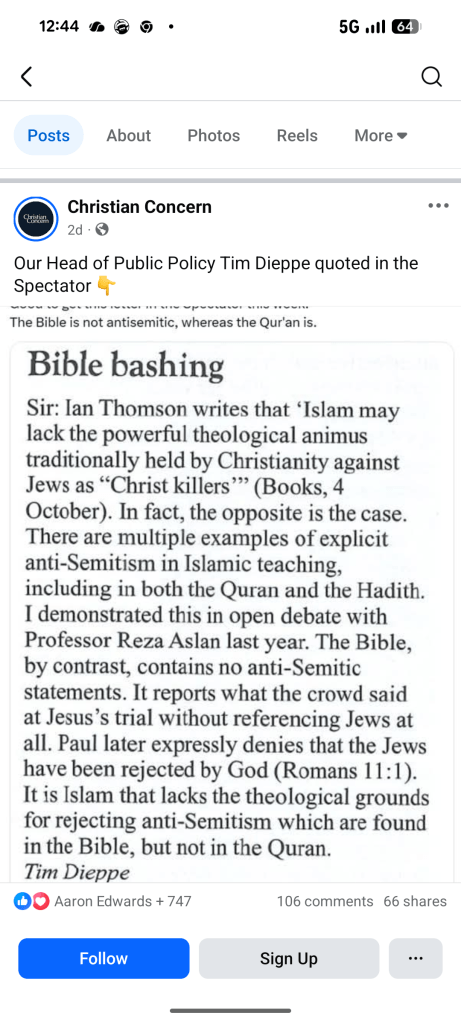
As you can see, Dieppe’s argument is that the Quran contains significant examples of antisemitism whereas the Bible does not. I agree with Dieppe that the New Testament is not antisemitic. However, it is important to recognise that there are a number of texts in the Gospels that have been interpreted as antisemitic both from within the church and critics without including references to the Jews opposing Jesus in Johns Gospel and Matthew’s reference to the crowd declaring that Jesus’ blood was on them and their descendants.
Now to repeat, I do not believe that those texts are antisemitic but it is important to acknowledge that they have been used that way. Sadly the history of Christian Europe both pre and post Reformation contains numerous examples of antisemitism through pogroms, murders and systemic exclusion. Stereotypes were used to caricature Jews in art and literature and prominent theologians including the leading reformer, Martin Luther expressed antisemitic opinions. We cannot ignore our history.
When I mentioned this in response to Dieppe’s letter being shared on social media, I got some pushback along the lines that antisemitism has nothing to do with the church or Christ. I am afraid that such complacency simply does not fit the facts. Not only is it in our longer term history but it’s in our recent past too. Consider for example how long it took for the Church of England to desk with Stephen Sizer and his egregious examples of antisemitism. Meanwhile, my own experience is of raising serious concerns about antisemitism being significantly present in a book written by a prominent evangelical. As far as I’m aware, the book has neither been withdrawn nor amended. Indeed those of us who raised concerns with dismissed as being liberal lefties.
And all of this matters because first, when Jews see our history, it puts up a stumbling block other than the Cross to them. It also matters because far too often Christians have been rather silent on this issue, particularly over the past decade during which antisemitism moved into the mainstream of our politics. Indeed, the impression given is that antisemitism is only something that gets raised when it suits an agenda to attack Muslims.
If we get the seriousness of antisemitism, then we will oppose it at every opportunity and for its own sake not because it fits our agenda on Islam.
 Faithroots