
I’ve been engaging with the question of Sola Scriptura (Scripture alone) prompted by this post by Aaron Edwards, or more precisely the follow on discussion on his Facebook page. The big pushback to Aaron’s original post was the claim that there wasn’t such thing as “Sola Scriptura” because Scripture itself doesn’t make such a claim.
My response, as per this post, was to show that yes, Scripture itself does talk about the thing we label as “Sola Scriptura”. We find that most overtly in 2 Timothy 3:16-17 which says:
“16 All Scripture is God-breathed and is useful for teaching, rebuking, correcting and training in righteousness, 17 so that the servant of God[a] may be thoroughly equipped for every good work.”
Notice that those verses tell us about the quality of Scripture, its function and its effect. In terms of Quality, it is “God-breathed” and Paul is distinguishing this quality out from other sources, it’s where we get the idea of “inspiration” from. Paul goes on to tell us what it is “useful for”, its job is to train people “in righteousness” and to do that, it teaches, rebukes and corrects. Those words indicate authority. Finally, its effect is that it equips believers for good works. Note it does this “thoroughly” and for “every” good work. This points to a completeness in achieving its purpose, or to put it another way, Scripture is sufficient to the task asked of it. It’s those factors which come together to tell us that Scripture is the sole authority we need and have for living faithfully as God’s people.
Now, the first pushback I got, was that this could not be the case because Scripture wasn’t complete at the time Paul wrote 2 Timothy. I’ve engaged with that challenge here. However, I had a further bit of pushback from someone on Daniel’s Facebook page and I’ll reproduce that in full here.
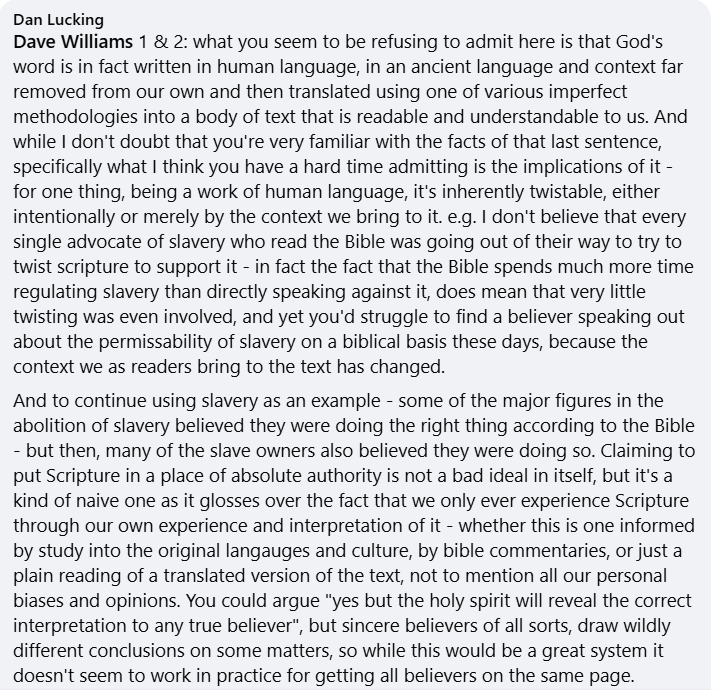
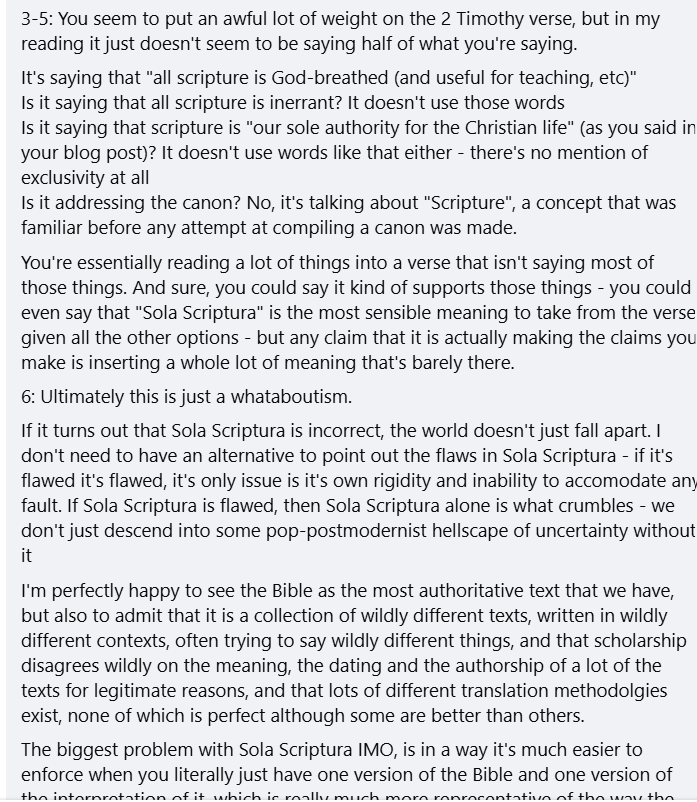

Now, it’s probably worth pointing out that in my previous comments, I don’t say the things he suggests I must think and that’s because we’ve not got into those questions in the conversation. On a general point, I’ve noticed a tendence in modern debate, especially on social media to try and put thoughts into people’s heads and words in their mouths, to speak for them and make claims for them. That’s really not a great debating strategy both in terms of how effective it is and how ethical it is (it’s neither). We do better to let people speak for themselves. So, in this case, Dan is bringing up a fresh objection to my position, something that it is legitimate to do but would have come better as a question:
“How do you deal with the problem that we are working with a variety of translations and multiple interpretations from different languages of texts written in a very different cultural context?”
Note, that there are two linked but different issues here. First, there is the issue of translation. Note, that here, Dan’s comments would prove rather too much. The concerns he expresses are very similar to the reasoning behind Islamic suspicion of translation, both in that officially the Quran has to be preserved and recited in Arabic and secondly, this has been one of the arguments used against Christianity, that we do have Bible translations and as soon as you translate, it changes things.
So, first of all, it is important to recognise that yes translation does bring challenges. However, that in fact is where having multiple translations helps because what they do is help us to get to an accurate understanding of what the Greek and Hebrew texts were saying. Having people who know Greek and Hebrew helps as well. It’s also why having two translation philosophies help. Formal Equivalence follows the vocabulary, syntax and grammar closely whilst Dynamic Equivalence gives more of the overall sense of what something is saying.
Secondly, there’s “interpretation” which is about more than just moving from one language to another. It’s about working through what the text means as well as what it says. And yes, Dan is right to pick up on the fact that our understanding will be shaped by cultural context, both the culture of the original context and our own context.
It is worth noting a few things here. First, that this means that those of us who seek to engage with Scripture either as preachers and teachers in the local church or as theologians spend time getting to understand the culture, just as we will often spend time getting to know Greek and Hebrew.
Secondly, whilst there are differences between the cultural context of Jesus’ day, we can sometimes overstate them. First in that the difference tends to lie primarily in modern/postmodern western culture. In that respect, its us that are the anomaly. The rest of the world throughout much of history finds itself closer to Scriptural cultural understandings. Second because we can overstate the differences at times. There is often more commonality than we appreciate. This also has implications because Dan’s reasoning against sola scriptura only works for our limited context.
Thirdly, it is helpful to remember that Sola Scriptura is not about privatised individualistic “me and my Bible” Christianity. The reformers were clear that God’s Word was given to the whole church and so they were keen to make sure that their interpretation and application lined up with what the Church had thought throughout history.
Crucially, what this means is that the limitations are with us, not with Scripture and so, that we might find it challenging getting to a clear understanding ourselves of what Scripture might be saying, this does not take away from its authoritative nature. So, for example yes, there were debates about the morality of the slave trade but what it ultimately comes down to is that the moral authority of Scripture lay with the abolitionists not the owners and traders.[1]
So neither the reformers, nor contemporary Reformed Evangelicals are using “Sola Scriptura” to suggest that you can sit down in your room, select a random proof text and then say “that settles it.” Listening to God is something we do together and it involves a lot of patience and a lot of work.
What is being said is:
- The idea seen in traditions such as Roman Catholicism or going back further to the Gnostics and further forward to modern day groups such as the Mormons, of there being either secretly preserved, separate and fresh authoritative tradition, or fresh new authoritative revelation is wrong. We have Scripture as the sufficient authority, available to all.
- That all things today, including prophecies, words of knowledge in the charismatic tradition and speculative theological thinking in other circles do not have the authority of Scripture and must come under its authority.
- That our posture is of allowing God to disagree with us through his Word.
[1] I pick up on a specific example in my MTH Short dissertation available at The hermeneutical basis for John Wesley’s opposition to the Slave Trade and its relevance to contemporary ethical debates
 Faithroots