
One of the challenges with attempts at conversation and debate with Christian Nationalists is that in my experience, it doesn’t tend to follow the conventions of traditional debate, Instead of the usual back and forth that you might expect where one person sets out a proposition and another challenges it with questions before offering a counter proposition expecting their challenge to be rebutted and their own thesis questioned, you get something like this.
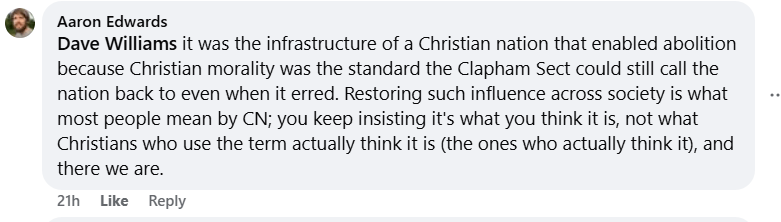
Notice a couple of things here about what Edwards does in an exchange with me. Instead of actually defending his position and then questioning mine, Edwards does three things. First he resorts to personal accusation, second he falls back on the argument that anyone who challenges or questions Christian Nationalism is misunderstand what Christian Nationalism is and thirdly he attempts to co-opt historical moments anachronistically into his defintition. Now all of that makes for poor history and poor debate and so I wanted here to try and get us back onto more secure ground.
I’ve much to say about the issue of what lay behind the abolition of the slave trade, its an area of interest to me and it was my bemused reaction to someone else attempting to claim abolition as the outworking of Christian Nationalism (my comment was that you can’t just make stuff up about history) that led to Aaron’s riposte. In short though:
1. Slavery had arisen within that same system/ structure. We have to acknowledge that the system note caused than corrected it.
2. The history of abolition is complex and tends to focus on a few key names but there was ongoing debate with even key Evangelicals owning slaves and supporting it. There was a continuum from this through those who wanted a gradual approach to abolitionists.
3. The context of the Evangelical awakening and changed hearts is crucial to what happened and still required many years of campaigning. 4. The significant role fell to a backbench MP. It wasn’t the work of a Christian government.
5. There are many reasons why just sticking your 21st century label onto that historic event or co-opting past successes for a contemporary cause doesn’t work
In terms of Aaron’s suggestion that “restoring such influence [as the abolitionists had] across society is what most people mean by Christian Nationalism will I think come as quite the surprise both to those who disagree with the idea and its most fervent adherents. In terms of the former, this is because, as I’ve explained in previous posts, there is a substantial history across the political spectrum of seeking to have a Christian influence in the public square. On a personal level, I’ve been involved as a political activist, a church member and a church leader in seeking to bring Gospel ethics to bear where it counts. Yet those of us who were doing so long before people like Aaron and the Christian Nationalists began to make a thus and claim the discover of public and political theology do not recognise in this novel movement much to agree with.
It will be surprising too for Christian Nationalists to hear Aaron’s definition because they have been very clear in their writing and speaking as to what they are about. It is such writing and speaking that I’ve interacted with when responding most recently. It’s fair to say that much of the philosophy and theology goes back further than its recent popularisation and people have been advocating for things associated with it, without necessarily using the term. I’m particularly thinking of the US postmillennial/theonomist movement. However, in recent times, it is perhaps Stephen Wolfe in his book “The Case for Christian Nationalism” that has done most to popularise the term.[1] Wolfe is significant because he claims that his Christian Nationalism is rooted in the historical reformed tradition. Crucially Wolfe kindly offers us a definition:
Christian nationalism is nationalism modified by Christianity. My definition of Christian nationalism is a Christianized form of nationalism or, put differently, a species of nationalism. Thus, I treat nationalism as a genus, meaning that all that is essential to generic nationalism is true of Christian nationalism.”[2]
He also adds in a definition of nationalism, saying that:
My definition of nationalism is similar to that of Christian nationalism, though with less content: Nationalism refers to a totality of national action, consisting of civil laws and social customs, conducted by a nation as a nation, in order to procure for itself both earthly and heavenly good.” [3]
Then he tells us what it means to be a nation:
the nation is rooted in a pre-reflective, pre-propositional love for one’s own, generated from intergenerational affections, daily life, and productive activity that link a society of the dead, living, and unborn. Concrete action—past, present, and future—which enlivens space to the benefit of generations, is what grounds the nation.”[4]
In other words, this is an identity based primarily on ethnic identity, if not exclusively. It is an ethno-cultural nationalism. Now, you can find my review of Wolfe here and you’ll find out more there about why I strongly disagree with him and why his position is grievously wrong.[5] However, my point here is simply that we have been given a definition, and more than a definition, a description. It’s that ideology that I personally have been engaging with for a long time.[6] And, furthermore, what Wolfe offers is significantly beyond the benign and minimalist response that Edwards offers to me.
The question then to Edwards who have attempted this claim (I’ve been told by others that anyone who wants to see Christ’s influence in their country is really a Christian Nationalist) is whether he has grasped and understood what Wolfe is saying? If so, then he must decide whether or not he disagrees with it and explicitly say so. I certainly would hope that he would strongly disagree with Wolfe’s ideology. He can of course choose to hold a different viewpoint but that position will not by definition be Christian Nationalism. It is possible of course that he has missed the actual definition and its implications.
[1] Though the term itself predates Wolfe. The South African Prime Minister BJ Vorster seems to have used the term back in the 1940s. Vorster was a prominent member of the National Party, played a key role in the development of Apartheid and sought links with the Nazis/National Socialism and Fascism.
[2] Wolfe, Stephen. The Case for Christian Nationalism (p. 10). Canon Press. Kindle Edition.
[3] Wolfe, Stephen. The Case for Christian Nationalism (p. 10-11). Canon Press. Kindle Edition.
[4] Wolfe, Stephen. The Case for Christian Nationalism (p. 120). Canon Press. Kindle Edition.
[5] I was particularly concerned with his insistence that spiritual unity depended on civic unity with leanings towards ethno-cultural segregation between churches. Wolfe, Stephen. The Case for Christian Nationalism (p. 199-200). He goes on, in arguing against multiculturalism to argue that whilst a Christian nation might help out Christian refuges, its best course of action is to help Christian nations so that its citizens remain where they are rather than becoming immigrants. He writes: “The best way a Christian nation can help another Christian nation is by aiding it in flourishing as a people in their own place. It is not by importing that people. Just as families help families while maintaining healthy separation, nations ought to help other nations while maintaining separation. Wolfe, Stephen. The Case for Christian Nationalism (p. 204). Canon Press. Kindle Edition.
[6] Indeed, it is worth noting that Wolfe writes from within the Canon Press, Douglas Wilson stable. I’ve been engaging with Wilson and Federal Vision for coming up to two decades now.
 Faithroots