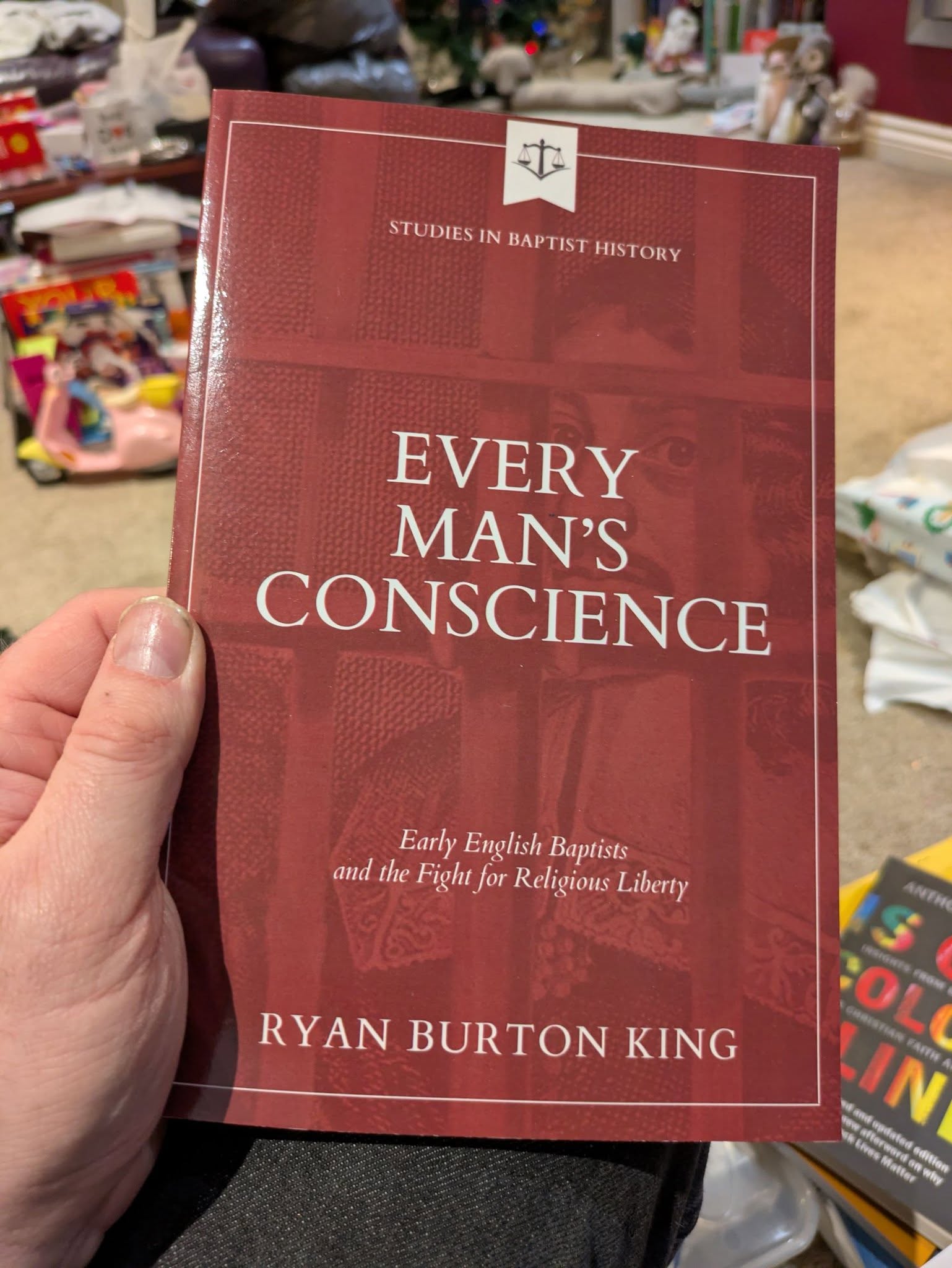
This is a fantastic short book written by my friend Ryan Burton King , pastor of Grace Baptist Church Wood Green. Apart from being an important read for anyone who has an interest in Baptist history, the subject matter covered is highly relevant to issues we are facing today.
King’s thesis is that the early Baptists were committed to freedom of conscience and religion in contrast not only to the Roman Catholic Church but also to other protestant and reformed movements that sought to impose uniformity across nations using the mechanisms both of established churches and of government.
The book is divided into three parts. The first part describes the experience of persecution that early Baptists faced, notably the anabaptists on the continent and here in England. It also addresses the persecution that those from other religions faced, notably the Jewish diaspora and also Muslims, especially Black Muslims who faced xenophobia originating from the Royal Court in Elizabethan England.[1]
The second and third parts trace the response of Baptists to that persecution in developing a theology of freedom. The Baptist movement has historically included General Baptists and Particular Baptists with the dividing point being over the classic reformed position that the atonement was particular to the elect (Particular/Limited/Definite Atonement) or something generally offered to all, to whosoever will believe. King observes that this commitment to liberty is to be found in both General and Particular Baptist movements.
King traces the origins of the Baptists to Zurich and to those under the leadership of Felix Manz, Conrad Grebel and George Blaurock who objected to Zwingli allowing the civic authorities responsibility over church practice. Manz, Grebel and Blaurock became convinced of
“the institutional separation of church and state and a church membership comprised of believers at an age of understanding, baptised after profession of faith in Christ.”[2]
This position led to their persecution. The idea of being rebaptised (anabaptism) was considered to be heretical and dangerous. The new protestant and reformed churches used their relationship to the magistrates to enforce discipline and conformity through imprisonment and even the death penalty.
“Grebel died in 1526 after imprisonment. Manz was drowned in 1527…Blaurock was burned in 1529.”[3]
King’s survey covers John Smyth and Thomas Helwys, Leonard Busher and John Murton representing General Baptists who were influenced by the continental anabaptists. [4] The early General Baptists strongly resisted the involvement of civic authorities in church matters. An early confession based on a draft from Smyth states:
“That the magistrate is not by virtue of his office to meddle with religion or matters of conscience to force or compel men to this or that form of religion or doctrine but to leave Christian religion free to every man’s conscience, and to handle only civil transgression … injuries and wrongs of man against man, in murder, adultery, theft, etc., for Christ only is the king and lawgiver of the church and conscience.”[5]
King includes Roger Williams with Reformed Baptists even though he notes that Williams was no longer a Baptist by the time he wrote his treatise on religious liberty. However, his views on liberty of conscience were shaped by his prior baptistic commitments. [6] Williams believed that liberty of conscience extended to those of other religions and that it was the sword of the Spirit, God’s Word that was to be used to challenge and correct, not the magistrate’s sword. [7] King also covers the London Baptist Confessions (1st and 2nd) and individual Particular Baptists such as Samuel Richardson and Thomas Colllier in his survey.
In his conclusion, King observes that
“The Baptist approach to religious liberty and what it means more broadly for life even in hostile environments does not promise ease or even safety. But it is not shaped by circumstantial complaints -rather Scriptural convictions as to the nature of Christ’s kingdom and how that overflows into how we treat people others may be frightened of or prejudiced against.”[8]
King writes of course against the backdrop of a rise in Christian Nationalism both here and in the United States. He sees this as an option that has become deeply attractive to believers living in a post-Christian age where the dominant authorities are pagan and so Christians of all tribes often feel as though they are facing opposition if not yet all out persecution from authorities. It is tempting to see the Christian, covenantal nation as an attractive option. However for King, this is a wrong turn.[9]
Regular readers of Faithroots will be aware that I’ve had a particular interest in responding to the rise of Christian Nationalism over the past year and so you will not be surprised to hear my endorsement of King’s analysis. I will turn to that in more detail shortly but I think it is worth noting that his analysis has implications for a number of issues which may in fact be related to the discussion about the Christian state.
In particular, I would highlight two areas. First, there was the debate a few years back about how to respond to government lockdowns during COVID and the question over whether or not the State could interfere by instructing churches on whether, when and how to meet. Non Conformoist Christians, particularly baptistic ones may trace a certain reticence to trust the state with authoritarian powers affecting worship back to those early dissenters. However, I would note that those early concerns were primarily about the ability of the state to engage in doctrinal and discipline matters. I’m not sure that COVID was in their prevue. Indeed, ironically, it seems to me that some who championed the church’s independence from the state on public health matters are more inclined to have a closer relationship to the State in the very areas that the early Baptists identified as out of scope.
The second area to highlight is sexual ethics. Much of the culture war seems to be focused on this issue, particularly around same sex attraction and gender dysphoria. The logical conclusion of the Baptist position should surely be that these are issues relating to sin and therefore to discipleship, pastoral care and discipline within the church but not civil or criminal law matters,
When we come to the question of Christian Nationalism today, there is one particularly important contribution that King’s survey makes which is worthy of particular attention. There is a tendency among some advocates to insist that Christian Nationalism today is no more than the Christianity of the early reformers. I’ve even read some comments to the effect that if we complain that it is an import from the US, it is simply the same Christianity and political settlement that we exported to the colonies. There is some truth in this, although I would still argue that the particular form it has now taken through the coming together of Reformed Reconstructionism/Theonomism, New Apostolic Reformation Dominionism and Far right politics makes it a substantially different beast that I don’t think even the Magisterial Reformers or the later Dutch Reformed would recognise.
However, what this also means is that they cannot have their cake and eat it. They must also recognise that their “experiment” has already been tried, not only in Apartheid South Africa where the term was first coined but in Elizabethan England and Zwingli’s Zurich. If there is a nervousness among some of us about the implications not just for those of other faiths and ethnic backgrounds but also for Christians do not align with a State prescribed orthodoxy then that is because of the precedent of history.
I would commend this book to all. It is a short and easy read. If that leads to any criticism it is just that the brevity means that there are areas where I would have appreciated lengthier and deeper treatments. However, I’m confident that this gives space for further study and discussion (indeed I’m hoping to interact further with Ryan to this end)
It is worth observing that there are many of us who are not formally “Baptist” but are baptistic. This includes many independent evangelicals, charismatics and of course the Brethren movement. The book is worth a read even for the purpose alone of offering an introduction to the roots of our own movements.
I hope particularly that those seeking to engage with the contemporary debate will turn to King’s book as a useful source. For those of us seeking to critique Christian Nationalism, it is important that we understand the historical background to the debate. For those seeking to advocate for Christian Nationalism, it would be amiss to seek to defend their position without responding to King’s evidence.
Everyman’s Conscience is priced at £12.99 and is available in paperback.
[1] King, Everyman’s conscience, 17-21.
[2] King, Everyman’s conscience, 9.
[3] King, Everyman’s conscience,10.
[4] King, Everyman’s conscience, 25ff
[5] Propositions and Conclusions concerning the Christian Religion, containing a confession of faith of certain English people living in Amsterdam (Article 84). Cited in King, Everyman’s conscience,27.
[6] King, Everyman’s conscience, 53.
[7] King, Everyman’s conscience,56.
[8] King, Everyman’s conscience, 100.
[9] King, Everyman’s conscience, 97.
 Faithroots
1 comment
Comments are closed.