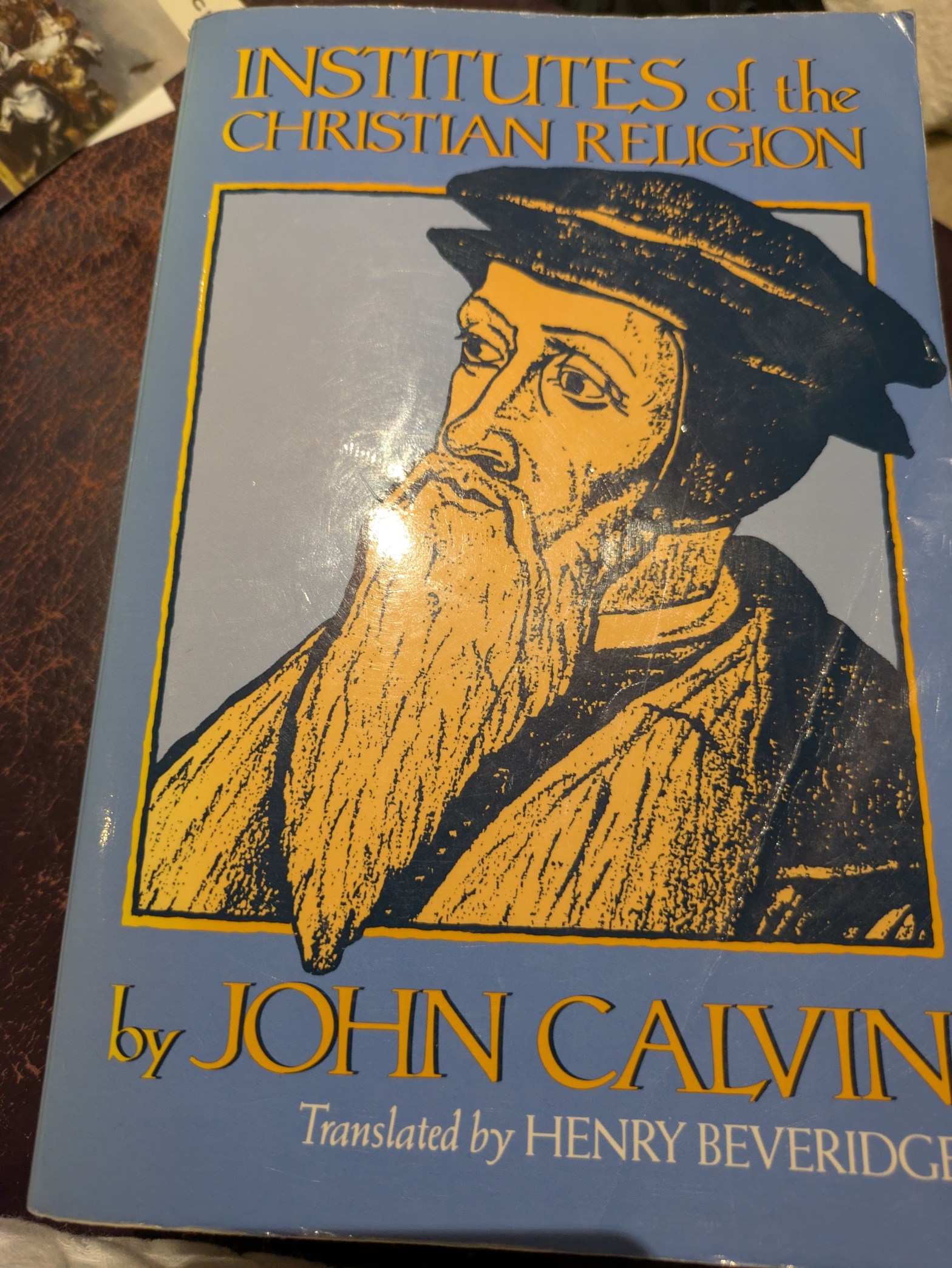
The Reformers including Luther, Calvin and Zwingli were acting in a context in which it was the established norm that the state was Christian. If the early church fathers were acting pre-Christendom and we live in a post Christendom world, Calvin and the early reformed lived within Christendom. Whilst the radical reformers would in effect reject the concept of Christendom, the magisterial reformers arguably sought to continue and reform not just the church but the state as well.
Gatgounis suggests that:
“Calvin advances a doctrine of separation of church and state, not religion and state. Because God is sovereign, Calvin postulates that he should rule both church and state, since both are spiritual entities predicated on God’s authority, even though the two structures are distinct organizations.”[1]
He considers Calviin to offer an alternative to both an Erastian position where the Church acted as an arm of the State, and an Ecclesiocracy where the state acted as an arm of the state, what today we might consider to be a form of theocracy, a Christian equivalent of the Ayatollah’s rule in Iran.[2] Rather, Gatgounis argues that Calvin supported a true form of theocracy with God ruling over both church and state.[3]
For Calvin, this means that “the church has not the right of the sword, to punish or restrain, has no power to coerce, no prison, nor other punishments which the magistrate is wont to inflict.”[4] However, the magistrate does have the power to inflict punishment for moral failure.
“Does anyone get intoxicated? In a well ordered city, the punishment will be imprisonment. Has he committed whoredom? The punishment will be similaror rather more severe.”[5]
So, Calvin believed it was the duty of the state, or civil authorities to:
““foster and maintain the external worship of God [and] to defend sound doctrine and the condition of the Church,”[6]
In other words, they were responsible for ensuring:
“that no idolatry, no blasphemy against the name of God, no calamities against his truth, nor other offences against religion break out and be disseminated among the people.” [7]
Civil order existed in his view, in order to protect the well-being of God’s people and the work of Christian religion. We might see the foundations of this idea in Paul’s instruction in 1 Timothy 2:1-3.
First of all, then, I urge that petitions, prayers, intercessions, and thanksgivings be made for everyone, 2 for kings and all those who are in authority, so that we may lead a tranquil and quiet life in all godliness and dignity. 3 This is good, and it pleases God our Savior, 4 who wants everyone to be saved and to come to the knowledge of the truth.
In Romans 13:1-7, Paul says:
“Everyone must submit to the governing authorities, for there is no authority except from God, and those that exist are instituted by God. 2 So then, the one who resists the authority is opposing God’s command, and those who oppose it will bring judgment on themselves. 3 For rulers are not a terror to good conduct, but to bad. Do you want to be unafraid of the authority? Do what is good, and you will have its approval. 4 For government is God’s servant for your good. But if you do wrong, be afraid, because it does not carry the sword for no reason. For government is God’s servant, an avenger that brings wrath on the one who does wrong. 5 Therefore, you must submit, not only because of wrath, but also because of your conscience. 6 And for this reason you pay taxes, since the authorities are God’s public servants, continually attending to these tasks.[a] 7 Pay your obligations to everyone: taxes to those you owe taxes, tolls to those you owe tolls, respect to those you owe respect, and honour to those you owe honour.
On this, Calvin is clear that “although dictatorships and unjust authorities are not from ordained governments, yet the right of government is ordained by God for the wellbeing of mankind.”[8] Calvin sees Government as useful, especially in that it restrains disorder and war. We can even see unjust, ungodly government as acting unwittingly for God in that our experience of it indicates that we are under curse and judgement for sin.[9]
There is a sense then in hsi perspective that all things and all people are under God’s rule, whether we know it or not and whether we like it or not. Believers know this explicitly and experience this spiritually through the rule of the Church but unbelievers and unbelievers alike experience God’s temporal rule through the civil authorities. One can see, from this perspective why it might seem better for all, for God’s hand to be seen explicitly at work and acknowledged. Indeed, there is surely here an argument against a Christian support for principled pluralism here. In other words, it is hard for us to argue that it is better for people to live in a secular state where God as the source of goodness is left unacknowledged and where the State itself lacks moral clarity is unable or even unwilling to determine what goodness is. At its worst, the State may even choose to promote evil instead of good either because it sees such evil as for its benefit even whilst recognising its wrongness or because a distorted ideology leads it to call good evil and evil good.
Calvin’s views were not unique to him and were held more widely in the Reformed tradition. This is what the Westminster Confession has to say about Church and State.
God, the supreme Lord and King of all the world, has ordained civil magistrates, to be, under Him, over the people, for His own glory, and the public good: and, to this end, has armed them with the power of the sword, for the defence and encouragement of them that are good, and for the punishment of evil doers.[10]
It goes on to say that
The civil magistrate may not assume to himself the administration of the Word and sacraments, or the power of the keys of the kingdom of heaven: yet he has authority, and it is his duty, to take order that unity and peace be preserved in the Church, that the truth of God be kept pure and entire, that all blasphemies and heresies be suppressed, all corruptions and abuses in worship and discipline prevented or reformed, and all the ordainances of God duly settled, administrated, and observed. For the better effecting whereof, he has power to call synods, to be present at them and to provide that whatsoever is transacted in them be according to the mind of God.[11]
The question though is whether or not we can and should expect a state of affairs where the State overtly acknowledges God and his morality. My thesis is that whilst this is a good thing, and that Christians placed in positions that of influence them should use those positions to seek good. That is of course what we have seen throughout history through the likes of Wilberforce and others campaigning for the abolition of slavery, others seeking factory reforms to protect children and still others looking to bring forward the provision of universal education and healthcare. However, I have argued that this is not something we can expect as we live in a now and not yet world, waiting Christs return. This of course reflects, in my case, an a-millennialist eschatology whereas a post-millennialist presupposition will expect with confidence a situation where there is a greater acknowledgement of Christ’s temporal as well as spiritual reign before his return.
I’ve also argued this because, the paradigm in Scripture seems to consistently be one of exile. In 1 Peter 2, the apostle says:
“11 Dear friends, I urge you as strangers and temporary residents to abstain from fleshly desires that war against you.[r] 12 Conduct yourselves honourably among the Gentiles,[s] so that in a case where they speak against you as those who do what is evil, they will, by observing your good works, glorify God on the day of visitation.[t]
Note, it’s in this context that Peter gives similar instructions to Paul’s in Romans 13. We are to:
“13 Submit to every human authority[u] because of the Lord, whether to the Emperor[v] as the supreme authority 14 or to governors as those sent out by him to punish those who do what is evil and to praise those who do what is good.”
Peter, as with Paul, reminds us that the civil authorities are there for our good and to confront and restrain evil. However, remember that in both contexts, the apostles wrote to people who were not living under just and godly government but rather under the tyranny of Rome, a foreign and pagan government. Now, Calvin very clearly recognises both the paradigm of exile and the tyrannical nature of Roman rule. On the former he writes:
“And he so calls them, not because they were banished from their country, and scattered into various lands, but because the children of God, wherever they may be, are only guests in this world. In the former sense, indeed, he called them sojourners at the beginning of the Epistle, as it appears from the context; but what he says here is common to them all. For the lusts of the flesh hold us entangled, when in our minds we dwell in the world, and think not that heaven is our country; but when we pass as strangers through this life, we are not in bondage to the flesh.[12]
Whilst on the latter he goes on to say:
As Peter referred especially to the Roman Emperor, it was necessary to add this admonition; for it is certain that the Romans through unjust means rather than in a legitimate way penetrated into Asia and subdued these countries. Besides, the Caesars, who then reigned, had possessed themselves of the monarchy by tyrannical force. Hence Peter as it were forbids these things to be controverted, for he shews that subjects ought to obey their rulers without hesitation, because they are not made eminent, unless elevated by God’s hand.[13]
This leaves us with a conundrum. How is it that the Reformers were able to see quite clearly the paradigm at work and the tension that rule for God’s people was often experienced as pagan, tyrannical and unjust? Well, it is possible that there is a clue in what Calvin says above. Did they primarily see the motif as influencing our attitude to worldly desires and temptations rather than the structures and systems of government in this world?
Another possibility is reflected in Zwingli’s position. Zwingli took a more Erastian position. As Larson observes:
“Zwingli labored in a setting in which church and society were identical. The church was not a distinct entity in the larger society. The church and Zurich were one and the same thing. Zwingli nevertheless distinguished between minister and magistrate. The office of the minister is to teach the Word of God (art. 36). Rulers, on the other hand, “look after the office of the sword” (art. 41). In this connection, Zwingli addressed the pope, who wanted to take up arms against the Ottoman Turks who were threatening Europe. Zwingli exhorted, “Listen to Christ, oh pope, ‘Put it away'”— referring here to the sword. “The secular princes,” he said, “are undoubtedly quite capable of protecting their own land.” He then added, “Take no other sword into your hand than the sword of the Spirit which is the word of God” (art. 36).[14]
It is important to remember that both Calvin and Zwingli functioned not within nation states but city states. It is possible to see then how they might have considered the city state as either providing shelter and respite for pilgrims in their Exodus or in Zwingli’s case, to be the actual people of God on pilgrimage in this world.
These options are both possible. I think too that we should allow for two other factors. First a post-millennial framework which would allow them to see the journey out of metaphorical Egypt of Babylon to be reaching its conclusion for them Secondly, we can simply allow for human inconsistency. We are capable of compartmentalising our theological thinking allowing us to grasp a truth in one aspect of our thinking whilst failing to follow through on its implications elsewhere.
Whatever the reason, that tension does seem to be there in early reformed thinking. We may see the way in which this lead to serious problems acting as a catalyst for more radical forms of reformation, particularly from the Reformed perspective. First, there is the example of Servatus who promoted a heretical view of the Trinity and disagreed with Calvin on other matters. He exchanged correspondence with Calvin and when he indicated his intention to travel to Geneva, Calvin apparently commented:
He takes it upon himself to come hither, if it be agreeable to me. But I am unwilling to pledge my word for his safety, for if he shall come, I will never permit him to depart alive.”[15]
When Servetus came to Geneva, he was arrested, charged with blasphemy and burnt at the stake. Calvin apparently sought leniency and argued for him to be beheaded instead.[16] Heinze argues that:
Although future generations have judged Calvin harshly for his part in the Servatus affair, in his own age people praised him and it helped him to win the day in Geneva.”[17]
I’m afraid I find such an argument unconvincing. This was surely an opportunity for a leading Reformer to set a different tone and standard rather than to conform to such a standard and indeed he seems to have encouraged that approach by expressing his own wishes to see Servatus killed.
The second horrific expression of the Magisterial Reformers approach is seen in their response to the Radical Reformation and how in turn that encouraged early Baptists to advocate for freedom of conscience.
In his book, “Every Man’s Conscience, Ryan Burton King King explores the responses of early Baptistic movements to the Magisterial Reformers reliance on civic authorities to enforce religious and moral conformity. He starts in Zurich with those under the leadership of Felix Manz, Conrad Grebel and George Blaurock who objected to Zwingli allowing the civic authorities responsibility over church practice. Manz, Grebel and Blaurock became convinced of
“the institutional separation of church and state and a church membership comprised of believers at an age of understanding, baptised after profession of faith in Christ.”[18]
This position led to their persecution. The idea of being rebaptised (anabaptism) was considered to be heretical and dangerous. The new protestant and reformed churches used their relationship to the magistrates to enforce discipline and conformity through imprisonment and even the death penalty.
“Grebel died in 1526 after imprisonment. Manz was drowned in 1527…Blaurock was burned in 1529.”[19]
The response of early Baptists is exemplified by John Smyth who argued that:
““the magistrate is not by virtue of his office to meddle with religion or matters of conscience to force or compel men to this or that form of religion or doctrine but to leave Christian religion free to every man’s conscience, and to handle only civil transgression … injuries and wrongs of man against man, in murder, adultery, theft, etc., for Christ only is the king and lawgiver of the church and conscience.”[20]
It is of fundamental important that those who wish to defend a form of Christian Nationalism on the basis of the Magisterial Reformers approach answer the question as to how those men ended up in a position where they saw it as approach to imprison, exile or execute through drowning or burning, those who dissented from their position.
It is also important to note that those from within a Magisterial Reformed and Presbyterian position, themselves over time reflected on these matters. In 1788, a revised version of the Westminster Confession was produced that amended Chapter 23. Kevin De Young observes that:
A church officer in the OPC or PCA, for example, who subscribes without exception to his denomination’s version (the American version) of WCF 23:3 is implicitly rejecting the view that the civil magistrate has the duty to purify the church, to suppress heresies, and to call ecclesiastical synods. He is, instead, affirming a different view of the civil magistrate that does much more to restrict the magistrate’s power and gives members of the commonwealth much more freedom and liberty in the realm of religion (even to the point of practicing no religion at all).[21]
The text of the revised 23:3 is as follows:
“3. Civil magistrates may not assume to themselves the administration of the Word and sacraments; or the power of the keys of the kingdom of heaven; or, in the least, interfere in matters of faith. Yet, as nursing fathers, it is the duty of civil magistrates to protect the church of our common Lord, without giving the preference to any denomination of Christians above the rest, in such a manner that all ecclesiastical persons whatever shall enjoy the full, free, and unquestioned liberty of discharging every part of their sacred functions, without violence or danger. And, as Jesus Christ hath appointed a regular government and discipline in his church, no law of any commonwealth should interfere with, let, or hinder, the due exercise thereof, among the voluntary members of any denomination of Christians, according to their own profession and belief. It is the duty of civil magistrates to protect the person and good name of all their people, in such an effectual manner as that no person be suffered, either upon pretense of religion or of infidelity, to offer any indignity, violence, abuse, or injury to any other person whatsoever: and to take order, that all religious and ecclesiastical assemblies be held without molestation or disturbance.[22]
The intent of the new clause is to ensure that there is liberty of religion. In context, the focus is less likely to have been on full blown religious pluralism. Religion would have been considered to include a diversity of Christian denomination and sects. So, the intent is still to protect Christian faith and worship. However, the principle is that the State cannot interfere into the church and so is not there to enforce orthodoxy.
It is important therefore to recognise that the 1788 version is not supporting secular pluralism and it does not fully land where those who have followed a dissenting tradition do. However, it is different to the position followed by Christian Nationalists. De Young notes that Stephen Wolfe, author of “In Defence of Christian Nationalism” holds to a different view.
Wolfe insists the Christian prince “has the power to call synods in order to resolve doctrinal conflicts and to moderate the proceedings. Following the proceedings, he can confirm or deny their theological judgments; and in confirming them, they become the settled doctrine of the land.” According to Wolfe, the prince may look to pastors for theological advice as a father seeks advice from his son, but the prince “still retains his superiority.”[23]
De Young considers the revised version to be “irreconcilable” with the original. This also means that it is irreconcilable with the position held by early reformers including Calvin and Zwingli. We hear a lot from those advocating for Christian Nationalist positions today about the diversity of Christian Nationalism but less acknowledgement from them about the diversity that there has been within the Reformed tradition.
It is reasonable to ask someone who says that they are simply advocating for a classical reformed position, “which reformed position.”
[1] Cman_110_1_GatgounisB.pdf, 60.
[2] Cman_110_1_GatgounisB.pdfm 61.
[3] Cman_110_1_GatgounisB.pdf, 61.
[4] Calvin, Institutes of the Christian Religion (IV.xi.3).
[5] Calvin, Institutes of the Christian Religion (IV.xi.3).
[6] Calvin, Institutes of the Christian Religion (IV.xx..3).
[7] Calvin, Institutes of the Christian Religion (IV.xx..3).
[8] Calvin, Romans, 280.
[9] Calvin, Romans, 281.
[10] Westminster Confession, 23:1. Westminster_Confession.pdf
[11] Westminster Confession, 23:3. Westminster_Confession.pdf
[12] Calvin, John. Commentary on 1 Peter . Ravenio Books. Kindle Edition.
[13] Calvin, John. Commentary on 1 Peter . Ravenio Books. Kindle Edition.
[14] Zwingli’s Theocracy | Christian Library
[15] Cited in Heinze, Reform and Conflict, 189.
[16] Heinze, Reform and Conflict, 189.
[17] Heinze, Reform and Conflict, 190.
[18] King, Everyman’s conscience, 9.
[19] King, Everyman’s conscience,10.
[20] Propositions and Conclusions concerning the Christian Religion, containing a confession of faith of certain English people living in Amsterdam (Article 84). Cited in King, Everyman’s conscience,27.
[21] ‘Of the Civil Magistrate’: How Presbyterians Shifted on Church-State Relations
[22] Cited at ‘Of the Civil Magistrate’: How Presbyterians Shifted on Church-State Relations
[23] ‘Of the Civil Magistrate’: How Presbyterians Shifted on Church-State Relations
 Faithroots
1 comment