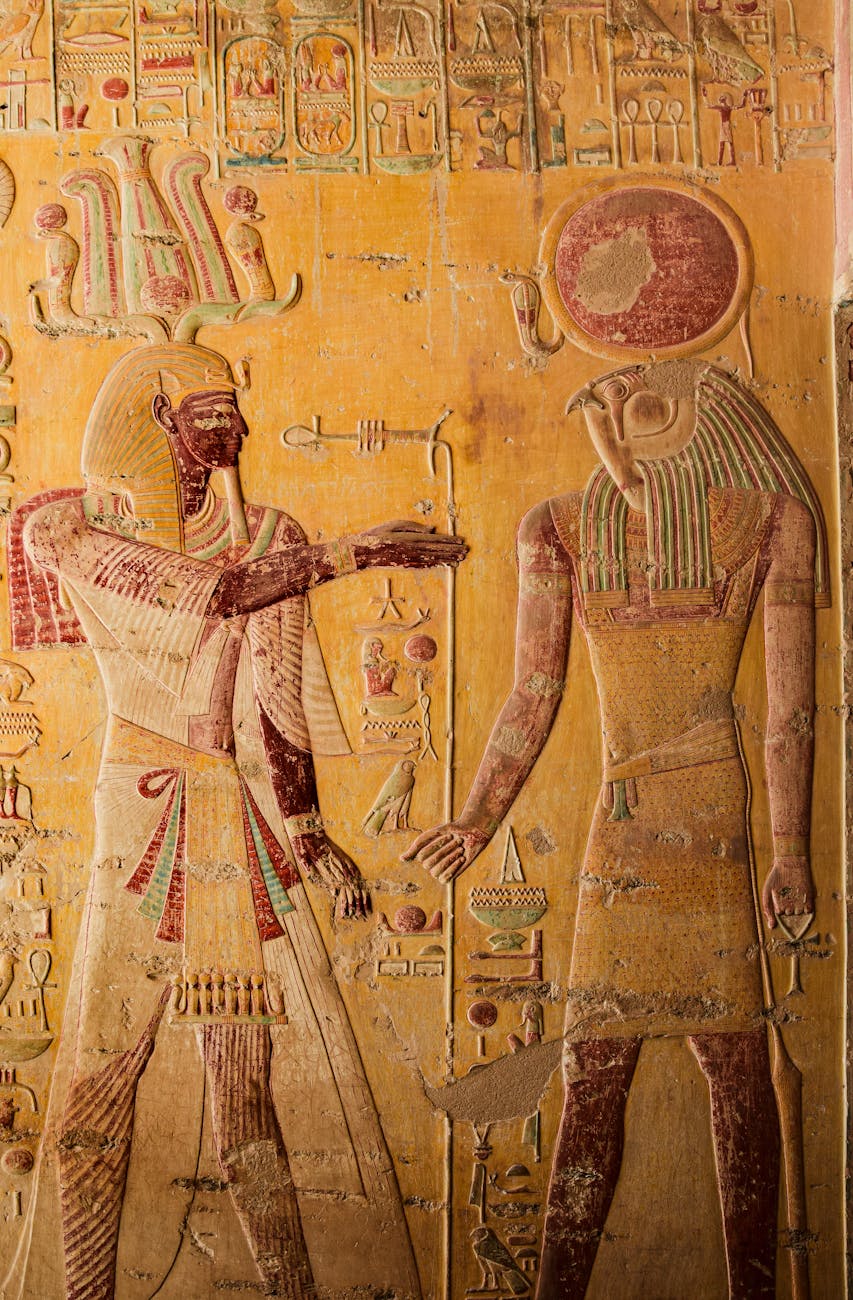
The plagues unleased against Pharoah and Egypt may also be seen as Yahweh’s triumph over the gods of Egypt. Like most ancient civilisations, Egypt was polytheistic. The plagues can each be seen as portraying a direct confrontation with those gods.[1] Serpents were of course seen as sacred to many cultures and we might trace back a link to Genesis 3 where Satan takes the form of a serpent to tempt Adam and Eve.[2] The Serpent of course was cast down to crawl on the dust of the ground. Moses and Aaron cast down their rods onto the ground which become serpents, crawling in the dust. If a poisonous snake such as a cobra, this would have been a frightening sight but ultimately the serpent is under God’s authority through his servants.
Egyptians saw the River Nile as the source of life and worshipped the associated god, Heti. However, the Nile has become a place of danger and death to the Israelites and now is made a place of death to the Egyptians too. Kek, a frog headed god was believed to be married to the serpent headed goddess Kauket. Together they represented night and day, or in his case, primordial darkness. A land overrun with frogs was a land slipping back into that darkness.
There were gods of the fertile ground (Horus) and of the desert (Seti) and we can see their judgement in the plagues that bring gnats, flies and boils from the dust. Seti is also associated with storms and chaos. Hamilton observes:
The plague of hail comes on “so you may know there is none like me in all the earth” (9:14), and “so you may know the earth is the LORD’s” (9:29).[3]
God brings darkness onto the land, the Sun is eclipsed, Ra, the Sun-God defeated. Pharoah himself was worshipped as a deity but he was not safe from God’s judgement as his firstborn died.
The plagues also bring Pharoah’s magicians out into the open and expose their powerlessness. They are able to replicate miracles to a limited extend but not able to restore things to right. All that they can do is add to the destruction. The magicians were not mere court entertainers but would have fulfilled a priestly role, drawing their believed powers from the gods. Were they simply clever fakers, conjurors or were they relying on demonic power to replicate the plagues? We are not told this. However, one thing is for certain, they could only do anything with YHWH’s permission.
[1] For further information on the gods mentioned below and more, see Ancient Egyptian gods and goddesses | British Museum
[2] Out of interest, Hamilton observes that in “7:9. The Hebrew word for “serpent” (and in vv. 10, 12 [plural]) is not nāḥāš as in 4:3–4 (Moses throws his staff on the ground and it becomes a nāḥāš), but tannîn.
Hamilton, Victor P.. Exodus: An Exegetical Commentary (p. 214). Baker Publishing Group. Kindle Edition. This may be simiply vocabulary variation but it may also be intentional with the Greek equivalent being “drakkon” similar to “dragon”.
[3] Hamilton, Victor P.. Exodus: An Exegetical Commentary (p. 226). Baker Publishing Group. Kindle Edition.
 Faithroots