
Blogger, Aaron Edwards has posed a set of questions to people he describes as “Christians who loathe the idea of Christian Nationalism.”
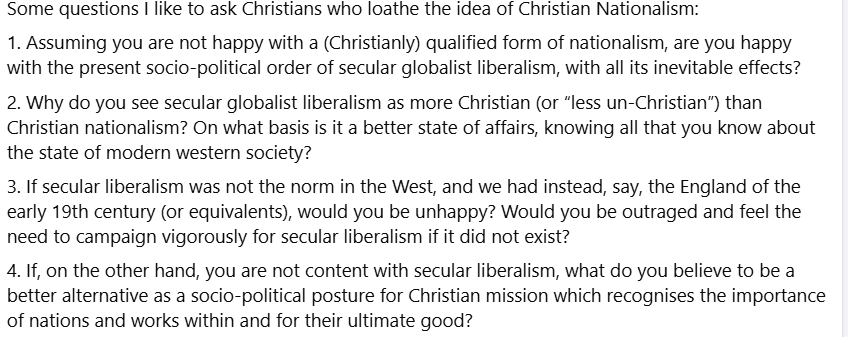
Below are my brief responses to the questions.
Assuming you are not happy with a (Christianly) qualified form of nationalism, are you happy with the present socio-political order of secular globalist liberalism, with all its inevitable effects?
I’m not happy with the present socio-political order. You don’t have to be in favour of the present political order in order to be against Nationalism with or without the Christian prefix.
Why do you see secular globalist liberalism as more Christian (or “less un-Christian”) than Christian nationalism? On what basis is it a better state of affairs, knowing all that you know about the state of modern western society?
I’m not saying that “secular globalist liberalism” is more Christian that Christian Nationalism. What I am saying is that Christian Nationalism, especially in the form that is being heabily promoted right now is not Christian. This does not require me to favour any other political option and nor does it mean that there is the binary choice suggested.
If secular liberalism was not the norm in the West, and we had instead, say, the England of the early 19th century (or equivalents), would you be unhappy? Would you be outraged and feel the need to campaign vigorously for secular liberalism if it did not exist?
No, I would not see the need to campaign for secular liberalism. At no point in my opposition to Christian Nationalism have I said that favour secular liberalism. There would have been aspects of early 19th Century life that I would have been happy with and areas that I would have disagreed with. At different times there would have been governments in power that I agreed with more than at others.
If, on the other hand, you are not content with secular liberalism, what do you believe to be a better alternative as a socio-political posture for Christian mission which recognises the importance of nations and works within and for their ultimate good?
I don’t have to offer an alternative that commits to something I don’t see Biblically as being the priority of Christian mission. Our mission is to make disciples of Jesus Christ, to baptise them and to teach them to obey all he has commanded. That’s what the early church did and what the church at its best has done ever since.
You will realise as you read through my responses that they end up being a little repetitive. That’s because the nature of the questions rely on a faulty presupposition and so in effect, he keeps asking the same question in different ways.
The assumption is that what we have done is looked and seen two political options, Nationalism and globalist liberalism. Once we have looked at the two options, then we choose one as having more potential to be Christian. Aaron has indeed already done that by providing the pre-fix “secular” to globalist liberalism and Christian to Nationalism. What we end up doing here is dividing the debate up between the extremes.
The first problem with the presupposition is that it does not allow for the possibility that I might want to refuse your dilemma. I might not find much appealing at all about either political offering. I may not consider either to be transformable by the prefix of Christian. I might be concerned by the possibility that in fact attempting to mix Christianity with either will contaminate the Gospel.
Secondly, there has often been the presupposition that if you refuse the dilemma that you are disinterested in politics and are taking a “not of this world” pietist route. Leaving aside that pietists were not historically those who switched off from the affairs of this world, it is worth restating that it is possible to be a Christian, engaged in the public square, concerned about the well-being of his fellow citizens without buying into nationalism.
Thirdly, it looks at the world simplistically. The reality is that the world is not like that. If we pay attention to global matters then we do so because things don’t fall neatly between borders. Nations have always had to choose to work together and not sit in splendid isolation. Indeed, Christians on the right have been the first to argue for free markets (globalist) rather than protectionism (nationalist) because that is not only likely to lead to greater prosperity for their nation but is perceived as a better route out of poverty for other nations. That’s just to give one example.
If Aaron wants to discuss politics and what solutions may be better in which contexts then I’m more than happy to do that.
In the meantime, here’s my more detailed critique of Christian Nationalism
 Faithroots