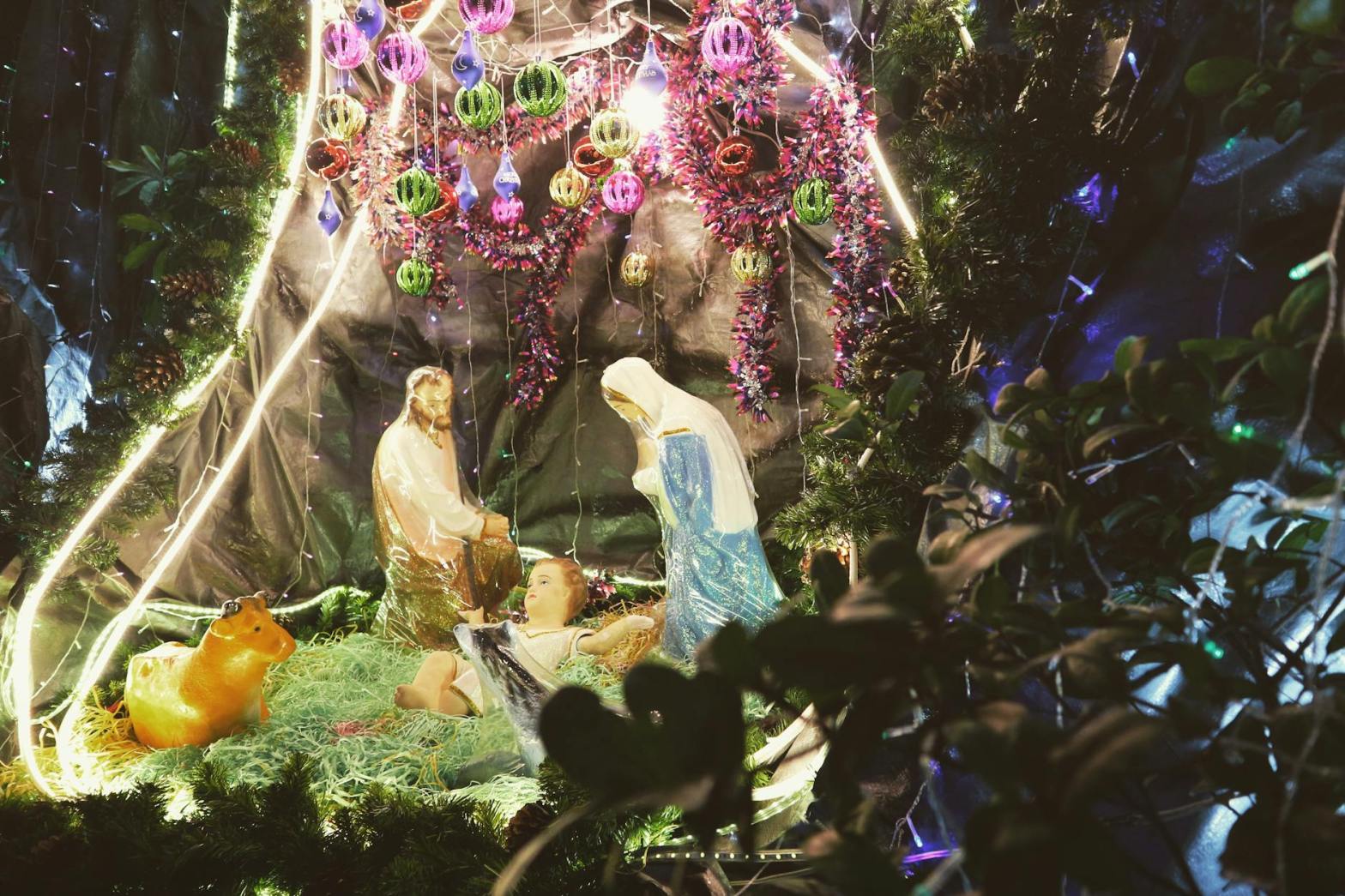
The solution to the problem of sin, according to the Bible is seen in the incarnation by which I mean the whole story of the birth, life, death and resurrection of Jesus.[1] This was central to the argument made by Athanasius in his book “On the Incarnation”. Athanasius says:
“…It was unthinkable that God, the Father of Truth, should go back upon His word regarding death in order to ensure our continued existence. He could not falsify Himself; what, then, was God to do? Was He to demand repentance from men for their transgression? You might say that that was worthy of God, and argue further that, as through the Transgression they became subject to corruption, so through repentance they might return to incorruption again. But repentance would not guard the Divine consistency, for, if death did not hold dominion over men, God would still remain untrue. Nor does repentance recall men from what is according to their nature; all that it does is to make them cease from sinning. Had it been a case of a trespass only, and not of a subsequent corruption, repentance would have been well enough; but when once transgression had begun men came under the power of the corruption proper to their nature and were bereft of the grace which belonged to them as creatures in the Image of God. No, repentance could not meet the case. What — or rather Who was it that was needed for such grace and such recall as we required? Who, save the Word of God Himself, Who also in the beginning had made all things out of nothing? His part it was, and His alone, both to bring again the corruptible to incorruption and to maintain for the Father His consistency of character with all. For He alone, being Word of the Father and above all, was in consequence both able to recreate all, and worthy to suffer on behalf of all and to be an ambassador for all with the Father.[2]
So, Athanasius presents the problem of sin in the form of a dilemma for God.[3] On the one hand, God has said that the penalty of sin is death and that includes the corruption and decay of creation. God is Eternal and Truth and so he must be consistent with his Word. What he says must come to pass. He observes that it would not have been enough for Adam and Eve just to repent. Serious damage had been done. Sin is not just about our actions but rather takes root. It has a corrupting effect. He describes it in the kind of “loss of grace” language that we might associate more with a later medieval, scholastic or catholic ideology as discussed in the previous chapter.[4] However, the gist is there. Sin does something to us, death has entered through sin. Adam and Eve become aware of their nakedness, they experience shame. However, Athanasius also says:
“It would, of course, have been unthinkable that God should go back upon His word and that man, having transgressed, should not die; but it was equally monstrous that beings which once had shared the nature of the Word should perish and turn back again into non-existence through corruption. It was unworthy of the goodness of God that creatures made by Him should be brought to nothing through the deceit wrought upon man by the devil; and it was supremely unfitting that the work of God in mankind should disappear, either through their own negligence or through the deceit of evil spirits.[5]
God’s unchanging nature, his truthfulness and his holiness must be protected. Yet, we cannot at the same time ignore other perspectives on his nature. God is sovereign and good, he is impassible and that means he is without serious rival or enemy. So, with all of those things being true, Athanasius considers the possibility of God’s creation plans being thwarted, especially through an enemy attack and deception as incredulous. On a side point, we often talk about the Incarnation and The Cross as where wrath and mercy or justice and love meet. But do you notice that it is in fact where all of God’s attributes are seen to meet. God is Truth, Love, Sovereign, unchanging, unconquerable/impassible and none of those things are in conflict, the Incarnation and Cross are evidence of this.[6] Athanasius says that the Incarnation is the answer to the dilemma.
“For this purpose, then, the incorporeal and incorruptible and immaterial Word of God entered our world. In one sense, indeed, He was not far from it before, for no part of creation had ever been without Him Who, while ever abiding in union with the Father, yet fills all things that are. But now He entered the world in a new way, stooping to our level in His love and Self-revealing to us. He saw the reasonable race, the race of men that, like Himself, expressed the Father’s Mind, wasting out of existence, and death reigning over all in corruption. He saw that corruption held us all the closer, because it was the penalty for the Transgression; He saw, too, how unthinkable it would be for the law to be repealed before it was fulfilled. He saw how unseemly it was that the very things of which He Himself was the Artificer should be disappearing. He saw how the surpassing wickedness of men was mounting up against them; He saw also their universal liability to death. All this He saw and, pitying our race, moved with compassion for our limitation, unable to endure that death should have the mastery, rather than that His creatures should perish and the work of His Father for us men come to nought, He took to Himself a body, a human body even as our own. Nor did He will merely to become embodied or merely to appear; had that been so, He could have revealed His divine majesty in some other and better way. No, He took our body.”[7]
Athanasius says that it was “the incorporeal and immaterial Word of God” who “entered our world.” In so doing, he points to the divinity of The Son. He does so without at any point distancing God from the world prior to creation, he has always been engaged. However, this is a new way of entering the Word. Notice too, that Athanasius uses Penal language for the consequences of sin. We will pick up on that later. It is compassion and mercy, it is love that moves God to this. Finally note that the Son does not merely become embodied in the sense of divine spirit with a human body “God with skin on” or have appearance of humanity. This is a rebuke to Gnosticism and Docetism. When Athanasius talks about Jesus taken a human body to Himself, he means that he took on human nature, he becomes fully God and fully man. In terms of the doctrine of the Incarnation, we will want to unpack this further and consider what it meant for Jesus to be born of a virgin, fully God and fully man. This will take us into the doctrine of Christology. The birth of Jesus Before moving into a discussion on Christology,
The birth of Jesus
I thought it might be helpful to rehearse again the facts of the Incarnation. Mark’s Gospel of course doesn’t reference Jesus’ birth but delves straight into his adult life. John summarises it in one terse statement:
“The Word became flesh and made his dwelling among us. We have seen his glory, the glory of the one and only Son, who came from the Father, full of grace and truth.” [8]
“Became flesh” is similar to Athanasius’ language of “taking to himself a body.” The Greek word, sarx, is associated throughout the New Testament with “human nature” and in the context of humans in Adam or the old self in Romans this becomes “sinful/fallen human nature” but is not required to be taken as such. The incarnation is portrayed in terms of God The Son making a home with us. The word skenoou, translated “dwelt among” could be rendered as “pitched his tent” or “encamped”. This might cause us to think of the Tabernacle or tent of meeting in the Wilderness and if so, then of Moses wearing a veil after meeting with God. This helps us to consider what it means to say that “We have seen his glory”. The people with Jesus were given a glimpse of glory that was forbidden to the Israelites in the Exodus. It is the Son who reveals this glory and in doing that fulfils the intended purpose of humanity to be in God’s image and likeness. We, according to Romans 3:23 have fallen short of that glory but Christ has not.
Matthew and Luke flesh out birth accounts. Luke begins with Angelical appearances, first to a priest named Zechariah with the announcement that his wife Eizabeth will give birth to a son and they are to call him “John.” Zechariah and Elzabeth are old and infertile. Zechariah is incredulous. His age and initial doubt mirror Abraham and Sarah’s age and infertility as well as their initial struggle to trust in God’s plan. Zechariah is struck dumb by the angel for the period of Elizabeth’s pregnancy. As well as this reflecting personal judgement on him, it also seems to mimic the years of silence between the closing of the last prophecies to the post exilic people and these announcements. Similarly, that 400 year period of silence echoes the 400 years exile in Egypt. John will be a forerunner of his cousin, the Messiah.[9]
The angel Gabriel then announces good news to a young woman, a virgin betrothed in marriage, Mary. He tells her that she will conceive by the Holy Spirit and that she is to call her son Jesus[10]. Her fiancé, Joseph, is described as a righteous man. He is mindful to break off the engagement quietly. However, the angel also appears to him and exhorts him to go ahead with the marriage.[11] Joseph was a carpenter in Nazareth, Galilee. This fits with Isaiah’s prophecies.[12] However, prophecies had also pointed to David’s birthplace, Bethlehem as the place where the Messiah would come from.[13] Mary and Joseph travel to Bethlehem in response to a census called by the Roman Emperor. The family home is crowded and there is no place for them in the guest room so Mary gives birth in the main part of the house, shared by humans and animals.[14] That night they are visited by Shepherds who have heard the birth announcement from angels. Later, Jesus will receive visitors from the East, magi, wise men interested in astrology who have observed a new star. They arrive via Herod The Great’s court in Jerusalem. Herod recognises this new baby as a threat to his throne and sends henchmen to deal with this potential rival. The family flee to Egypt and stay there until they get report that Herod has died. They return but back to Nazareth instead of Bethlehem. Matthew tells us that this fulfils Hosea’s prophecy “out of Egypt I have brought my son.” [15]
This last point is significant because it points us towards a view which treats Jesus as a typological fulfilment of Israel. The identification of “Son of God” is often associated with his deity but in the Gospels it is linked to his humanity. Adam is identified as “Son of God”. Israel is also identified as a son of God. We are not merely meant to think of humanity in terms of individual human beings but also in terms of the human race. The whole human race therefore is, in Adam, God’s Son by creation, made in his image. Abraham is called out from Ur in order that a new humanity, a new son of God might be constituted through his heir. Jesus then becomes the representative of Israel. So, as with our consideration of the origins of humanity in the old creation, we can see here how a study of the text takes us first to Biblical Theology. Before moving to Systematic and Applied Theology.
Noah, Abraham, Moses and David can in some sense be seen to be “new Adams”. The story is building to a solution not just to the problem of sin but to the failing of the human race. Adam fails and so humans fill the world with evil, Noah’s sons fail and this culminates at Babel. So God calls Abraham out of Ur to be the ancestor of his people, they too, as Israel will fail but, according to Paul. The promise to Abraham was of an offspring, singular, and so where Adam had failed, Noah’s descendants had failed and Israel had failed, Jesus triumphs.
Born of a virgin
Matthew and Luke are both explicitly clear that Mary was a virgin at the time of conception. Her pregnancy is to be understood as miraculous in a manner distinct from Elizabeth’s or those in early biblical history such as Sarah and Hannah. Luke tells us that Mary was a virgin when Gabriel appeared to her. When Mary is uncertain about how pregnancy would be possible, the angel’s response is not to instruct her to move ahead with the marriage but to encourage her that the birth will be through the work of the Holy Spirit. On a side note, we should reject and ignore crass attempts to attack Christian faith that imply that God impregnates her through a form of sexual intercourse. This is about the Holy Spirit working a miracle. Mary remains a virgin. Matthew’s account adds the detail that although Joseph went ahead with the marriage, he did not consummate it prior to Jesus’ birth.
The virgin birth also was a matter of prophetic fulfilment. Isaiah says:
“Behold the virgin shall conceive and bear a son.”[16]
How the prophecy works requires some careful understanding. In Hebrew, the reference is not specifically speaking of a virgin but rather of a young woman. The prophecy likely has an immediate fulfilment with the birth of a boy into the royal court acting as a sign that Isaiah’s words were true. However, the Greek translation of the word for young woman in the Septuagint moves to the more precise and technical term for virgin. I think it is reasonable to see that as at least a hint that there was more to come, a greater fulfilment, not just a young woman but a virgin.
Why does the virgin birth matter? Athanasius says this:
“He took our body, and not only so, but He took it directly from a spotless, stainless virgin, without the agency of human father — a pure body, untainted by intercourse with man.”
Notice that he explicitly sees sexual intercourse as tainting or staining. There have been tendencies within Christian theology at times to seeing sex itself as negative. However, that does not fit with the Biblical record. Sex within marriage is regarded as a good thing. Whilst others might be cautious about treating sexual intercourse as negative, they have linked the virgin birth to freedom from sins’ stain. If sin is inherited through the male line from Adam, then the absence of a human father might be seen as interrupting that transmission. There are problems with that view of course. First, it starts to place a heavy emphasis on Mary’s need to be spotless, thus Roman Catholic theology created the concept of an immaculate conception for her. The problem with that is that at some point in the chain of events there must have been a male forefather in Mary and therefore Jesus’ family line.[17]
It might also be thought that the virgin birth was the mechanism for Jesus being both human and divine. On that logic, Jesus receives his human nature from Mary and divine nature from God. However, this also feels unsatisfactory. It would suggest that Jesus was receiving a partial genetic identity from his human mother and a partial identity in terms of his characteristics from The Father. Would such a baby be fully God and fully man in the truest sense? Crucially, Scripture itself does not speculate or expand on if or why the birth needed to be a virgin birth. It simply predicts, promises and reports the facts. This should caution us against over speculation.
What I think we can say with certainty is that the phenomena was intended as a sign to show that God was doing something distinctive. We may also cautiously suggest that the sign points to there being an interruption in the normal mechanisms and that this hints towards the child’s unique identity as the spotless son of God, fully divine and fully human, a second Adam. This also indicates both continuity and distinction between the first and the last Adam.[18]
So Letham sees it as pointing to new creation.
“The virginal conception is a new creation -a renovation of the old (Luke1:34-35). As in the original creation and the resurrection, we understand by the Holy Spirit in faith, not by a process of human logic and argumentation, even though it can logically be defended.”[19]
Fully God and Fully man
If the original Nicene Creed was instrumental in defining and summarising the orthodox position on the Trinity. The Chalcedonian Creed (451 AD) was vital in helping the early church to define our understanding of Christology. It says:
“Therefore, following the holy fathers, we all with one accord teach men to acknowledge one and the same Son, our Lord Jesus Christ, at once complete in Godhead and complete in manhood, truly God and truly man, consisting also of a reasonable soul and body; of one substance with the Father as regards his Godhead, and at the same time of one substance with us as regards his manhood; like us in all respects, apart from sin; as regards his Godhead, begotten of the Father before the ages, but yet as regards his manhood begotten, for us men and for our salvation, of Mary the Virgin, the God-bearer; one and the same Christ, Son, Lord, Only-begotten, recognized in two natures, without confusion, without change, without division, without separation; the distinction of natures being in no way annulled by the union, but rather the characteristics of each nature being preserved and coming together to form one person and subsistence, not as parted or separated into two persons, but one and the same Son and Only-begotten God the Word, Lord Jesus Christ; even as the prophets from earliest times spoke of him, and our Lord Jesus Christ himself taught us, and the creed of the fathers has handed down to us.”[20]
Notice that the Creed explicitly states that Jesus Christ is fully God and fully man. He is complete in those aspects. He is fully God because he is “of one substance with the Father” but he is also “of one substance” or shares the same nature “as us”. The Creed then wants to outline several things that we must not say about Jesus, just as Nicaea identified the three things we must not deny about the Trinity: oneness, distinction and equality. Jesus in terms of his person is without confusion. In other words, there remains a distinction between the two natures. They have not become mixed together to create a composite “godman” nature. This would be distinct from the kind of thinking seen in ancient religions where the gods mated with humans to create a new godman, superhero species. This is important because such a mixing of natures would mean that in a sense, The Son’s nature changed and he is “without change.” At the same time, whilst there is distinction of natures, we are not meant to envisage a kind of split personality or a scenario where the two natures are hidden behind a kind of interface and accessed separately.
There is no division or separation between the natures. This is important because it means that it was the whole, fully divine and fully human person of Jesus who did miracles, healed the sick, knew the future and rose from the dead. These statements are crucial to our understanding of Jesus and our ability to refute both ancient and modern heresy. The Council of Chalcedon had been called in 451 at least in part to settle some key disputes around Christology. In particular, the Church needed to respond to a monk called Eutyches who had been reacting to something called Nestorianism. Nestorius had served as archbishop of Constantinople from 428-431. He had developed an idea, emphasising the two natures of Christ. However, the result was that these became divided out. Eutyches wanted to avoid this and so emphasised the one person, however, the result of this was that Eutyches ended up presenting Jesus as having the one nature, a fusing together of his divine and human nature. The Chalcedonian Creed in effect insists that we refuse both positions. It rejects Nestorianism insisting that the two natures exist within the one person without division or separation. These are not two entities in potential conflict with each other, seeking to see which one wins. At the same time, Chalcedon says “but not Eutychian either. The natures are not confused or mixed together. Jesus is fully God and fully man, not a hybrid version fusing the two together.[21]
At the same time the language we encounter both in Scripture with its references to The Word becoming flesh or in Athanasius’ references to The Son taking to himself a human body remind us that this is not just the coming together of two equal parts within one frame. We are not dealing with equals and the human flesh certainly cannot contaminate divinity, which is one of the things that Arianism and Gnosticism feared. Instead, as Bavinck puts it:
“The divine nature completely permeates and sets aglow the human nature as heat does iron and makes it participatory in the divine glory, wisdom and power.”[22]
This point about participation brings us back to human identity at Creation because surely the idea of being made in the image of God points us to this sense of participation.
There is an interesting and perhaps overlooked implication from this. A contemporary dispute today is concerning the influence of temptation and desire on the believer’s life and their culpability. We tend, based on Paul’s writing in Romans 6-8 to think in terms of two natures in relation to the believer, the old sinful or fallen nature and the new, restored nature in Christ. Of course we should not treat these descriptions as a direct read across from the Chalcedonian formula and Paul was not intending such a formula in the use of the language. However, it might be helpful to consider how nature language may be influenced by similar thought in relation to anthropology. How should we think of those two natures? We will discuss this in more detail later. However, for the time being, my provisional conclusion is that we certainly do not want to go down the Eutychian line. The two natures are not cojoined. Whether Chalcedonian or even Nestorian language is more helpful in this context may be worth thinking though.
A third strand that both Athanasius and Chalcedon deal with is Docetism. This was a belief that treated The Son as merely taking on the appearance of humanity rather than fully taking on human nature. This kind of thinking may be identified with a purist understanding of “appearance only” where the person of Jesus might be considered a form of theophany rather than God incarnate. It may also be associated with viewpoints that see Jesus as being a divine or spirit being with a physical human body.
Contemporary issues
Whilst the Nestorian and Eutychian controversies at first glance may appear to be distant and historical, even compared to Arianism, I would argue that they and the Chalcedonian response still have relevance. Whilst we may not see the exact forms of heresy today, we can see examples of similar thinking popping up from time to time, especially within popular evangelicalism.
In particular I would identify two examples. First of all, I recall hearing Christian Union speakers, especially those seeking to be trendy referring to Jesus as “God with skin on” when I was at University. Further, I suspect that if you were to probe many Christians, they would acknowledge that they tend to think of Jesus as God with a human body or some kind of fused entity similar to a Marvel comic superhero like Spiderman whose DNA is altered when bitten by a spider.
Secondly, another example would be Kenoticism. This is a theory based on Philippians 2:6-11 and a misunderstanding of what it meant for Jesus to “empty himself.” Did Jesus empty himself of key divine attributes, especially those relating to his sovereignty and power? Such a view risks treating the human Jesus as a container for his divine nature. This create a problem with The Doctrine of God as it leads to both change in God and a God with parts which undermines Divine Simplicity. Philippians 2 is, in my opinion, best understood as pointing to an emptying of status, Jesus chooses to humble himself although there is an appropriate discussion to have as to the extent to which in the Incarnation, the Son constrains himself through temporal and spatial limitations. However, in this context, we should be concerned with the impact it has on Christology and what it means for Jesus to be fully God and fully human with no confusion or separation of his human and divine nature.
Thirdly, we have at times seem contemporary forms of an ancient heresy known as Adoptionism. This is the belief that Jesus was not fully God and fully man at his birth but rather that the Father adopted him as his Son at his baptism or resurrection. This might mean either that Jesus was seen as purely human but experiencing a specific awareness of God’s presence or in some cases, that through being baptised in the Spirit, Jesus became a partaker of the divine nature. In the former case, we can see comparisons to some contemporary forms of liberal theology.
An interesting variant was initially posited by John MacArthur before its later retraction. MacArthur initially rejected eternal generation and therefore eternal sonship believing that sonship was confirmed on Christ in the incarnation. However, he also continued that Jesus was always fully divine. He argued:
“Son is an incarnational title of Christ. Though His sonship was anticipated in the Old Testament (Prov. 30:4), He did not become a Son until He was begotten into time…The Bible nowhere speaks of the eternal Sonship of Christ…He was always God, but He became Son. He had not always had the title of Son. That is His incarnation title. Eternally He is God, but only from His incarnation has He been Son…Christ was not Son until His incarnation. Before that He was eternal God. It is therefore incorrect to say that Jesus Christ is eternally inferior to God because He goes under the title of Son. He is no “eternal son” always subservient to God, always less than God, always under God….His Sonship began in a point of time, not in eternity. His life as Son began in this world…He was not a son until He was born into this world through the virgin birth…The sonship of Christ is inextricably connected with His incarnation…Only after Christ’s incarnation did God say, `This is My Son.’” [23]
When he retracted this view, he wrote:
“To that end, I want to state publicly that I have abandoned the doctrine of “incarnational sonship.” Careful study and reflection have brought me to understand that Scripture does indeed present the relationship between God the Father and Christ the Son as an eternal Father-Son relationship. I no longer regard Christ’s sonship as a role He assumed in His incarnation.”[24]
He added:
“My aim was to defend, not in any way to undermine, Christ’s absolute deity and eternality. And I endeavoured from the beginning to make that as clear as possible. .”[25]
The tone of MacArthur’s article suggests that he sees this in terms of a minor correction. He uses the example of Augustine to show that it is normal for pastor-theologians to be learning and revising. This is of course true, each of us will recognise that there are issues and interpretations which we have changed our minds on over the years.
But is this only a minor error? MacArthur seems to suggest that it is because at no point did he fall into Arianism. However, Arianism is not the only significant error we can fall into when talking about God and the Trinity.
You will notice that in his original position MacArthur not only affirmed the eternal divinity of Christ but also insisted that he was a distinct person, that God eternally is three persons. This would suggest that he also was seeking to avoid modalism – the belief that God reveals himself in three different modes at different times, Father, Son and Spirit.
However, whilst Incarnational Sonship does not immediately result in modalism, it does leave us confused about the nature of the Trinity. In what way are the persons distinct from one another? Orthodox Christianity has insisted that the distinction is in the relationships otherwise we end up placing it elsewhere such as by identifying three different wills within the Trinity. So at best, MacArthur’s original position left us with a muddled and confused understanding of God’s triune nature.
I think the problem goes a little deeper though because in effect, it implies change within God and that is a serious issue.[26] In what way does Incarnational Sonship result in change within God? Well, not within Christ because its proponents would argue that Sonship is an aspect of his acquiring a human nature, not a change to his divine identity. However, it does result in change within the first person of the Trinity. Here is Athanasius responding to the Arians:
“Therefore it is more pious and more accurate to signify God from the Son and call Him Father, than to name Him from His works only and call Him Unoriginate. For the latter title, as I have said, does nothing more than signify all the works, individually and collectively, which have come to be at the will of God through the Word; but the title Father has its significance and its bearing only from the Son. And, whereas the Word surpasses things originated, by so much and more doth calling God Father surpass the calling Him Unoriginate. For the latter is unscriptural and suspicious, because it has various senses; so that, when a man is asked concerning it, his mind is carried about to many ideas; but the word Father is simple and scriptural, and more accurate, and only implies the Son.”[27]
Athanasius’ point is that we know God as Father. We recognise in the name something of his eternal character. The problem with Incarnational Sonship is that it leaves us with a God who at one point was not Father and at a later point becomes Father.
We cannot underestimate how serious the matter is. Whilst it is commendable that MacArthur changed his position, the original error was serious and contemporary conservative Evangelicals may wish to reflect on the extent to which we take error seriously when it originates from those we might consider as within our own tribe.
On a side note, the question of natures, especially in relationship to Nestorianism has come up in discussions around the EFS controversy. From early times, it was concluded that because “will” is a property of nature, Jesus had two wills, one human and one divine. This has led to an interesting discussion about what took place in the Garden of Gethsemane and what Jesus meant by “Not my will but yours?” Does this indicate that this was in reality a debate between Jesus’ human nature and God? Would that not risk Nestorianism? However, there is equally a concern on the part of Classical Theists to avoid the Eutychian error. Are those who insist that the Son both in regards to his human and eternal, divine nature submits to the Father guilty of confusing the natures and treating the Son as having one will? Mike Ovey in his book “Your Will Be Done” specifically links the issue to the Chalcedonian definition.
““Jesus is fully human and fully divine and yet fully one, unified person. This ruled ou various unorthodox positions to the effect that he was not fully and always divine (adoptionism), that he was not fully human (Docetism and Apollinarianism), that he was a composite of deity and humanity but not fully either Eutychianism) and that he was not a fully unified person, but divided (Nestorianism).”[28]
Ovey recognised that there was a challenge for The Dyothelitism position that there Jesus has both a human and divine will. He affirms that this position was right and necessary.
“This was required because will at this point is being defined as an attribute of substance/nature not an attribute of Person. If one defines ‘will’ in this way as an attribute f substance/nature, then it follows as the night follows day that one must assert two wills, otherwise one or other nature, or both, will lack something that properly belongs to it, namely ‘will’ defined in this sense. There are two wills in Jesus the Son, a human will, arising, so to speak in his human nature and a divine will arising in his divine nature.”[29]
However, he believed that we also needed to pay significant attention to the unity of the person of Jesus.
“It was precisely the unity of the Person of the Son that guaranteed that the two natural wills would not be in conflict. One person cannot ultimately will inconsistently with himself or herself, even if that person has two ways in which ‘will’ may be exercised.”[30]
This is important because we are now opening up the possibility of distinguishing the different ways in which we talk about will:
“The meaning of the term ‘will’ for which the dyothelites were contending was that of the faculty ‘in virtue of which one is able to will or act’. As such, it belongs in the category of the nature of an entity. This stands in distinction from ‘will’ as ‘the actualisation of these faculties in willing or acting, or even the results, the object willed or the work done’. One might say that the latter category relates more to what ‘I’ do with my natural faculty of will.”[31]
So, Obey argued that we need to distinguish the sense in which we are talking about will. The Son has two wills as God has one in the sense of the faculty of willing or the mechanism if you like. However, in terms of the outcome, he has one will, purpose, desire.
Conclusion
We began this chapter by seeing how Athanasius treats the incarnation, including from his perspective not just Jesus’ birth but his life, death and resurrection as the antidote to human fallenness. Indeed, this is not merely a novel introduction from Athanasius, he acts as an interpreter of the New Testament account. The Fall might present a logical dilemma for God. Can he be true to his word and nature without suffering defeat and loss. The answer is that yes he can, by in the person of Jesus stepping into the World and taking on human nature. He does not relinquish or compromise his divine nature.
Jesus is one person with two natures. He remains fully God and fully man. At the same time, Jesus is a real person, a unified whole, not an interface for two entities sharing the same host. Later, when we will come to the Doctrine of Atonement specifically, we will see that it is the person Jesus, with regards to his human nature who dies on the Cross and makes atonement for sin.
We might also want to observe that an Athanasian understanding of why Jesus came gives us a resurrection that is more than a mere add on. Jesus does bear the penalty for sin but his incarnation was also about the need to put right what was wrong. The Resurrection then is not just evidence of God’s power or even of the acceptability of Christ’s sacrifice. It is about the restoration of humanity. Jesus is described in Romans as taking on “flesh” (sarx). In that he was without sin, we must not see that as corrupt in the sense of sinful. However, he experienced tiredness and frailty, his human nature or flesh is subject to the consequences of the Fall. However, after the Resurrection, that is no longer the case, Jesus will not die again, will not suffer again, his body is not constrained in the way that ours are. Jesus’ resurrection body in fact is not just better than fallen Adam’s. It is better than Adam’s in his pre fall, Edenic state. Paul in Romans 5 and 1 Corinthians 15 presents Jesus as what Tim Keller would refer to as “The true and better Adam.”
This means that we are not meant to see Jesus as an interruption, an anomaly. Jesus is the archetype human. We may also legitimately in a sense say that Jesus is “the true and better Dave Williams”.[32] This will have significant implications for what is to come. If Calvin insisted in his introduction to his Institutes, that we know ourselves only when we know God, then that becomes even more so of Christ.
This means that in terms of human anthropology, we have to be careful. This is much discussion about biblical manhood and womanhood these days. Indeed, we have already sketched out a cautious biblical theology of manhood and womanhood. However, if Jesus is the archetypical human then this means that whilst we rightly observe distinctions, men and women are not interchangeable, they are also not separable either. We want to insist that men are not from Mars and women are not from Venus. Men and women alike find their human identity in Christ.
Further, it means that we will need to pay attention not just to the Doctrine of the Atonement but to the implications of both The Resurrection and The Ascension. What does it mean to say that “there is the man, Christ Jesus, in the heavenlies.” God does not change but there seems to be a sense in which Heaven has. We will trace out some of these themes in later chapters as we begin to look in depth at the pastoral implications of our Doctrine of Humanity.
Finally, it reminds us of what humanity was meant to be. Jesus reveals God The Father and reveals humanity as he reveals God. We were meant to be in God’s Image, to participate in his work and reflect his glory. We were meant to be sons and daughters. Jesus restores this in the new humanity. We need to be careful because there is a difference between the way in which The Son in his divine nature took to himself a human nature and the way in which the Holy Spirit comes and fills us. However, Biblical language draws some similarities in terms of the way the Spirit works upon our human nature.
[1] When Systematic Theologians talk about The Doctrine of the Incarnation, proper they are narrowly referring to The Son becoming man. However, early Christian works such as that of Athanasius which we are about to encounter seem to think in terms of the broader category.
[2] Athanasius, On the Incarnation, 2 (7). Available at On the Incarnation, cited 19/09/2026.
[3] Remember that we should be careful not to treat this as a suggestion that there was a real difficulty for God, a dilemma outside of him. This would go against his aseity, impassibility and immutability. Rather I understand Athanasius to be describing a logical tension from a human perspective. See Dave Williams, Who is God, 67-84. who-is-god-v-2.pdf Cited 19/09/2026.
[4] Note that this should not lead us to assume that he was anticipating such categories, rather simply that we might see similar language but should not anachronistically read the later doctrinal development back on to Athanasius.
[5] Athnasius, On the Incarnation, 2 (6).
[6] Again, we need to be careful about what we mean when we talk in popular language. Strictly speaking we talk about God being simple meaning that he does not have parts. This means that his attributes are not distinct from his essence and indeed we should not in any way think of him having competing attributes. Rather, we have language for describing different perspectives on his character. See Williams, Who is God, 56-59.
[7] Athanasius, On The Incarnation, 2 (8).
[8] John 1:14.
[9] See Luke 1:5-25.
[10] Luke 1:26-38.
[11] Matthee 1:18-25.
[12] Isaiah 9:1-2.
[13] Micah 1:2.
[14] Luke 2:1-7. Note that tradition speaks of Jesus being born in a stable and most translations refer to there being “no room for him in the inn.” However, the word often rendered “inn” also referred to an upper or guest room in a middle Eastern House. The main family would have lived in a single room shared with animals. It seems more likely in terms of historical reconstruction that Joseph would have returned to a family home than to a commercial inn.
[15] See Matthew 2.
[16] Isaiah 7:14.
[17] See Grudem, Systematic Theology, 531.
[18] See Wayne Grudem’s handling of this. Grudem is careful not to suggest the transmission of sin through the male line only but uses similar language in suggesting an interruption to the natural order that evidences the difference between Jesus and other humans. Grudem, Systematic Theology, 530-531.
[19] Letham, Systematic Theology, 487.
[20] The Chalcedonian Creed is also known as the Chalcedonian Definition. The Chalcedonian Creed – The Westminster Standard Cited 19/09/2026.
[21] Note that for our purposes here, this is intended as a summary of what reflects a complex, intense and lengthy period of debate in Church History. For more detail, see Letham, Systematic Theology, 491-576.
[22] Bavinck, Doctrine of Sin and Salvation in Christ, 256.
[23] John MacArthur, The MacArthur New Testament Commentary HEBREWS, 1983,27-28
[24] Reexamining the Eternal Sonship of Christ cired 19/09/2026.
[25] Reexamining the Eternal Sonship of Christ cired 19/09/2026.
[26] see e.g. Malachi 3:6
[27] Athanasius, Four Discourses Against the Arians 1.34.
[28] Ovey, Your will be done, 101.
[29] Ovey, Your will be done, 103.
[30] Ovey, Your will be done, 104.
[31] Ovey, Your will be done, 104.
[32] Readers may recall that at Tim Keller’s memorial service, Sam Allbery refereed to Jesus as “The true and better Tim Keller.” This proved controversial in some quarters and at the time, I responded on the Faithroots blog arguing as follow. It’s one of those immediately quotable and therefore tweetable phrases and so of course people have been tweeting it and reacting to it. Now, there’s a risk of reacting to something out of context and stark statements can make us feel uneasy. So, some of the responses have expressed unease with the statement. I’m not quite sure what the exact unease is because I’ve not yet seen anyone take Sam’s quote apart and critique it. I suspect though that there is a fear that this is making too much of Tim Keller, putting him on a pedestal. Though if it’s just that, the words of an emotional mourner, seeking to express their gratitude to a mentor figure, then I hope we’ll give Sam some grace.
However, I want to suggest that what Sam says there is actually profound, sensitive, theologically correct and pastorally helpful. Let me explain why.
Context matters and so it’s important to know that the quote is a play on something Tim Keller used to say. Keller’s point was that all of the big name characters in the Old Testament were shadows and types pointing forward to Jesus as greater and better. Jesus was the true and better king, priest and prophet. He was greater than Abraham, David and Elijah. To take the exact, specific quote, “Jesus is the truer and better Adam.”
This is important because Keller’s point was founded in the kind of theology we find in Romans 5. There, we see that Jesus is referred to as the second or new Adam. In Biblical thinking Adam represents the human race, particularly in its fallen state. He is our “federal or covenant head”, we are in him, that’s where we look to for our identity and status. However, for believers, Jesus is now our head, our representative, we are in him.
It’s helpful then also to see how Old Testament Scriptures that talk about humanity are taken up in the New Testament. Have a look at Psalm 8 and the question “Who is man that you are mindful of him.” At one level, that passage applies to the human race generally and therefore includes each of us in it. However, without fail, the New Testament authors apply it to Jesus, not so that we are excluded from the promises but so that we are only included because they are first to him and then to us, in him.
What this means is two things. First, that my whole identity, status, satisfaction is found in and only in Christ. My life’s purpose is to enjoy him for ever. Second, it means that my calling, is to point towards him and away from myself. My life’s purpose to glorify him. I think it is fair to say that Tim Keller grasped both of those things and did them both.
That’s the sense in which Sam was right to say that “Jesus is the true and better Tim Keller”. It’s true because it is true generally of man or humanity. Jesus is the true and better man, the true and better human. This also means, I think that we can say it about each of us individually.
So, this helps us in two ways. First, it helps how we think of our heroes in the faith. Note, that Sam didn’t say it the other way round. As much as we might look to Tim Keller, John Piper, Augustine, Calvin or whoever, there is someone truer and better. Secondly, this helps us to put our own lives and identities into perspective.

