I recently shared this post on Facebook. I am appreciative of the way in which quite a number of people have expressed support and engaged with what I said.
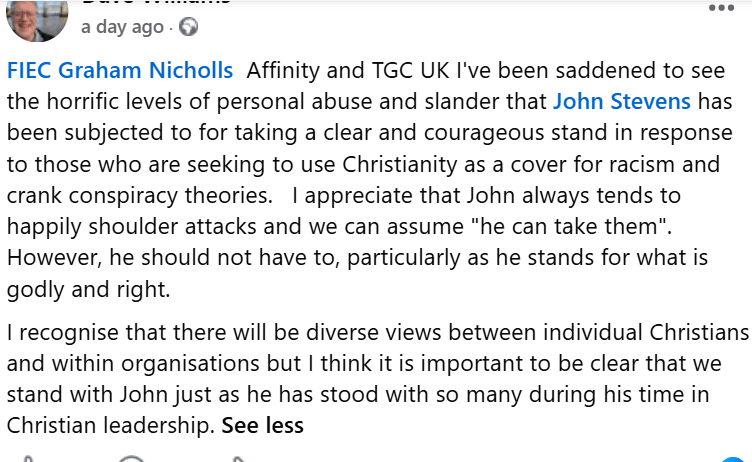
I did get a little pushback and so I want to respond to that. I’ve also included a video walk and talk at the end explaining why I made this appeal.
First of all though, I wanted to respond to one specific challenge that came up in the comments. I was put under pressure to name names and to share examples. The pretext for this was so that people could make their own mind up and avoid wolves.
You will notice that my post was not about identifying specific people to condemn or argue with. I do not claim in my post that anyone is a wolf. I do express the concern that comments have crossed a line into personal abuse and slander. I’m using the term “slander” reasonably broadly as a moral category here rather than making an assessment on whether the threshold for a defamation case has been crossed. It is worth noting that legally though, someone is liable for republishing defamatory comments of others. Whilst I don’t think there is a legal duty here, I do think the principle applies to a more general moral duty not to repeat and reproduce the wrong and harmful comments of others. Further, I was responding to material readily available in the public sphere. My request was addressed specifically to the people and organisations who know John and have visibility of his social media conversations. Additionally, I did volunteer to make evidence available privately to those I think have a specific responsibility if requested. This works with another underlying principle but often misunderstood. We sometimes get in a muddle over what confidentiality is. I always insist that it is about only letting know, the people who need to know, what they need to know.
I also want to highlight here, again, the specific issue that I encouraged people to stand with John against. It was not merely that I believed people had crossed the line in response to john, though that was significant. Rather, I was observing that John had spoken up specifically in regards to racism and conspiracy theories. This relates to him addressing the most egregious forms of ethno-nationalism and recently speaking up against those who in support of particularly agendas seek to question and undermine the verdicts and sentencing in trials, specifically Russell Brand’s conviction for rape and sexual assault.
This matters because I was looking for something specific. I wasn’t just saying that John might engage robustly in conversation and debate but sometimes his opponents take it too far. I was not insisting that people should endorse and agree with everything John says, nor does he ask that of people. What I was saying was that when a national Christian leader speaks up on specific matters of serious public sin, then other leaders and the organisations represented should stand clearly and publicly with them. This should be regardless of whether or not they receive abuse and slander in return but more so then.
This matters for a few reasons. First, we can assume that Christian leaders can just shoulder things. I myself have at times said something along the lines that particularly unpleasant experiences “come with the territory” However, we can presume that someone can just go on shouldering it. First of all, it may not be the case that they can do that indefinitely, something may well give. Secondly we may underestimate the impact it is already having on them and indeed, they may do too. We assume there are no wounds but worse, those wounds may be hidden and deep. One such wound can be the impact on families. A wife watches their husband, a child sees what happens to their dad. They see the abuse given and they see whether or not anyone stands with them.
Finally, it matters because in the end, it’s not just about senior leaders. Churches are watching, the wider Christian community are watching. What do we see? There is an opportunity to model something here, to show what it means to stand alongside one another, to have someone’s back. This does two things. First it sets an example. How do the rest of us make sure we have one another’s’ backs. Too often I’ve heard other Christians who have been speaking up say “I feel like I’m on my own, no one seems to be really supporting me.” Dare I say that this seems to be more the case if a woman speaks up and whether or not men will publicly stand with her.
The other message it sends out is that we, the leaders, the movement, the network, the constituency have your back too. We are with you, we will not leave you alone, isolated to speak up and to withstand the abuse.

