The other day, I shared this article, attempting to map out the different complementarian positions. I thought it might be helpful to begin to attempt something similar with Egalitarianism. Now, I’ve not got as far yet as creating the equivalent map or compass, perhaps that will come later but to start with, I hope that this article sketching out the motives and types of thinking will help us to see the diversity within that position, just as we have seen diversity within complementarian thinking.
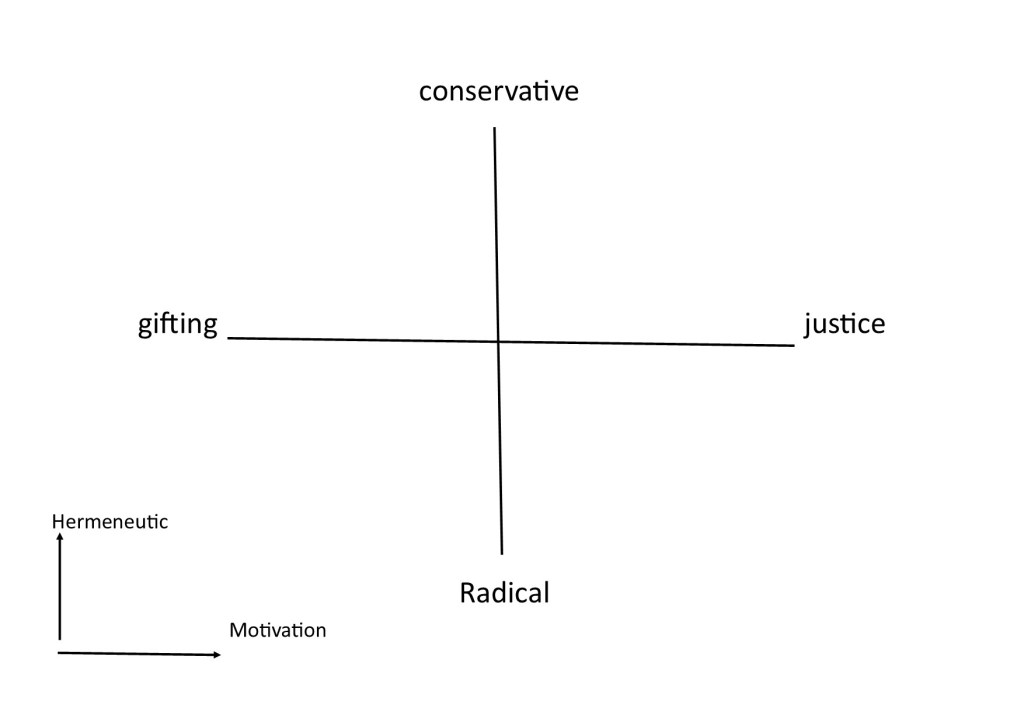
First of all, it is helpful to think in terms of motivation. Some forms of egalitarianism may be seen as a response to the growth of feminism. In this case we are talking about an alertness to inequalities in society that have also permeated the church. The concern is that women have been treated as chattel in relationships and excluded from certain jobs and positions in society. If we have recognised that a woman can be the CEO of a corporation or Prime Minister of a country, why do we exclude them from senior leadership in the church? We might describe this as a “justice” motivation.
On the other hand, some egalitarians will be less concerned about questions of justice. This is not to say that these are completely absent, as with complementarianism, we are likely to see continuity along an axis rather than binary decisions. However, others will lean more to concerns about gifting and availability. Their concern here is not so much to do with have women been discriminated against at a loss to them but rather, have we excluded women’s gifts from the church by restricting what they can and cannot do?
I would argue that with this second perspective there may be some overlap with soft/wide complementarianism because there is likely to be a recognition that men and women, in general terms bring different things to the table.
Secondly, we will want to think in terms of hermeneutics. I am focusing purely on evangelical egalitarianism here. So, we are talking about those egalitarians who would seek to justify their position and practice from Scripture. They take the authority of God’s Word seriously. Some egalitarians have felt that a new hermeneutic, or framework for interpreting Scripture is necessary, especially if we are to engage with issues of justice. Therefore, a lot of egalitarian arguments are based on what has become known as the “Redemptive-Movement-Hemeneutic”. This approach argues that through history, we see a movement or trajectory in ethics that is based on the principle of redemption. This means that we see the effects of God’s love and healing at work. It means we will see progression in Scripture but also beyond Scripture. From this perspective, inequality between the sexes is a result of The Fall. In that respect, there will be some agreement between egalitarians holding to this perspective and some complementarians who argue their position in part from one interpretation of Genesis 3:16. We might, for simplicity refer to this as a radical hermeneutical position.
On the other hand, some evangelical egalitarians continue to hold to a grammatical-historical-hermeneutic”. We might refer to this as the conservative hermeneutic. Those at this end of the spectrum are likely to be concerned about things like
- Have we correctly understood the meaning of kephale/head in 1 Corinthians 11 and Ephesians 5?
- Have we paid enough attention to the status and role of people like Junia, Phoebe and Priscilla?
- Is 1 Timothy 3 really limiting the role of elder to men, any more than it might be seen to limit it to married fathers?
I think that being able to map out the lay of the land on both sides could be helpful and enable better conversations between evangelicals holding to different positions. There is a temptation for complementarians to see egalitarianism to be primarily about feminism and furthermore to see this in wholly negative terms. However, it is helpful to remember two things, first that a concern for justice is not a negative thing and secondly that not all egalitarians are arguing from a feminist perspective. Secondly, complementarians tend to be suspicious of egalitarianism because they see it as Bible-light, a move away from accepting the infallibility and sufficiency of Scripture. It is important to remember that the people you are disagreeing with are not closet liberals just because they disagree with you on this point.
It is my hope that we can have better conversations both around what marriage and the church are meant to look like which will help us to glorify God more and to pastorally care for one another better.
 Faithroots