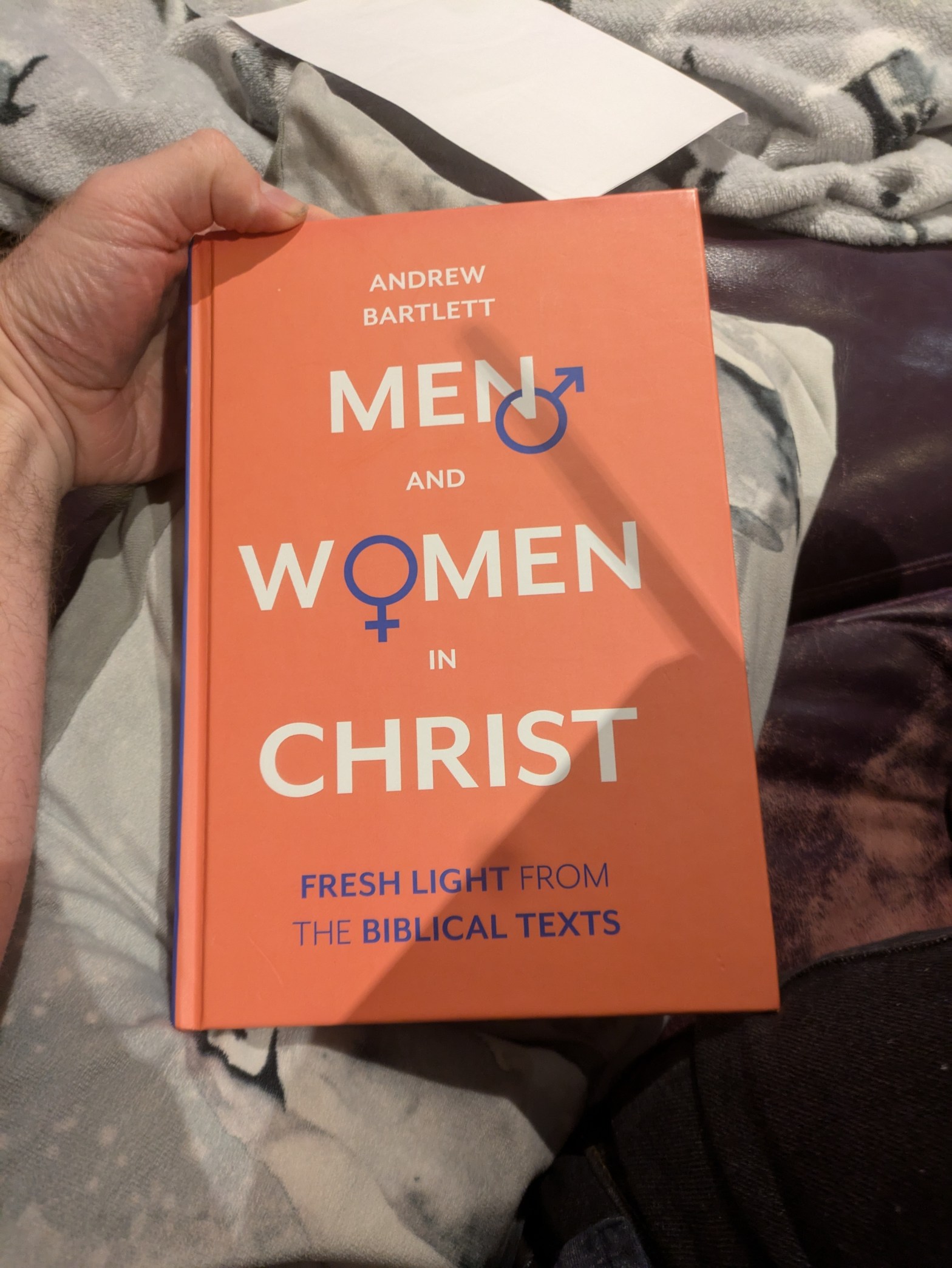
I don’t know about you but I’m enjoying the opportunity for back and forth conversation with Andrew Bartlett about his book, perhaps even more than the book itself. It’s not an opportunity that you get often, few authors would be so willing to give their time to something like this. I appreciate that this isn’t about winning an argument but rather about seeking to know God’s Word better for the benefit of the church but also that this doesn’t preclude robust conversation. I hope that if nothing out of this I’ve found a new friend!
Andrew rightly notes that I’ve got a further post coming engaging particularly with Ephesians 5. In fact, there may be more than one more, unsurprisingly. So, I hope he will let me off if he doesn’t feel that I answer everything fully here as I am hoping to flesh some things out a bit more then.
I also may not comment in so much detail on each point here, especially where I think we’ve covered the ground previously. So, for example, I appreciate his response on unilateral authority. I’m still not sure that I’d go for a less familiar term in this context but I find his discussion here helpful. His further questions about what is and isn’t asked of the man will hopefully be covered a little more in the next post. That will also help me to respond as cose to the grain of the Biblical terms rather than our contemporary terms as possible.
I’ve also engaged previously on why the ordering of materials matters but I think it is helpful to pick up on a couple of things here. First, my point is not about objecting to a starting point so much as saying that you do need to make a clear case for a starting point, because, to repeat, how we order an argument shapes the argument. The Gospel writers got this (see Luke 1).
So, Andrew suggests in his response to me one possibility and that is that we treat 1 Corinthians first as it is generally agreed that this was written earlier than Ephesians and 1 Timothy.
Now, those seeking to develop a biblical theology of a subject will attempt at times to show how a concept seems to develop over time (similarly historical theologians). So, there is a distinction made between “diachronic” and “synchronic” readings, the forner where we see how a subject develops over time, the latter where we read all the material together regardless of chronology.
However, first, I’m not sure that Andrew’s work counts as a Biblical Theology looking at an argument built up over time. Second, we need to be careful that we don’t conflate what was written with what was taught. We only know what was said at any one time based on the written record but this does not mean we can assume an absence of such teaching and knowledge.
I think this begins to matter in other contexts too. For example, I note that Andrew refers to “the majority of complementarians” where I think he means “the majority of published complementarian authors “
This may also become relevant later when we look at the meaning of Greek words, where a usage may be rare in the written literature we have available to us today. This does not mean that a word’s usage was necessarily rare at the time either in oral or in day to day written language.
Regarding the setting out of the different viewpoints. The reason why I think this matters is perhaps best demonstrated by his own comment that he got as much pushback from egalitarians as by complementarians. I don’t think this means that he is not a true egalitarian no more than the fact that people who hold a position like mine get push back from other complementarians but are still just that, complementarians. I think that in this case showing a bit of the diversity of the egalitarian position would have been helpful and would have improved the book to Andrew’s benefit. I think it would help tease out both where there is agreement between us and where the differences are.
As far as I can tell, Andrew and I would both agree that there is an equality that pushes against hierarchy. We also agree that there are distinctions between men and women that affect how they relate in marriage. However, there are differences too, we don’t belong in the same category.
I will talk more about the meaning of kephale and authority next time. At this stage I just want to note two things. First, resolving one specific dispute might require us to focus on one specific meaning of “authority” but that is not the same as what we might want to consider if we are seeking more positively to develop a better understanding of Paul’s teaching.
My simple point regarding the use of head in Ephesians 1, 4 and 5 is that how the metaphor works is that we are meant to see the imagery as being about Christ and the body. Body is a metaphor for the church and head for Christ, which then leads to the metaphor beign applied to the husband and his wife. So, I’m saying that it is not a metaphor for authority or source. To repeat, kephale is a metaphor for Christ and husband. We might even note that husband and bride are used metaphorically to apply to Christ and the church in the New Testament (or Yahweh and Israel in the prophets). So, all I’m saying is that at those points, you cannot evacuate the ideas of authority or source from the mentions of kephale in Ephesians. It’s about both.
I hope this helps as an interim response before we dive further into Ephesians 5.
 Faithroots