
In my engagement with Robert Gagnon about Christian perspectives on US politics, we had the following interaction.
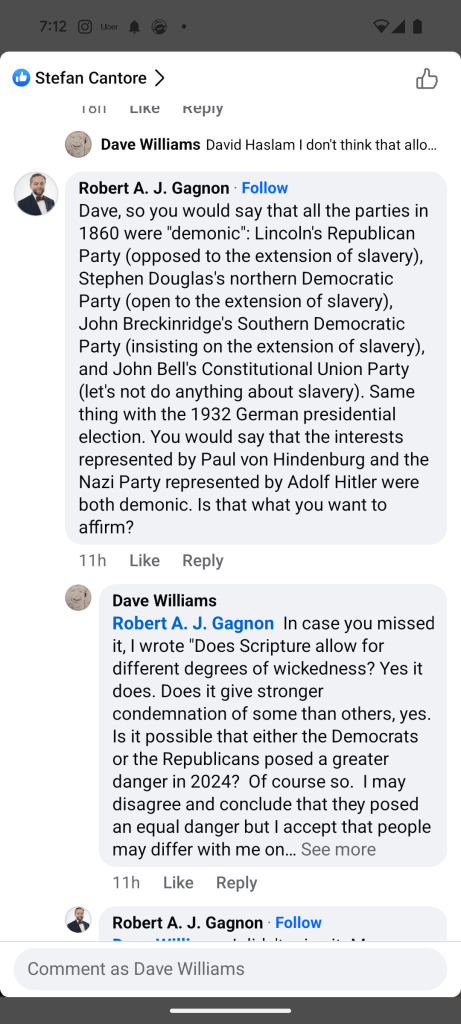

The reason for my response was that Gagnon ‘s question really amounted to an assertion which he was trying to get me to affirm or deny. It felt rather like one of those trick/trap questions intended to skewer me. If I answer yes then I’m guilty of one thing, if I answer another. It reminds me of the old “Have you stopped doing (reprehensible thing)?”
That concern was confirmed in this case by this further comment from Gagnon.
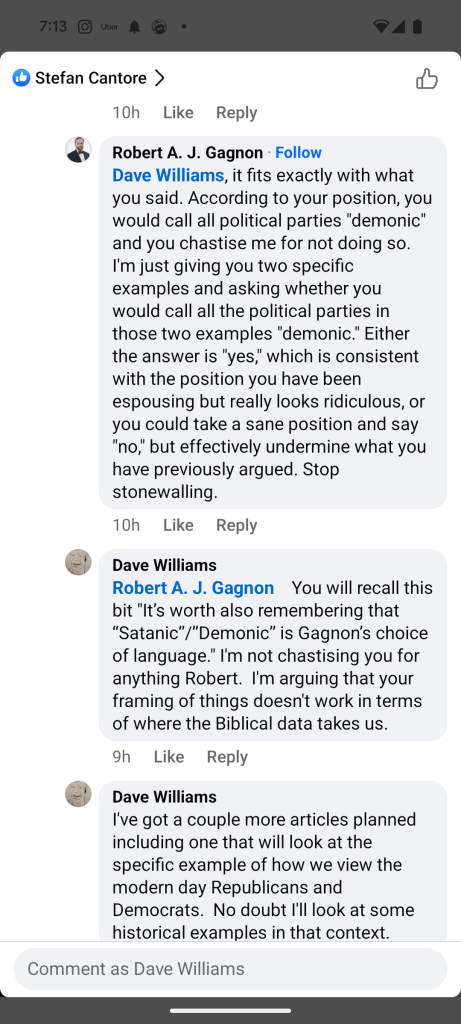
if I answered his “yes/no” then apparently I was going to either look inconsistent/ be seen to concede a debate, or I would apparently look ridiculous. Fair play to Robert for trying the move..
I have no problem with a bit of knock about debate for fun. However, whilst knock about debate is all good fun, this wasn’t really why I was engaging with Gagnon. I’ve been trying to think through an ethical question because I thought it might be helpful both for myself and for those who read Faithroots.
Additionally, whilst the “yes or no?” device may be used by politicians and journalists interviewing journalists, it is also reasonable to decline the question, especially when its framing does not reflect your position correctly. You see apart from someone appearing to score debating points, it’s not going to move the conversation on and enlighten us
In this case, I’ve noted already that the language of being demonic or Satanic is Gagnon ‘s choice. I don’t think it’s the way I would frame things. The risk then is that we might end up talking past each other and misunderstand each other.
I think the examples he raises are good ones, just as I’ve offered examples from UK politics. I’m happy to give a full and proper answer to how I would approach those scenarios and will potentially engage with them in a later article.
However, I feel under no compulsion to be hurried into saying yes or no to a question based on a faulty premise where neither answer will accurately reveal my position
 Faithroots