
If you know me, then it won’t have escaped your attention that something significant happened in Bradford at the weekend and I was there for it. The significant thing was a football game. It is worth pausing there. Some of you may be choking on your coffee at the suggestion that there is anything significant about football. I remember some Christians complaining about news reporting on the England teams’ progress to finals and semi-finals that this wasn’t news, it was much more trivial. There is already a divide between the high culture of art, classical music and theatre, and the low/popular culture of sport, film, TV and pop-music. That seems to be amplified in some quarters of Christianity.
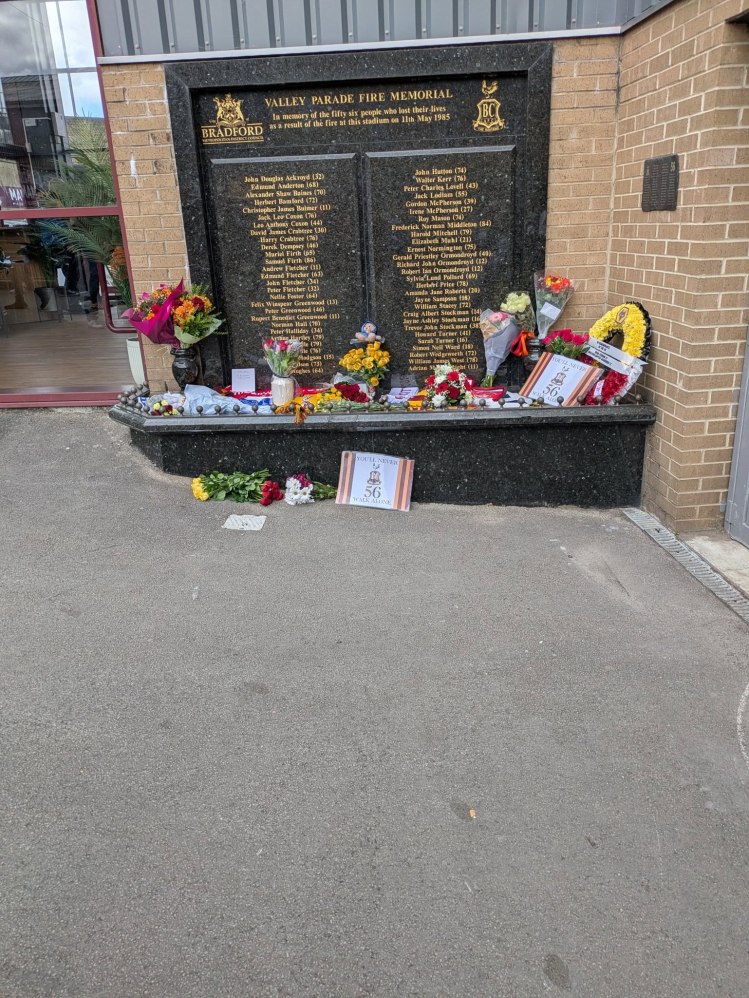
So, was last Saturday significant or trivial? Well, let me tell you a little bit about the day, from my perspective. There were two stories that were interwoven. First, when I arrived at the ground, I paused for a moment’s silence by the Fire Disaster memorial. 40 years ago on the 11th May, Bradford City suffered one of the worst tragedies in football when the main stand burnt down injuring many and costing the lives of 56 fans (54 from Bradford, two supporting the away team Lincoln). The last name on the list is Adrian Wright, aged just 11 years old and so one of the youngest victims. Adrian was in my class at school.
When I got into the ground, I chatted to a couple of other fans. Most conversations went along the lines of “We like to do it the hard way don’t we?” You see, a few weeks back, it looked like City would comfortably be promoted out of League Two where they have been for the last 6 years. Instead, we needed to do better than Walsall and Notts County or end up in the play-offs. City have a history of leaving it late, promoted via the play-offs in 2013, failing to get automatic promotion, losing to Ipswich at home in 1988 on the final day and famously winning promotion to the Premier League away to Wolves in 1999. That was the other thread to the story.
We return to the first thread shortly before the game starts. On the pitch is a large flag saying “Always remember”. The teams walk out rather than running out to the usual cheers accompanied by the dignified singing of football anthem “You’ll never walk alone.” There’s a minute’s silence, impeccably kept in memory of those who died. Later on during the 56th minute of the game, the crowd will stand and applaud.
After the silence, the referee’s whistle prompts a loud roar and then we get down to business. Back to the second thread of the story. The game kicks off, City should be able to comfortably beat their opponents, but they make hard work of it and are clearly nervy. Shots hit the post or sail over, passes and crosses are over hit, corners taken cautiously short. News circulates around the ground that Walsall are winning. The clock ticks on. Then the announcer tells us that there will be 6 added minutes. Five minutes later and hope is fading when suddenly there’s a long hopeful ball, a volley which the keeper looks to have covered and then it clips off of another player before bobbling into the net. The moment seems to take an age, it feels like it is happening in slow motion. Suddenly everyone’s singing, dancing, shouting, screaming, hugging and grown men are crying. They have left it late but somehow they have done it and managed to snatch hope back from the jaws of despair. Bradford City are going up.
The two threads merge, many of those watching are remembering that day 40 years ago. There’s a sense that this is part of a bigger story, of a club that has been through everything, from relegations and bankruptcies through to awful tragedy and yet has stayed together through much thin and occasional thick for moments like this, moments of joy and exultation.
Why am I telling you all of this. Well, I want to help give you a sense of why football is not trivial. Indeed, when I say football, I mean all sports and past times. Like all culture, football is about creativity, both the creativity and skill of players on the pitch to turn a ball and the whit of fans on the terrace to turn a phrase and pick up a tune to create a chant. Football has everything, drama, music and humour. It tells stories, it paints pictures. Football creates shared history and creates shared identity. In other words, it is about both culture and community.
This has a few implications. First, for preachers, it means that it can provide a rich seam of material for sermon illustrations. However, it needs to be done carefully and well. Better not to use that “soccer” example than show that you are really into rugby and cricket. You can’t tell stories from the outside. The best football illustrations come from the fans and come naturally to them. They are not forced or collated by chat-gpt.
Secondly, it should alert us to the risks of having a shallow approach to popular culture or even looking down, dismissively on it. If we do this, we could miss out on the depth of emotion and the strength of connections that it creates. Positively, we should recognise that football does create a shared community identity, that in many ways it reflects what it means to be human. Furthermore, we should be able to see how those real life stories, like all stories carry a trajectory of either comedy (in the literary rather than funny sense) or tragedy. This means we can see real life examples of that pattern of death and resurrection. We can see how football as an imperfect, flawed human story points us to the better story of the Gospel. I should perhaps stop short of paraphrasing Tim Keller and suggesting that Jesus is the true and better Liverpool, Aston Villa or Bradford City.
More negatively, if we miss the strength and depth of emotion, purpose and identity to be seen in popular culture, then we risk missing the dangers too. If we treat it as trivial then we fail to see why it can have such an idolatrous hold on so many. In the case of Bradford City or Leeds United fans this past weekend, the danger was that we found greater joy and greater hope in our teams’ successes. Think though of those fans that experienced the crushing devastation of relegation or missing out on promotion or a title. Overwhelming despair that left them unable to find delight in Christ, to engage with church, to look out for their family, to do their jobs would be another example of idolatry arising out of seriousness not triviality.
As I said early on, I’m talking about football here because that’s an example of popular culture that I know well and have skin in but this would apply to other aspects of culture too.
 Faithroots