
Have a watch of this “sermon” from Christopher Wickland.
There are a number of things that we would want to pick up on in it. However, I want to pick up specifically on one particular claim. In the talk, Wickland claims to have seen, through prophetic visions, an economic crisis, in fact, he claims to see a significant, epoch defining econo0mic crash and catastrophe. Not only that, but he explicitly links that to 1 Timothy 5:8 which says:
“Anyone who does not provide for their relatives, and especially for their own household, has denied the faith and is worse than an unbeliever.””
He then applies that to the UK, arguing that we have put immigrants and asylum seekers first, that whilst we should show compassion for those genuinely in need, we have taken on too many immigrants and it has overburdened our welfare system, contributing to a social crisis (lack of housing) and to the coming economic crash.
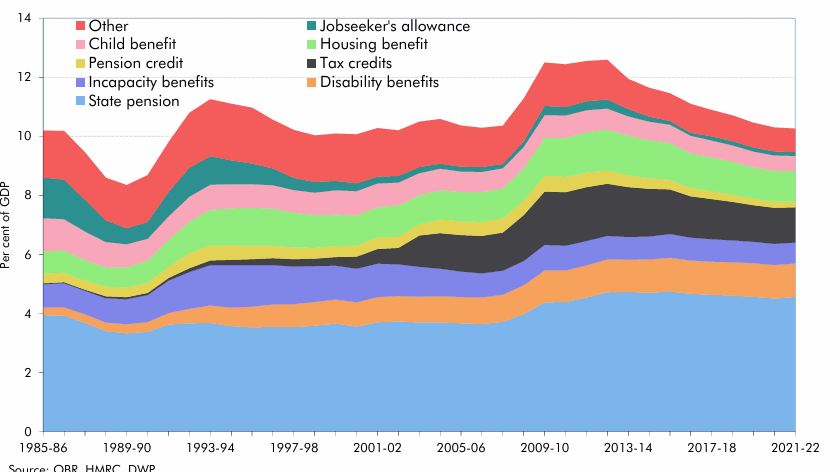
Now, we will obviously want to have a look at how Scripture has been handled here and I will do so late in another post. However, before we do that, we need to deal with a couple of important points of fact. First, there is no evidence that asylum seekers or immigration more generally is causing an economic crisis. We are not extending beyond our means and taking on an unfair share of the burden in responding to a refugee crisis. The UK does not even come into the top ten host countries for refugees.[1] Further, when it comes to the UK welfare bill, this has not grown significantly but rather has fluctuated between 10 and 12 % over the past 40 years apart from a period in the late 1980s when it dropped down to around 8%. Unsurprisingly the weldfare bill follows the economic cycle. It peaked between 2009 and 2014, following the 2008 credit crunch and resulting recession. The biggest portion of the welfare bill is the state pension and it is this that is expected to increase.[2]
Secondly, this may be surprising, but the UK actually saw healthy economic growth from 2010-2019, averaging around 2% each year. There was also strong growth after the pandemic although the economy slowed in late 2024. Remember that despite Gordon Brown’s claims to have ended boom and bust, economic growth tends to follow cycles. There were recessions at the beginning of the 1980s and 1990s as well as around 2008-2010. We were probably due for economic slowdown around about 2020 but this has perhaps been masked by the effective shut down of the economy during lockdown leading to a significant bounce back.[3] On a side note, it is worth considering that when you look at economic growth, inflation and deficit reduction that history will probably look more favourable on the Conservative’s record in office than the picture presented by their opponents and even some of their own.[4] It is perhaps more the case that the benefits of growth were not felt due to the pressures of austerity on wage growth intended to both reduce the deficit and guard against inflationary pressures that potentially would have been reintroduced through quantitative easing as a solution to the credit crunch. Additionally, the tax burden has increased significantly.

Thirdly, the budget deficit peaked at about 10% of GDP and had been brought down to 2% in 2019. It then shot up again during the pandemic but has been reducing downwards since, although there are question marks about how the current government’s overall agenda is affecting that.
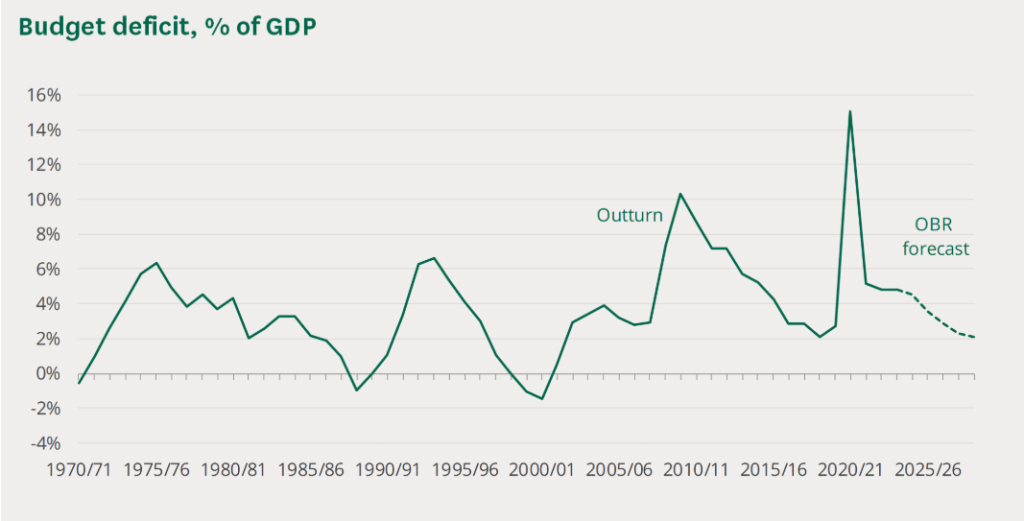
What is notable is that for my lifetime, it has been rare for the UK government to run budget surpluses. What this means is that year on year, the deficit has been growing and it is that which creates a potential challenge and leaves the country vulnerable. The UK does have a debt problem and that does, in the view of some economists risk further economic challenges ahead.
However, note two things. It is not a case of great prophetic insight to suggest that we might be due an economic downturn. It would be more prophetic to spot those times in the cycle where the period of growth is extended. Furthermore, the economic challenges we face have nothing to do with asylum or immigration. Indeed, immigration has over the years contributed to economic and social well being with immigrants providing labour in key areas and notably contributing significantly to health care. There has of course been a tradition of blaming immigrants for challenges in terms of housing but again, there are numerous other factors to consider including the impact of house price inflation (the kind of inflation that middle class home owners consider positive) on the affordability of housing and additionally long term challenges regarding the provision of social housing.
In a further post we will check what Wickland has to say theologically but it is important to state first of all that not only do the claims he makes lack evidence but they go against the evidence we have.
[1] Which countries are taking in the most refugees in 2025?
[2] An-OBR-guide-to-welfare-spending-Bud-17.pdf
[3] United Kingdom GDP Annual Growth Rate
[4] Liz Truss in particularly painted a far bleaker picture of the situation with regards to growth
 Faithroots