
I’ve been picking up recently on the responsibility of elders to shepherd the flock by leading them to shelter and pasture, by providing spiritual food and protecting from wolves. In a recent sermon, I mentioned that Mike Ovey, the late principal of Oak Hill once expressed his desire that theological training would help us to spot the wolves, not just when they are right on us but when they are far off.
The challenge of course then is knowing when to respond because an issue that we become aware of, perhaps these days because of the internet may be something affecting a church or movement over in the US or Australia, or even here in the UK but the reality is that the issue concerned is not going to affect our church or movement one bit. In fact, the way churches move in very different circles means that the people that one pastor hears about and that his congregation known about will be completely unknown to a pastor and church 5 minutes down the road.
So, I’ve wondered whether it might be helpful to think in terms of a kind of spiritual health and safety risk assessment. I would keep it simple and perhaps plot where an issue sits on a matrix that looks a bit like this:
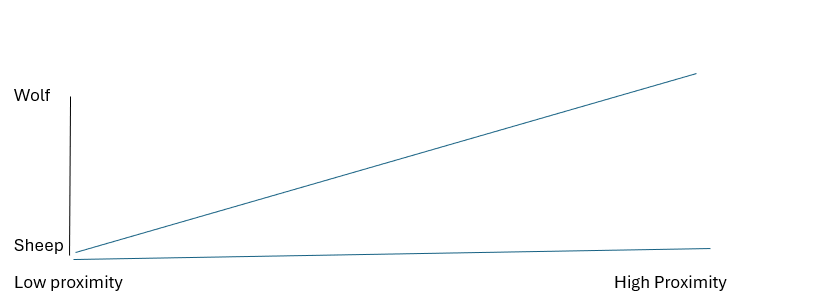
Once we’ve plotted where the issue sits, we can then think in terms of what to do next. This will range from one end of the spectrum where you have an issue that seems clearly to be about sheep and has a low proximity connection to our church should just be left alone. Don’t waste head space on it. Then at the other end of the spectrum, you have situations where wolves are right at the door and you need to act quickly to warn and protect the church. Other situations will sit somewhere in between and it’s best to keep watching, keep investigation and reassessing what response if any is needed.
 Faithroots