
One of the intriguing and saddening things about the Sam Allberry case, is the way in which he has come under fire from both the theological right and the left. I’ve dealt with previous posts with the attacks from the right. However, this from the theological left came up the other da in a comment on Premier’s Facebook post about Allberry.
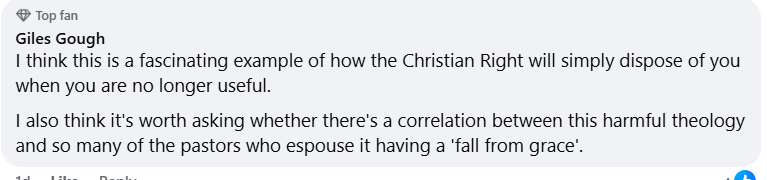
I asked the poster what exactly was the dangerous theology that Sam Allberry was promoting. He responded with the following.
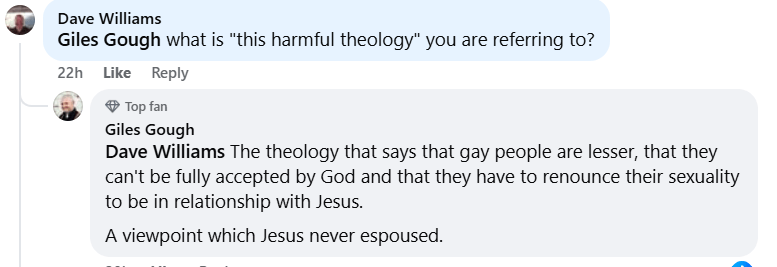
It is worth noting that Sam Allberry ‘s theological position doesn’t come anywhere close to this. Sam would recognise all human beings as equally made in God’s image. This would be the position of all reformed evangelicals.
Secondly it’s fascinating that Sam is being attacked by one side for renoincing his sexuality given that the other side are attacking him for apparently making his sexuality part of his identity and refusing to repent of it. Both criticisms surely cannot be correct.
Perhaps we would do well at this stage to pause and think about what the argument actually is. The most helpful way of doing this might be to take the word “sexuality” out of the conversation for a moment.
The reformed position is that we are all equally made in God’s image. Sin means that the image is marred or corrupted. We talk about this in terms of “Total Depravity” meaning simply that son and death affect every aspect of our identity. Indeed, Scripture goes so far as to say that we were dead in our sins.
When Jesus died on the cross, he took our guilt and shame upon us so that he “became sin for us” and in Christ, God judged sin. The result is that those who believe are made right with God, they are justified because Christ’s righteousness is credited to us just as our sin was credited to him. The consequence of this is that we are raised to new life (regeneration) by the Holy Spirit.
Our hope is for the day when Christ returns and we are physically raised to life. In the meantime we live in a now and not yet context. Reformed Christians recognise that there are tensions here in that we are “new creations”, we are forgiven, we are justified and yet there is still more to come. We talk in terms of sanctification meaning that there is a need to grow into our new identity as saints. This means “saying no to sin” or putting sin to death and “saying yes to righteousness” or training to be godly. This means that we recognise that there are still ways in which fallen nature has an affect on our lives.
The recent debate amongst reformed evangelicals over concupiscence has been to do with this with some arguing that our desires as an aspect of that fallen nature are therefore sin to be repented of. Others have argued that it functions more like an alien interloper and therefore is to be resisted but does not need to be repented of because it is not sin in the sense of our own defiance and disobedience against God.
Allberry sits more in the second camp and that’s why he has taken quite a bit of flack. His understanding, from what I’ve read from him is that sexual orientation and sexual attraction are not in themselves sin but an aspect of that desire which tempts us.
Does that mean, for Allberry that those things have to be renounced, well in a sense, yes and no. Yes because they are to do with our fallenness but no because there is a complexity to our now and not yet identity. It is not so simple as to say that your desires are evil and sinful and that your identity is sinful and evil in Christ.
Coming back to the specific question of sexuality now. This means that there are aspects of my sexuality that are expressions of my desire for intimacy, recognition, security, comfort etc. There’s the desire to love and be loved, to know and to be known, to care for and be cared for. However, there is also the desire to seek distorted versions of those things and to seek them in the wrong way, the wrong place and at the wrong time. I understand that Allberry would be arguing that this is true for heterosexual and for homosexual people.
So, does a homosexual man have to renounce his sexuality to follow Christ? Well, yes he does. Guess what, so too does an heterosexual man. You see both of us need our sexuality and the desires that come from it to be reordered where they are disordered. This means that both the heterosexual and the homosexual man recognise that our desires are truly met in Christ and that he will meet them through one of two means, either through marriage between a man and a woman or through celibacy unless or until we are married.
And it’s important to recognise that gift of celibate singleness is really all about. Some contemporary rhetoric treats it as a special, magical or mystical removal of all sexual desire and so beleive that this is a gift for a few people but everyone else should be married. This gets translated into the belief that same-sex attracted people should also be permitted to find sexual fulfilment in the context of gay-marriage. However, the reality is that marriage itself is not some kind of magical gift that removes all struggles and temptations. In the same way, singleness is not a magical gift, rather it both are simply the opportunity that God gives us to live for him and grow to know him more and more whether in marriage or singleness.
I’ve been encouraged to see single Christians such as Dani Treweek making the case for a positive vision of singleness. One of her arguments is that Jesus presents marriage as a temporary, this life possibility. Marriage is not for eternity. So, growth and re-ordering of desires for the single person, gay or heterosexual is that growing awareness of how Christ will meet our truest desire in eternity.,
I hope that this helps to reframe the conversation. I would be interested to hear from anyone who disagrees with me on this. Particularly, I’d be interested to know what is considered dangerous about such a theological vision.
In the meantime, I would ask all sides to step away from the temptation to fight theological battles vicariously through personal attacks on individuals including Sam Allberry.

