
A good few years back, we were just getting ready to baptise a couple of people when a spanner was thrown in the works. One of those getting baptised arrived and came to see me saying that they only wanted to be baptised in the name of Jesus because in Acts, it was always in the name of Jesus. We always used the liturgical formula “in the name of the Father, the Son and the Holy Spirit.” Well, he was baptised after a very quick Bible study and bit of theology,, From memory the person baptising that evening used the words “I baptise you into Jesus Christ, in the name of the Father, the Son and the Holy Spirit.”
The person getting baptised had picked up on some online stuff insisting that we should only be baptised in the name of Jesus and had arrived believing it would be sin and invalid baptism if any other formal was used. Well, I didn’t really think about that issue much more until the other day when I came across a social media post promoting that theory.
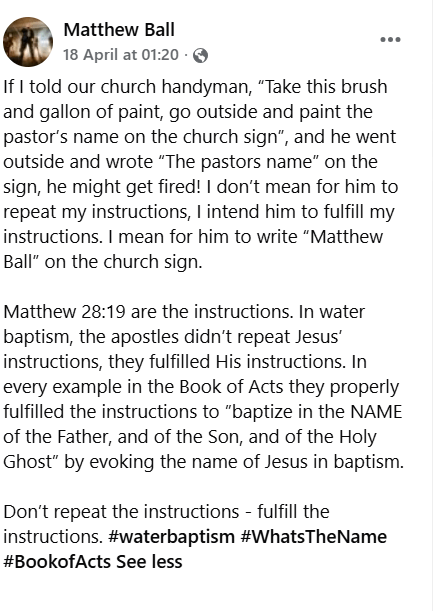
Now, I don’t think this is going to be the biggest challenge facing your church, it seems a fairly obscure minority position. However, the issues raised give us an opportunity to think through what is going on in those baptism formulas and to work through some Trinitarian theology too. So, even if you don’t get thrown this particularly curve ball anytime soon, I think there will be some helpful lessons for other issues to be gleaned from considering it.
What’s in or what’s into a name?
By way of preliminary comment, I don’t think that either Matthew 28 or Acts 2 are intended as set liturgy, so it is always a bit of a red flag when people become legalistic over such things. Rather, in both cases, the speakers (Jesus and Peter) are telling us what baptism does. Further, we should treat these comments exactly as they appear as condensed summary statements rather than as exhaustive descriptions. If you want to know about everything going on when someone gets baptised, you will need to look beyond Matthew 28:19 and Acts 2:38. This means also that when we look at those specific verses, we are only commenting on what they have to say.
For example, it is of interest that different prepositions are used in the two cited verses, εις in Matthew 28 and επι in Acts 2. In the name of, in Acts 2, with επι could therefore have a causative sense, “on the basis of”, note that there, the “into” in that case, is “into the forgiveness of sins.” That would fit with the sense that in Matthew 28, those discipling and baptising do so under the authority given to Christ. However, it is worth noting that elsewhere, such as in Romans 6:1-2, we are baptised with Christ and there is much imagery in the New Testament of our new life being “in Christ” so that it seems legitimate to me to talk about being baptised in or into Christ.
Meanwhile, εις can mean “in” or more commonly “into”. Whilst I guess there might be an argument for treating this as Trinitarian authority though it tends to be taken in the sense is more that we are baptised into the name, this means that we bear the name, we belong to God, we have his image again. We might talk about acting “in the name of” someone meaning we exercise their authority. I’d have to look further to see if the Greek phrases can have that sense.
In the particular post I’m looking at, the author argues that we are meant to fulfil the command to baptise into the name of by using the actual name rather than just repeating “in the name of”. To some extent, I sympathise with that argument. However, I don’t think he follows it through far enough. You see, the point is not just to discover what a name is in order to have a magic word. The point is what the name represents. Biblically, names signify something about the character and mission of the person named.
And that’s where he gets things wrong. The name of the Father, Son and Holy Spirit is not “Jesus”, that’s the name of the incarnate son. We are probably better meant to think of the name indicated here as YHWH. It’s the covenant name. Baptism whether you think of it as in Christ or into the Father, Son and Holy Spirit is into the covenant.
Jesus and the Name – Trinitarian wobbles
Given what I’ve said above, perhaps it doesn’t matter too much as to what we say in a baptism liturgy. If the person officiating gets nervous, forgets their lines and shouts “under you go then”, is the baptism any less valid? I would argue that they are very much valid. However, I ws keen to ensure that we used the Trinitarian formula when asked on that occasion and I believe it is wise to stick with it? Why, well it’s always helpful to pay attention to what people get hot under the collar about and the extent to which they get hot. It’s a bit like the way in which Jehovah’s Witnesses get passionate about Jesus dying on a stake, not a cross. Does the shake of the instrument of execution really matter? Apparently it does to them. That suggests something bigger is going on. So, if someone tells me that the person who baptised them only used the words “in the name of Jesus”, I am not going to start rebaptising them any more than if they thought their face was slightly out of the water. However, I am going to start asking questions when someone starts telling me that if I wasn’t baptised using the words “in the name of Jesus” and that I need to be re-done.
You see, when we look under the liturgical bonnet to see what is going on with the doctrinal engine, we tend to find some confusion. In the follow up comments to the original social media post, the following types of statement were coming up.

Regular Faithroots readers will be familiar with the idea that with the Trinity, we can have no denial of the one nature of God, no denial of the three persons and no denial of their equality. Arianism denied the equality and treated the three persons as having different natures. Modalism was, or rather, is, the heresy which emphasises the one nature but denies the real distinction between the persons and teaches that God only appeared in different forms. If God only appears as those different forms, then how can we truly know God? He becomes the puppet master, hidden away behind the scenes.
The Trinitarian formula that Matthew has given us gives us both the one nature as pointed to by reference to the name (singular). We are not mean to stick the person under the water three times in order for them to be baptised into the Father, into the Son and into the Spirit. At the same time it gives us the distinction between the persons, between the Father, Son and Holy Spirit.
This wording fits with what we know about God from Scripture. We know the Father sent the Son. Jesus would both talk to his Father and point to the oneness of Father and Son. Jesus promised that the Father would send the Spirit as another comforter after he had ascended to Heaven.
Conclusion
Whilst in one sense, the baptism formula we use doesn’t matter too much, it is helpful to use wording that conveys an accurate understanding of who God is and avoids misunderstandings, especially when other forms of wording may provide the means for ancient heresies to be smuggled in. What a glorious truth it is that when we baptise someone, we do so on behalf of, with the authority of Jesus. How glorious to know that we are declaring them part of the New Covenant and recipients of the life that the Triune God, Father Son and Holy Spirit gives.


1 comment
Comments are closed.