When the mask slips -the real issues with attempting to be a gatekeeper of English identity
It was the moment the mask slipped. I’d responded to a social media post objecting to the suggestion that we provide the option of “Black English” identity on the census form. I observed that I’ve got Northern Irish, Italian and German ancestry (Great Granddad Louigi being Italian and my Northern Irish Grandpa being known as Paddy through most of his life). Despite that mixed heritage, I never have my English identity questioned because I’m white. I got this response:
“Ancestry means more than the colour of your skin. Just because the neighbour’s kid looks like me, doesn’t mean he belongs in my house.”
I’d expected the original poster to back up a little, seeing the reasoning behind the argument of those wanting to change the classification, recognising the problem of implicit bias, people gert policed and asked questions purely based on their skin colour when others don’t I didn’t expect the poster to immediately and completely back down, just to evaluate and modify their approach in the light of new information. Instead, they doubled down. It was a shokj to realise that my own identity and the rights of me and my family, my elderly father, my sister and her husband (himself the child of a German POW who fell in love with an Englishwoman and stayed, my niece and nephew and so on to live in our country and to identify as English. That’s the position we’ve reached. It leaves one wondering “how then will we be identified? Is someone going to come round and give us a little badge to wear, maybe as it’s near Christmas, a little yellow star will do it?
The challenge is harder because actually identifying a pure English ethnic identity gets trickier. Here’s a breakdown of ethnic mix for the average English person across the UK that I shared on Facebook.
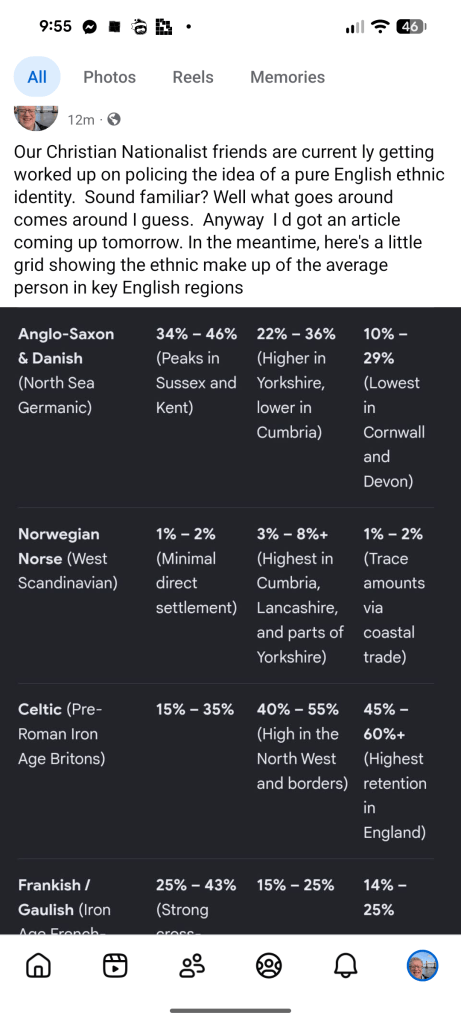
You will notice that Danish is included in with Anglo-Saxon despite the Danes today identifying more with Scandinavia. It turns out it is a little trickier still when unbundling an identity, Danes, Jutes, Angles and Saxons occupied the same area for some time and intermixed. Be that by the by, it’s still a shock to discover your own identity is under review by the ethnic gate keepers.
However, the reality is that even my own reaction should convict me. I say that the mask slipped when it became personal to me, when the ideology started to create the need for identity markers to work. However, the mask slipped in the first move. That’s why I’m concerned at the increasing way in which Christians seem to be joining in with questioning national identity in support of a Christian Nationalism that is becoming more and more overtly ethno-nationalist.
Here is Aaron Edwards writing on his Substack. He starts with a question
“What is the national identity of England? Why are people so confused about it? Is Englishness something you can simply identify with? Is Britain really just an idea or a set of values? In the long term, can we realistically expect the newer arrivals into “multicultural Britain” with no shared ancestry to care about those who fought and died to keep Britain “free”?
I could be wrong; you’ll need to read his article to the end but that does seem to be a pessimistic starting point. Buckle in though, it’s a long journey through his article. Edwards goes on to say:
“National identity continues to be very much all the rage. Following the recent public debates over who is or isn’t “English,” a new bill has been proposed to expand the official census categorisation of Englishness to include wider categories like “Black English” and “Asian English”. Of course, what this really means is to dilute and essentially eradicate the meaning of “Englishness” per se.
If the bill is successful it would mean there would no longer be such as thing as “English” by itself; it would instead require some kind of racial qualifier which would henceforth render Englishness a radically different thing altogether. As I highlighted in a previous article, it’s difficult to see such ideas any other way than as contributing to the definitional erasure of the very idea of that people group.
That’s quite the alarmist rhetoric and doesn’t really make much logical sense. First of all Edwards misses the purpose and effect of the bill. The purpose is to deal with the exact issue I raised above, it is to prevent the exclusion of people based on skin colour. Secondly, It’s effect is specifically to provide census categories. Those categories already allow for sub-division within British identity without us losing British identity. I can already be British and English, British and Scottish, British and Welsh, British and so on. I can also be working class British or middle class British and yes I can be Black British. The bill will not mean that there will no longer be such a thing as “Englishness” itself. This is simply not the case.
Edwards goes on to engage with the football analogy that has been increasingly used in the debate.
“One of the MPs promoting the bill, the Liberal Democrat President, Joe Babarinde, said:
“I’m a proud Englishman and Englishness is about more than the colour of your skin. Most people in this country already agree that you don’t have to be white to be English. Just look at the England football team. But our census hasn’t properly caught up.”
I have a few observations on this short but bizarre statement.
For starters, why should the Football Association’s criteria for whether a player is eligible to play football for England be allowed to change the official definition of Englishness? Even if you think people with no English ancestry should be allowed to be English, surely it should be obvious that this is not the way round it’s supposed to work? I suspect the use of the idea of the England football team is a deliberate political ploy, capturing a popular frame of reference familiar to the average person which likely nudges them to think it might be ludicrous to suggest that some of the “England” players are not officially “English”. Who wants to be caught saying that out-loud these days? And yet, the whole point is that—officially speaking—this is, in fact, the case!
That’s precisely why such MPs trying to adjust the nationality definition so that the indigenous (white) people with ancestral links among the people of this land which stretch back thousands of years are deemed to have no greater claim to being English than people whose familial connection to England is exclusively within the last several decades and whose actual ancestral links are rooted somewhere entirely different. “Why do you care?” says the white multiculturalist, well-drilled to see any attempt to defend the category of white people as a covert form of racism. Well, there may be many reasons to care about it, but even if you don’t, the question remains: does the national census really need to “catch up” with the England football team?
One of the possible criteria that enables you to play football for England is simply to have been in education here for 5 years while under the age of 18. In such a scenario, you could be 100% non-English in every other respect and yet still potentially “represent” England for your whole life. Another criteria is having a grandparent who happened to be born in England, regardless of however long they lived here or whether they had any ancestral connection to the nation whatsoever. This means that if a couple happened to be on holiday in England while their baby was born—even if they left for their home country the very next day and lived in their home country for the rest of their life, not even learning to speak English—if that baby grew up and went on to have a grandchild, that grandchild would be eligible to represent England.
Even if it’s unlikely that such a person would want to play for England, it seems beyond ludicrous that they would be eligible to play for a country without any genuine familial connection whatsoever. We all know such a system sounds a bit mad, but we don’t really mind that much because we tell ourselves it’s only football and it’s probably just the odd chancer or two here and there who at least has some connection to the place, and if they’re really good then supporters of a national football team are unlikely to kick up a fuss about the dilution of their nationality if it’s helping their nation win… But then the politicians come along and start saying, “We need the census to catch up with the football!” and all of a sudden Englishness is available to anyone who really wants it, and all of a sudden “England” is not winning at all.
As is often the case with such arguments, Edwards has half a point here. Of course, English identity cannot come down to technicalities. There is clearly something more required just as the fact that I could more than meet the very criteria he identifies doesn’t turn me into an international footballer, just indeed as it might be possible to meet the entry requirements for plenty of church memberships without necessarily being truly as Christian. However, Edwards is talking in terms of norms and this undermines his argument. You see, we do have norms for understanding the distinction and they are nothing to do with skin colour or DNA. Let me give two examples. First of all, we don’t consider Thomas Tuchel to be English, even though he manages the team. I wonder whether we would have considered Chris Kamara to be a genuine English manager if he had put his name forward? Secondly consider the case of the Irish national team in the late 1980s. Managed by Jack Charlton, an Englishman, he exploited the eligibility rules to the maximum to bring in a variety of players who turned out to work well as a team together but individually would not have perhaps made it into their more obvious national sides. Some players were considered more obviously Irish. The point is that we could recognise that there was a question mark over the Irish identity of his side whilst not questioning the Englishness of the current England Team. There is a norm which enables us to make the distinction.
This matters because we see what happens when we lose that sense of agreed shared identity. We sometimes joke that Andy Murray was British when he won at Wimbledon but Scottish whenever he went out in the early rounds. On a darker note, we saw what happened with the lionising of young black footballers when they were playing well, scoring goals and taking the teem forward. However, when they did the ultimate of English cultural things and missed penalties to prevent England going through, those young black players were quickly subjected to serious racial abuse and othering. Their identity became subject to question in the most malign of manners.
Before we move on, I want to pick up on another important point. Edwards argues that it would be absurd for the football criteria to cause a change in the official definition of Englishness. Here’s the thing, there is no official definition There are a number of dictionary definitions which simply say that it means “of or belonging to England”.
It may be that Edwards is thinking of the House of Lords case Mandla v Dowell Lee [1983] 2 AC 548 in that case, the Lords offered some characteristics of ethnic identity. The leading judge, Lord Fraser found that in terms of the Race Relations Act, a racial group was identified by shared history and culture. Geographical origin was considered relevant but not essential, Crucially, membership of a group was possible through adherence and acceptance. It is worth noting that the findings do not do what Edwards and others want to do in that they explicitly allow for inclusion through those means.
It is also important to note two things. First that the Lords were not offering a tight and exhaustive definition but description of potential characteristics. Secondly, they were not seeking to answer the question “who is included and how?” but rather “what are the characteristics of the racial group.”
This means that further consideration is needed and crucial to that is the question of what we mean by sharing history. This is where Edwards’ question about Remembrance Day becomes important. Edwards observes (and I will quote him at length).
I had not realised before just how seriously it is taken in the area of the part of the north of England where we are, and the way locals tend to approach it brings several things into sharper focus.
Where we were, there were several hundred people in the streets, gathered around the monument for the laying of wreaths, led by a grand procession of cadets and veterans.
Does it matter that everyone there was white? Well, it only doesn’t matter if the particular people being remembered don’t matter, because the sacrifices being commemorated are sacrifices made for England at a time when the population was almost entirely white. I noticed the same thing in London the week before when the Royal British Legion were selling poppies at various spots around St Pancras station, and had a choir of around a hundred women singing old songs with a conductor. All these women bar one, I think, were white. Again, why would the non-white British not flock to Remembrance Day in such places? Probably because they do not feel the connection to it the same way white people do because they don’t have grandparents or great-grandparents who fought or died for this country, given that most of the “multi-ethnic” populations of modern multicultural Britain arrived in this country after the Second World War.
I’m sure there must be some areas (Birmingham perhaps?) where non-white British people are more represented at Remembrance Day events, but probably more as joining in with a general sense of remembrance for their own familial forebears who died in the wars, or perhaps in service of the British Empire, rather than “for England” or “for Britain”. Nonetheless, I suspect that the reason the DEI metrics don’t usually apply on Remembrance Day is because it shines a light on what national loyalty really means in a way that is inescapably linked to the people you are connected to who came before you, which by default does not include the majority of non-white British people. So we can keep pretending race or ethnicity is entirely irrelevant to national identity if we like, but the reality of Remembrance Day doesn’t lie. The people who do or don’t care about it don’t lie.
Indeed, where we were for the wreath-laying, the crowd was gathered across a main road, with several surrounding roads closed off for the afternoon. A couple of times I noticed foreign men, usually of Middle-Eastern descent—perhaps proprietors of the abundance of takeaways or hairdressers in the town—would bustle their way through the crowd to carry on walking up the road, sometimes showing deliberate disdain for what was happening, as if the remembrance was just an inconvenience to them. Another man did this during the two-minute’s silence itself, refusing even to stop and wait until it was over, busily bustling his way through to the other side amidst the silence. Dozens of older heads were visibly upset by this and you can tell they would not have found it coincidental that the man was clearly not “English”.
Were all those turning and tutting heads “racist” by discerning a correlation between those men’s actions and their ethnic ancestry? I don’t think so. They just felt profoundly dishonoured as a people, and perhaps hoped that those who had been welcomed into this country off the back of those who fought to keep it free, might have shown more respect. But once again, why would they? For so many such people, was their principal attitude in deciding to come here or stay here because they thought, “I love England; I want England to flourish; I want to respect its customs and culture and people; I want to honour those who made it what it is”? Or was it something far more pragmatic, using the economic advantages of the country for what they can get from it rather than what they can give to it?
I do not pretend to know the thoughts of all such men as those who bustled past, or the many more who did not turn up or give any thought to it at all, but I wouldn’t bank on “seeking the good of England” as having been the primary motivation for most. It’s not even that such people should be demonised for this, necessarily. Many of them simply should not be here. That’s the reality. And so you can’t say multiculturalism is great and then expect all the new cultures to give greater precedence to the host culture. That’s never how it works. It would be highly unusual for foreign people to care to the same extent about the deeds of ancestors who are not their own. That’s why ancestry really does matter to a nation, a people. How much should it matter? How far back should it start mattering or stop mattering? Well, those are questions that can be debated, but they are not questions that, in lieu of precise answers, should make us avoid the reality of national identity which most people “feel in their bones”.
I want to make a few initial observations on this section. First of all, my understanding is that Edwards lives in Derbyshire. I’m not surprised by the ethnic make up of the gathering which would reflect demographics. Secondly, he has turned the Remembrance observation into an essential nationalist, patriotic event when the organisers have historically insisted it is not and explicitly have included Commonwealth countries in. Edwards seems to be confusing Remembrance Day with the kinds of Armed Forces days that some countries have and which has been introduced as a separate occasion here. There is a clue here, November 11th is strictly Armistice Day, it marks the end of the First World War. We have V Day and VE Day to mark victory in the Second World War and yet, Armistice Day has become recognised as a day to remember much more than the end of the Great War and those who fought in that specific war even though the timing and emblem are closely associated with that. Nowadays, we remember those involved in Korea, The Falklands, Iraq (twice) etc. We honour not just the armed forces but the auxiliary services too.
Thirdly, Edwards says that he won’t try to second guess people’s thoughts but on three occasions he does just that. He assumes a racial dimension to the tut tutting of the elderly bystanders and then legitimises it but would they not have tutted if a young English lad had wandered through? I suspect they would.(and I’ve been at Remembrance observations where there has been thoughtless disinterest from white people. I suspect the challenge is generational one rather than an ethnic one. How do we encourage this generation to keep remembering.
He then makes assumptions for the motives for non white people attending events in Birmingham and he assumes the thoughts and motives of those people walking through. It is of course possible that they had not cottoned on to Remembrance Day and saw it as an inconvenience. It is possible that sadly, some people associate the event with the kind of nationalism that tells them they are not welcome through flags, demonstration and racist comments.
Crucially though, Edwards is assuming that to share the history, you have to have lived it. Now, if that is the case, then we probably might as well give up on trying to get teenagers to stand for two minutes silence and wear a poppy. You see, the truth is that a 50 year old man who was born in Birmingham and whose parents were from Pakistan has lived the same shared experience of English heritage that I have and much more than a thirty year old white person.
This has broader implications. First, my experience is that often those who are newer to a culture will want to get to know it, to share it to live it. I’ve found Africans and South Asians keen to take Remembrance Sunday just as seriously as I do out of respect for their new culture and indeed out of a cultural respect for their elders often lacking in the host culture. I suspect that if I moved to the USA I’d join in with Thanksgiving and 4th July with the same enthusiasm. Indeed, I’d be positively encouraged to.
This is getting to the heart of identity where it matters. Again there are darker, weightier matters. More personal biography. Four years ago, we met our daughters. Coming up to three years ago, we officially adopted them. I can tell you that our girls have absorbed themselves in our family traditions, they share the same jokes, they often show the same mannerisms. Not only that, it goes deeper, they want to know and honour our family history. They love Nanna and Grandad. They miss and mourn a Grandma and Grandad that they never actually met and insisted on coming to Grandma’s grave to lay a wreath last Christmas and of course they did not quite get everything in perhaps they way Granddad would want time at the grave to be observed. Grandad did not push them away though. Why, because he knows they are young children who struggle to be some where still for long and found the emotion of our time there heavy to bear. By the way, Aarón does not allow for that latter possibility. I worry though that there are those who if they follow their logic through would want to tell our girls that they aren’t really part of our family, it’s not a real family, they don’t belong.
This matters further because we come into God’s kingdom, into his family through adoption. We all were aliens and strangers, the Gospel brought us near. I’m beginning to wonder if Christian Nationalists grasp that. It does not matter if your parents were Christians and your grandparents, you belong because Jesus died for you, the Father welcomes you.
And it is interesting to remember that whilst Aaron spends most of the article attempting to identify who to exclude from being English based simply no the colour of their skin, the article is meant to be arguing that what matters in terms of Englishness is Christian identity. So Edwards insists, though he hasn’t really given space to arguing it that:
“To seek the preservation of England is not just the preservation of a race, of course. It’s not really a choice between Christianity or ethnicity. To fight for England is to fight for Christianity in England, not merely because it is the religion of our forebears and the basis of our laws and morals and monarchy, but because it is itself good, true, and beautiful, based not upon political whims of this or that generation but upon the one who is “the same yesterday, today, and forever” (Heb. 13:8), the One who called himself “the way, the truth, and the life” (John 14:6), and the One who ultimately wants to “let the nations be glad and sing for joy” (Ps. 67:4).
There is a dilemma here that leaves his case potentially unstable and inconsistent. Does Edwards want to insist that the true thing we are patriotic for, that we want to protect are specifically Christianity. I’m sure we can say a hearty amen at least to that. However, then what makes this specifically English? Edwards must acknowledge that this is not a uniquely English thing, that rather all Christians can share in it. O he must conclude that the Englishness/Christianity match is such an exact fit that being Christian means to be English and being English means to be Christian. That leaves us asking where that leaves the many Christians throughout history and form around the world have had a completely different ethnic and cultural identity.
And it brings us to a critical question. Edwards has been challenged by a fee people to describe what he means by “Christianity” What is it exactly that he wants the country to be shaped and influenced by. His stock answer is “Just Jesus Christ”. Which is ironically how a liberal, a prosperity teacher or Catholic would say. Yet I’m sure he would agree that if those people so redefine the Gospel and Jesus, then we can’t say it is Him.
I started writing concerned about how Edwards understands English identity but the more important question is how he understands Christian identity and Christ’s identity.

