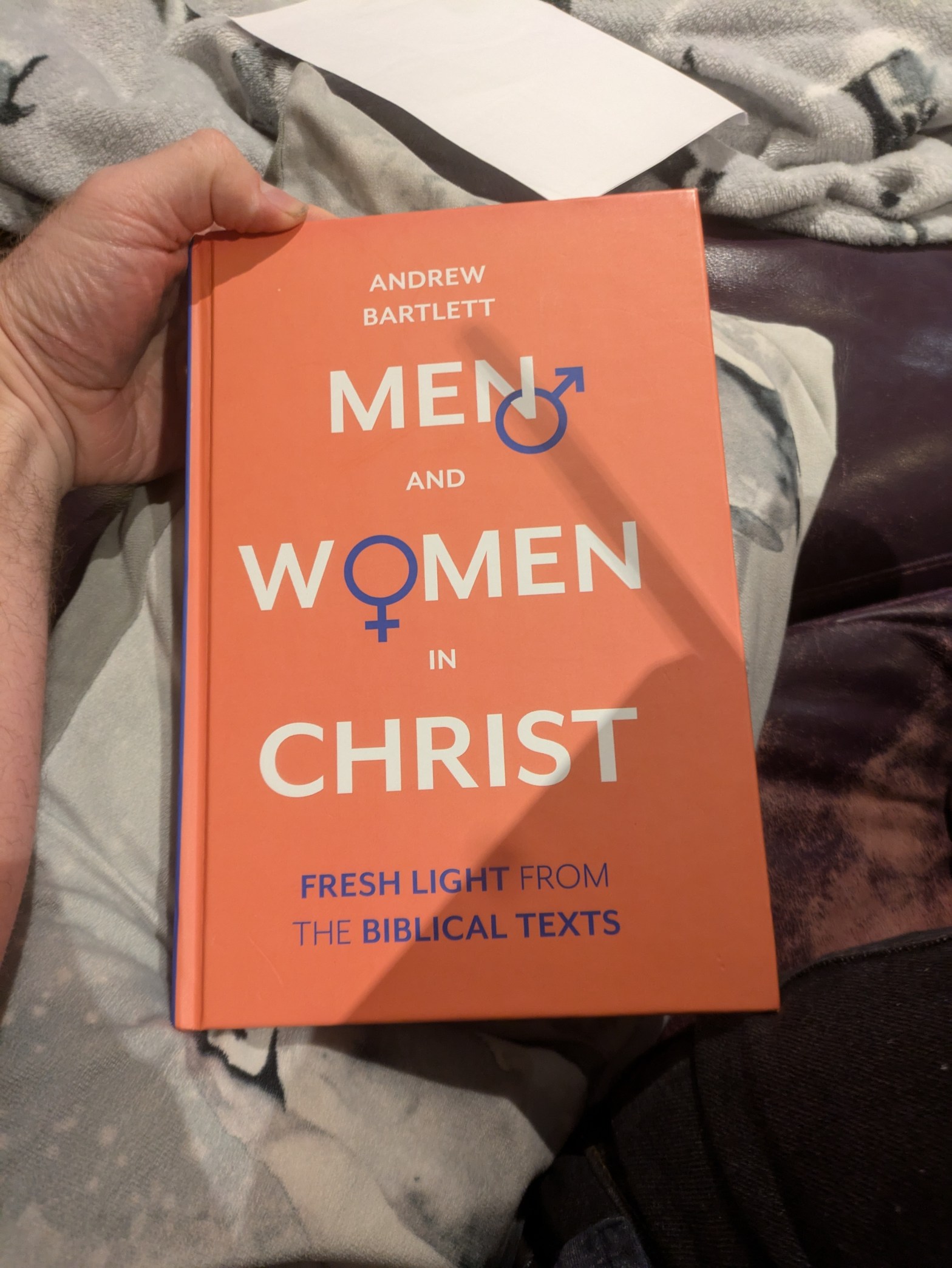
This is a guest post from Andrew Bartlett, author of “Men and Women in Christ”. I’m currently writing a series of articles engaging with his book and Andrew has kindly agreed to engage in response. I don’t intend to have a lengthy back and forth on each section but my plan is to publish his responses in full. I will respond again if there is something to pick up but that should not be treated as the last word on the matter! This response is a little out of the runnig order but I’m trying to stick with the order of Andrew’s responses to me
I am extremely grateful for Dave’s stimulating thoughts on the question: How novel is complementarianism? They have sent me back to the sources to review the whole question. This has helped me to think through how to explain it more fully.
Complementarianism, as a system of thought, was developed in the latter part of the twentieth century. The seminal complementarian source book Recovering Biblical Manhood and Womanhood explicitly offered “a new vision” – one that was “not entirely the same as the ‘traditional view’”, and which was said to “correct the previous mistakes” (1991, pp10-11).
As I see it, there are three features of complementarianism which are most significant for understanding the ways in which complementarianism is novel.
The first feature is
(1) rejecting the traditional majority view that women are inferior to men in rank and nature, and holding that men and women are equally in the image of God.
In the founding statement of complementarianism (the Danvers Statement), the first affirmation is: “Both Adam and Eve were created in God’s image, equal before God as persons …”. This feature is shared with egalitarians. In itself, it is not new. Throughout church history, minority voices have disagreed, partly or wholly, with the view that women are inferior to men in rank and nature, and are not as fully in the image of God as men. I will provide a few examples in an appendix at the end, under the heading SOME HISTORICAL EXAMPLES OF REJECTING THE TRADITIONAL MAJORITY VIEW.
The second feature is
(2) justifying the subordination and restriction of women, as being consistent with feature (1), by offering an analysis in terms of ‘roles’.
This new analysis is reflected, in part, in the second affirmation of the Danvers Statement: “Distinctions in masculine and feminine roles are ordained by God …”. In the approx. 480 pages of Recovering Biblical Manhood and Womanhood, the new term ‘role’ appears more than 700 times. I will explain more about the concept of ‘roles’ below, after examining Dave’s comments about Augustine, Calvin and Matthew Henry.
The third feature is in a different category from the first two, because it remains internally disputed within complementarianism. It is challenged, in varying degrees, by a weighty minority. The third feature is
(3) a belief that definite restrictions on women’s ‘role’ and activities apply only to marriage and to church leadership, and not to society at large, so that it is acceptable for women to take leading roles in public life, whether in politics, business, academia, or otherwise.
Perhaps because of internal dissent, the Danvers Statement makes no specific comment on the propriety or impropriety of women’s leadership in society. This third feature is a radical departure from the traditional majority view, which largely confined women to the domestic sphere and considered women’s leadership in society to be unnatural, improper and unwise. As John Knox put it, in 1558:
“Who can deny but it is repugnant to nature, that the blind shall be appointed to lead and conduct such as do see? And . . . that the foolish, mad, and frenetic shall govern the discreet, and give counsel to such as be sober of mind? And such be all women, compared unto man in bearing of authority. For their sight in civil regiment [government] is but blindness; their strength, weakness; their counsel, foolishness; and judgment, frenzy, if it be rightly considered.” (First Blast of the Trumpet against the Monstrous Regiment of Women)
AUGUSTINE
I consider that Dave is mistaken in regarding Augustine as contradicting the novelty of complementarianism. Augustine viewed women as inferior, and – as necessarily follows – he never used the language of masculine and feminine roles to justify women’s subjection as being consistent with their equality.
Dave interprets Augustine as not seeing a difference between men and women as regards their “mind/soul”. I am not persuaded that is an accurate interpretation of Augustine’s thought. When Augustine says, in the passage cited by Dave, that woman has a rational mind, Augustine does not say that a woman’s mind is as good as a man’s. In the quoted passage, Augustine is acknowledging that women have minds which are able to reason, not that their minds are the equal of men’s. And where he says, in respect of woman’s mind, that “she too was made to the image of God”, he does not mean that women are in the image of God in the same full sense as men (see below).
In general, Augustine regarded men as far superior to women in their minds. He makes this clear in multiple places in his writings. As he saw it, the sole purpose of woman being made as man’s helper was for procreation – it couldn’t be that the mind of the archetypal woman would make her a good companion:
‘If it were not the case that the woman was created to be man’s helper specifically for the production of children, then why would she have been created as a “helper”? Was it so that she might work the land with him? No . . . a male would have made a better assistant. One can also posit that the reason for her creation as a helper had to do with the companionship she could provide for the man. . . . Yet for company and conversation, how much more agreeable it is for two male friends to dwell together than for a man and a woman! . . . I cannot think of any reason for a woman’s being made as a man’s helper, if we dismiss the reason of procreation.’ (De Genesi Litteram IX 5.9, 7.12, cited at p87-88 of my book.) (And he makes this point again at 11.19.)
To his way of thinking, a woman was unsuitable for companionship to a man. Even in God’s original and “very good” creation, the mind of woman was of small intelligence. This was part of Augustine’s explanation for the fall:
That a man endowed with a spiritual mind could have believed this [the lie of the serpent] is astonishing. And just because it is impossible to believe it, woman was given to man, woman who was of small intelligence and who perhaps still lives more in accordance with the promptings of the inferior flesh than by the superior reason. (Literal Commentary on Genesis 11.42; cited at p5 of my book)
In his own life, when confronted with the phenomenon of an intelligent woman, Augustine reconciled her existence with his beliefs by characterizing her, anomalously, as being almost like a man. So, for example, when he praises his own mother’s “philosophy”, he says that she rises “above her body” and speaks “unmindful of her sex”, so “we might think that some great man was seated with us” (De Beata Vita, 10). Similarly, he described her as “virile” (manly) in her faith (Confessions, Book 3). In Augustine’s thought, if you were a woman, spiritual or intellectual progress in this present life was to become more like a man and less like a woman. Yet he viewed a woman’s progress in wisdom as an anomalous exception to the general condition of man and woman, whether before or after the fall – the general condition in which, as he put it: “He is ruled by wisdom, she by the man.” (Against the Manichees Book 2 chapter 11.)
As regards the extent to which women were in the image of God, Augustine wrote:
“the woman together with her own husband is the image of God, so that that whole substance may be one image; but when she is referred separately to her quality of help-meet, which regards the woman herself alone, then she is not the image of God; but as regards the man alone, he is the image of God as fully and completely as when the woman too is joined with him in one.” De Trinitate, XII, 7.10. (cited at p5 of my book)
Complementarianism has rightly rejected Augustine’s view of woman as being of small intelligence, and not fully in the image of God.
CALVIN
I consider that Dave is mistaken in regarding Calvin as contradicting the novelty of complementarianism.
Like Augustine, Calvin considered that woman was not in the image of God in the same way as man, but only (as Calvin put it) “in the second degree”. Calvin says this in his Commentary on Genesis, in the section on Genesis 2:18-24, part of which Dave cites. This is contrary to the complementarian belief that men and women are each fully in the image of God.
Dave cites Calvin as saying that “Moses intended to note some equality.” This is in Calvin’s discussion of the phrase ‘a helper corresponding to him’ in Gen 2:18. But we can see what Calvin meant by the qualified expression “some equality” when he revisits this topic in his Commentary on 1 Timothy (cited at p6 of my book, referring to 1 Tim 2:13):
Now Moses shows that the woman was created afterwards, in order that she might be a kind of appendage to the man; and that she was joined to the man on the express condition, that she should be at hand to render obedience to him. (Genesis 2:21) . . . . God did not create two chiefs of equal power, but added to the man an inferior aid.
This is quite unlike the complementarian belief that men and women are inherently equal as persons. It is an acceptance of the traditional majority view that women are inferior.
Dave says: “I have written previously about how Calvin holds to a form of mutual submission in his interpretation of Ephesians 5.”
In regard to this, the first thing to note is that Wayne Grudem, co-founder of complementarianism with John Piper, rejects mutual submission between husband and wife (Evangelical Feminism and Biblical Truth, 188-199). He has been followed in this by other prominent voices in the complementarian movement, such as Andreas and Margaret Köstenberger (God’s Design for Man and Woman, 160) and Kevin DeYoung (Men and Women in the Church, chapter 5).
Some complementarians do accept some form of mutual submission in marriage. But Calvin’s interpretation of Ephesians 5 is a long way from any ordinary understanding of mutual submission. This is seen in the explanation that he gives in his Sermons on Ephesians. His general idea is that submission on the part of those who are ruled consists in obedience, whereas in the other direction ‘submission’ on the part of the rulers consists in serving the ruled by ruling over them. In the particular case of marriage, submission on the part of the wife consists in obedience to the husband’s rule, while ‘submission’ on the part of husband consists in caring for her while he rules her. He says:
‘For is it not a subjection, that the husband bears with his wife’s frailty, and has the wisdom not to treat her strictly, holding her as his companion, and taking upon him a part of her burden, both in sickness and in health? Is that not a subjection? Yes.’ [Golding’s translation, 1577, modernised]
But the straightforward answer to Calvin’s question is ‘No, it is not!’ To care for one’s wife and treat her as a companion, while ruling over her, is outside any known meaning of ‘subjection’ or ‘submitting’, and this is as true in the original Greek of Ephesians 5 as it is in the English translation of Calvin’s French sermon. Calvin’s exposition empties mutual submission of its meaning.
So far as I am aware, Calvin does not use the term ‘role’ in regard to women anywhere in his writings. Any analysis of women as being inherently equal with men, and being subjected to men merely as a ‘role’, would be in conflict with his view of women’s created inferiority. This is particularly clear in his Commentary on 1 Timothy (cited at p6 of my book, referring to 1 Tim 2:12):
There is no absurdity in the same person commanding and likewise obeying, when viewed in different relations. But this does not apply to the case of woman, who by nature (that is, by the ordinary law of God) is formed to obey; …
In Calvin’s view, woman’s inferior position is not a role but is inherent in her created nature.
Calvin would be aghast at the third feature of complementarianism. As regards women’s participation in leadership of society, Calvin considered there is no room for doubt. He is firmly on the same page as John Knox. For example:
… government by women has always been regarded by all wise persons as a monstrous thing (Commentary on Timothy, Titus, Philemon, 1 Tim. 2:12)
MATTHEW HENRY
I consider that Dave is mistaken in regarding Matthew Henry as contradicting the novelty of complementarianism.
In the passage cited by Dave, on a first reading it sounds as if Henry considered women equal to men as persons. Henry uses the very word “equal” – woman was made “out of his side to be equal with him”. But we need to inquire what he meant by this. What kind of equality did he have in mind – equality in what respect?
Did he mean that women were equal to men in rank?
It appears not, for Henry considered that women were made inferior by God. He gives two different explanations for this. One is that she was made inferior at the fall, the other is that she was made inferior in the original creation.
The ‘fall’ explanation is found in his Commentary, in his comments on Genesis 3:
She is here put into a state of subjection. The whole sex, which by creation was equal with man, is, for sin, made inferior, and forbidden to usurp authority, 1 Tim. ii. 11, 12. The wife particularly is hereby put under the dominion of her husband, and is not sui juris—at her own disposal, …
The ‘original creation’ explanation is found in his Commentary, in his comments on 1 Corinthians 11:8:
She was naturally, therefore, made subject to him, because made for him, for his use, and help, and comfort. And she who was intended to be always in subjection to the man should do nothing, in Christian assemblies, that looks like an affectation of equality.
In his comments on 1 Corinthians 11:3, Henry again emphasizes man’s superior rank and woman’s inferiority.
In his comments on Genesis 2:21-22 “out of his side to be equal with him”, did he mean that women were equal to men in their created nature?
Again, it appears not, for Henry views women as inferior to men in their minds. In a passage cited by Dave, Henry says, in regard to the man being the head:
The metaphor is taken from the head in the natural body, which, being the seat of reason, of wisdom, and of knowledge, and the fountain of sense and motion, is more excellent than the rest of the body.
In other words, in his created nature, man is more excellent than woman in reason, wisdom, knowledge, sense and motion.
Similarly, Henry wrote, as regards Eve’s created condition before the fall:
It was the devil’s subtlety, 1. To assault the weaker vessel with his temptations. Though perfect in her kind, yet we may suppose her inferior to Adam in knowledge, and strength, and presence of mind. (Commentary, Genesis 3.)
Here he interprets ‘weaker vessel’ (Peter’s term in 1 Peter 3:7) as including weakness of mind, not merely as an allusion to the differing muscle strength of men and women. (When Henry comments on 1 Peter 3:7, the only equality that he sees in that verse is that both men and women are ‘heirs of the grace of life’.)
Whatever Henry meant by “equal” in his comments on Genesis 2:21-22, it was not equality of rank or of nature. So, it seems that he held his own version of the traditional majority view that women were inferior in rank and nature.
Given that Henry regarded women as inferior to men both in rank and in nature, it necessarily follows that he did not justify the subordination and restriction of women, as being consistent their full equality, by offering an analysis in terms of ‘role’.
To get confirmation of this, I searched electronically all of the approximately 10,000 pages of Matthew Henry’s Commentary on the Whole Bible (1706), and, as was to be expected, I found not a single occurrence of this term.
As far as I can tell, Henry does not anticipate the third feature of complementarianism, women’s participation in public life. His view is that women should concern themselves with domestic duties. Commenting on the ideal virtuous woman in Proverbs 31, he says:
“She applies herself to the business that is proper for her. It is not in a scholar’s business, or statesman’s business, or husbandman’s business, that she employs herself, but in women’s business.”
ROLES
In the latter part of the twentieth century, there was widespread rejection of the church’s traditional majority view of women (that they were inherently inferior to men in rank and in nature). If the subordination of women to men was to be continued, new reasons had to be found. In complementarianism, the new reasoning was constructed by placing alongside the idea of equal personhood the idea of differing ‘roles’.
Dave asks us to recognize, from his examples, “there are the distinctions of roles … found throughout which are found in modern complementarian thinking.” In my view, this rather misses the point. It would be right to say that the subjection of women to men is found in Augustine, in Calvin and in Henry. But Dave is anachronistically retrojecting the idea of ‘feminine roles’ onto writers who knew nothing of it. None of those writers believed that women were fully equal to men as persons, and none of them offers the complementarian justification of subjection as being consistent with full equality because men and women are allocated differing ‘roles’.
Before the twentieth century, this term was never used for explaining the teaching of the Bible. It was imported from secular sociology by George Knight and popularized in a book that he wrote in 1977, The New Testament Teaching on the Role Relationship of Men and Women.
The use of this term makes complementarianism sound more attractive. After all, people can have different roles, depending on what they are called to do. Having different roles need not imply any superiority or inferiority as human beings.
This sociological term has become a central tenet of complementarianism. I have already mentioned that in Recovering Biblical Manhood and Womanhood, the new term ‘role’ appears more than 700 times.
It is also worth noticing that, in complementarian thought, the way the term is used in relation to women is not like the secular use of it. In ordinary use, a role is an assignment that may change and may come to an end. But complementarian usage in regard to women refers to an unchangeable set of power-relations between women and men in this present world:
- In marriage, the wife is always under the authority of her husband.
- In the church, women are always excluded from eldership or senior pastoral office.
So, what does the Bible itself say about men’s “roles” and women’s “roles”? The answer is: nothing. “Role” is not a word found in the Bible, nor does this word express a concept that is attached to a specific gender in the Bible.
Let’s go back to Genesis 1 – 3. Those chapters do not say that God assigned to men and women distinctive ‘roles’ to perform. Instead, men and women are differentiated in their creation: created male and female. Sexual difference is a God-given, created fact of life. For Woman to be a ‘help corresponding to’ the Man or ‘strong ally’ as meant in Genesis 2 is not a role in the sociological sense, for it is not an assignment or a chosen task; the writer’s point is that Woman is made by God to be complementary to Man – that is her created nature. She is not instructed by God to be a strong ally corresponding to him; instead, that is what God makes her. Similarly, a woman’s ability to bear children is not a ‘feminine role’; it is a created, biological fact.
From my perspective, complementarian interpretations undermine true, biblical complementarity. Instead of being a full partner with her husband, the wife becomes a junior partner; and women’s gifts and wisdom are excluded from the leadership of the church.
THE IMPACT OF CULTURE
Dave flags his concern about the impact of culture, as if my book saw cultural blinders as a problem more for our predecessors in the faith than for us. The reality is that changes in readers’ culture can make some things in the Bible easier to understand and other things harder to understand.
I flagged up the need to navigate this impact in chapter 1, where I wrote:
In my view there are at least seven vitally important tools in the interpretive toolbox. I describe these as … (2) paying appropriate attention to culture, … I lay out my understanding of these in appendix 1.
The relevant part of appendix 1 begins with these words:
All interpretation is vulnerable to the impact of culture. Such impact can hardly be overestimated.
Appendix 1 includes this:
We must enter into the thought-world of the biblical writers in order to gain an accurate understanding of their meaning, rather than peering at the text through the distorting spectacles of our own times and imposing on it our own concerns. This is very difficult for all of us, because our own culture is so familiar to us that we are often unaware of it.
I hope and believe Dave would agree with these remarks.
MESSINESS AND OVERLAPS
Dave writes: “both sides of the divide may over assume a clear-cut situation throughout history when the reality was in fact messier.”
I agree with Dave that the historical reality was messy. That was why I used the phrase “The traditional majority view” (p4, emphasis added). The adjective “majority” makes clear that it was not the only view found in church history.
Referring to our predecessors in the faith, Dave suggests: “we can recognise that there is a sense of equality between men and women in what they write.” This is true in some cases, but I don’t see it as applying to Augustine or Calvin. There is a small element of equality in Henry, but it is minimal when compared to the equality of rank and nature that both complementarians and egalitarians believe in today, as being the teaching of the Bible.
Dave says of complementarianism: “the position is not without historical precedent”. This claim is correct in the limited sense that we can identify in the past some minority egalitarian voices who disagreed with all or part of the traditional majority view that women were inferior in rank and nature. But there is no historical precedent for the central complementarian idea that the subordination and restriction of women can be justified as consistent with women’s full equality by an analysis in terms of masculine and feminine roles.
APPENDIX: SOME HISTORICAL EXAMPLES OF REJECTING THE TRADITIONAL MAJORITY VIEW
Henrich Cornelius Agrippa von Nettesheim (died 1535)
Cornelius Agrippa was a German theologian and polymath.
In ‘The Glory of Women’, he declared women equal to men in nobility, and in the essence of their souls. In other words, they were not inferior in rank or in their nature. He also argued – probably as a deliberately provocative philosophical exercise – that in the ‘exercise and operation’ of their souls women were superior to men (see full text at https://quod.lib.umich.edu/e/eebo/A75977.0001.001?rgn=main;view=fulltext)
Rachel Speght (early 17th century)
Speght was the daughter of a Puritan minister in London.
In A Mouzell for Melastomus (1617) she presented a sustained argument that woman was equal in excellency to man. From the creation account, she inferred woman’s equal authority:
yet was she not produced from Adams foot, to be his too low inferior; nor from his head to be his superior, but from his side, near his heart, to be his equal; that where he is Lord, she may be Lady: and therefore says God concerning man and woman jointly, Let them rule over the fish of the Sea, and over the fowls of the Heaven, and over every beast that moves upon the earth: By which words, he makes their authority equal, and all creatures to be in subjection unto them both. This being rightly considered, does teach men to make such account of their wives, as Adam did of Eve, This is bone of my bone, and flesh of my flesh:
The contrast with Matthew Henry’s treatment of this passage is striking, because after an initial similarity it radically diverges from it. The conclusion of equal authority is totally at odds with Henry’s view.
In marriage, the title of ‘head’, says Speght, is meant to teach not a husband’s authority to issue commands but his duties to care for his wife:
… the Man is the woman’s Head; by which title yet of Supremacy, no authority hath he given him to domineer, or basely command and employ his wife, as a servant; but hereby is he taught the duties which he owes unto her: For as the head of a man is the imaginer and contriver of projects profitable for the safety of his whole body; so the Husband must protect and defend his Wife from injuries: For he is her Head, as Christ is the Head of his Church, which he entirely loves, and for which he gave his very life; …
(The full text can be seen at https://pages.uoregon.edu/dluebke/WesternCiv102/SpeghtMouzell1617.htm.)
Francois Poullain de la Barre (died 1723)
Poullain was a Catholic theologian who converted to Calvinism and moved from France to Geneva.
In 1677, he wrote a philosophical book called ‘The Equality of Both Sexes’. This attributed to prejudice all views that women were inferior or should be restricted in their activities, and promoted a full-blown form of egalitarianism. Poullain argued, as stated in the title of Part 2 of the book: “… the Reasons which may be adduced against the Opinion of The Equality of the two Sexes, from Poets, Oratours, Historians, Lawyers, and Philosophers; are all Idle, and Fruitless.” In his view, “The Scripture speaketh not a word of Inequality”. The full text can be seen at https://quod.lib.umich.edu/e/eebo/A55529.0001.001?rgn=main;view=fulltext.
 Faithroots