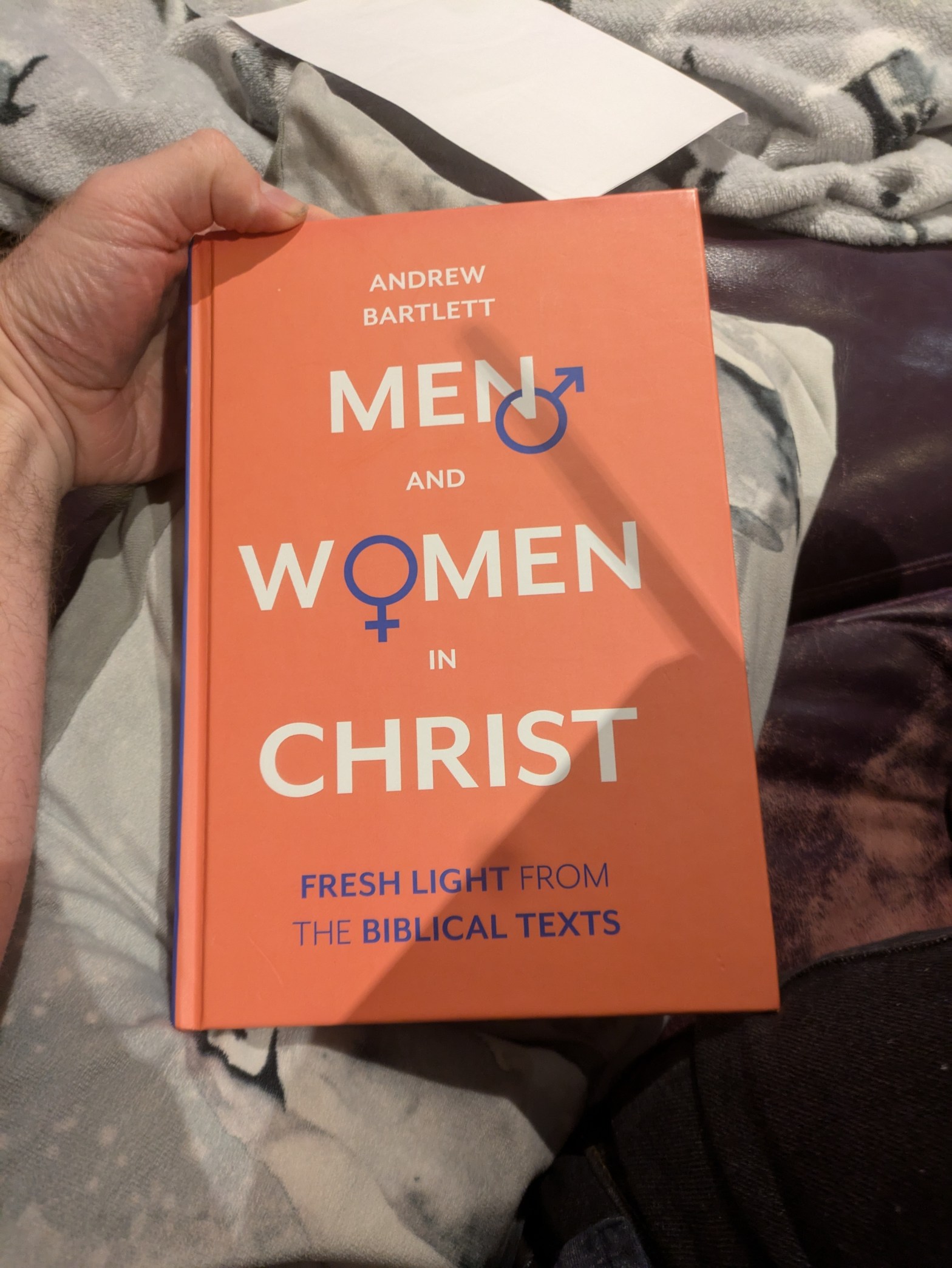
Andrew Bartlett has responded to my article questioning whether or not Complementarianism is novel. I thought it was worth a little response back. I think the crucial thing to say here is that I think Andrew misses the point. It’s important to be clar about what is being argued and what is not being argued, what is being conceded and not conceded and how past authors are being understood and used to support what argument
So, it is worth restating my penultimate paragraph in full.
“This means that, no, you cannot find an exact, unbroken tradition that completely matches with modern complementarianism. However, I do not believe that this is what is meant, or can be meant when we insist that complementarian is not novel. First, the primary point is that complementarians consider their interpretation the best fit with Scripture. That of course will be what we go on to debate. Secondly, it is that the position is not without historical precedent. Of course, you would expect there to be differences between a reformer position and what has come before, just as you might observe on other reforming moments, whether that’s the Doctrine of the Trinity, The abolition of the slave trade or the protestant reformation itself. It might be argued that each of those movements and moments had n element of novelty if we mean by that a break with the tradition. However, each of them could demonstrate roots in and continuity from tradition in so far as that tradition sought to engage with God’s Word.”
So to be clear, what I am arguing here is not that you will be able to go back in history and find model complementarian arguments either occasionally or consistently through history, further more nor is that been the understood when reforming positions have been contested throughout history. I’ve offered three examples of positions where opponents would have claimed that those developing or reforming doctrine and ethic were offering something novel, in each case, the proponents would want to insist that their position was no novel but this would not mean that they assumed history offered a continued, carbon copy expression of their position.
This means that as I discuss in an earlier article on the subject, that “we may still find ourselves disagreeing with his thinking as well as finding some of it offensive.” In other words, we would consider some views to be sexist. It is worth noting too that I would not expect to find terms like “role” or “function” used in previous historical documents.
All of this is important because Andrew claims that
“I consider that Dave is mistaken in regarding Augustine as contradicting the novelty of complementarianism.”
Well, not if by that I’m understood to be claiming that Augustine was a complementarian in the contemporary sense. But as I’ve kept stating, that’s not how history works To repeat, I’m not saying that Augustine has a solidly “complementarian” understanding of things, or that his ideas are unshaped by his culture. It is important to not just pick out quotes from history wiyohut neing clear about what the person was themselves arguing about. So, for example, Andrew cites Augustine’s comment that
‘If it were not the case that the woman was created to be man’s helper specifically for the production of children, then why would she have been created as a “helper”? Was it so that she might work the land with him? No . . . a male would have made a better assistant. One can also posit that the reason for her creation as a helper had to do with the companionship she could provide for the man. . . . Yet for company and conversation, how much more agreeable it is for two male friends to dwell together than for a man and a woman! . . . I cannot think of any reason for a woman’s being made as a man’s helper, if we dismiss the reason of procreation.’[1]
It is important to note the specific point Augustine is attempting to argue here, which is that marriage and the role of woman as helper is not to be understood as either for manual labour nor company/companionship. The need for a helper is specifically, in his opinion linked to the mandate to multiply, for procreation. It is worth noting that contemporary, complementarian author, Christopher Ash makes a similar argument in his book “Marriage, Sex in the Service of God.”
Now, we may consider his opinion that he would prefer the company of other men when it comes to socialising unenlightened but I’m not sure that you can read into that anymore than that he prefers the company of other men.
Let’s come back now to the argument that I misinterpret Augustine. I’m not convinced that I have. It is perhaps worth considering how Platonic thought influenced Augsutine’s thought, including regarding anthropology and so a tendency to think in terms of a dualism with the soul being higher than the body. Augustine is explicit that on that plane, there is “neither male nor female.” As I said in my earlier article, we may not want to follow his reasoning here, hence modern egalitarians and complementarians are not going to think and argue in the same way.
Augustine’s Platonic worldview may therefore allow for the possibility that he could hold to the view that women were in nature equal to men whilst at a bodily, biological level argue that they were weaker. I wonder to what extent he may have seen their capacity for reasoned conversation as belonging with the lower plane. However again, it is simply possible that we see examples of inconsistency here, reflecting culture.
Indeed, it seems, noting Augustines’ comments on his own mother, cited by Andrew that he seemed to think that women were more constrained by the lower part of their nature, hence his description of her “rising ‘above her body.’”
What it is worth remembering is that the concept of “equal in nature” arises directly out of the belief that we are of one nature. There are not two human natures. Augustien is clear that, where it counts, on that higher plane, there is one nature. Recognising one human nature does not of course mean that there are no biological distinctions. In fact, we might targue that the complementarian and egalitarian innovation here is to insist that one, equal nature biological equality.
The crucial point here is that what shape’s Augustine’s understanding of nature is his Platonic thought and when complementarians and egalitarians depart from him, it is because thy are departing from Platonism.
Indeed, we might argue that Augustine could never sound truly like either an egalitarian or complementarian but nor would he really sound like the contemporary “traditional patriarchalism.” In.
deed, he may not sound like our own interpretations of him.
On John Calvin, the crucial question is “What does Calvin mean when he says “in the second degree”? It seems reasonable to assume the point to be simply that man was created directly, whereas the woman is described in Genesis 2 as being made from the man. Does that mean a diminishing of her standing? I think not.
I don’t engage in depth on Calvin’s take on Ephesians 5 at this point becauseI have elsewhere and will no doubt return to it in my discussion on Ephesians 5 in this series of articles. However, suffice it to say that Andrew’s argument here is simply that Calvin’s form of mutual submission is different to some forms today. I must admit that I’m also a little confused as to to his point when arguing that there are differences of opinion on mutual submission among complementarians regarding mutual submission. That point isn’t disputed. It is also worth noting that complementarian forms of mutual submission would assume that it is still asymmetrical in nature as we will discuss late. The point though, as I have discussed in more detail elsewhere is that the expectation is the preference and prioritisation of the needs of the other. Again, this departs from a presumption that women are simply made for men’s enjoyment and they can lord it over them.
We then come to the third example, Matthew Henry. I think there is a consistent thread developing. I highlight examples where the authors explicitly state their belief that men and women are made equal in God’s image. Andrew then argues that they could not possibly mean what they explicitly say and I’ve misunderstood them because elsewhere they say things that seem inconsistent with belief in equality of nature. I would argue that this doesn’t make proper allowance for two things. First, that authors can be, and we might dare to suggest, often will be inconsistent. In fact, this is a point that I’ve made explicitly central to my argument and that I don’t think Andrew has engaged with.
Secondly, as with the others, noting there may well be some consistent underlying, pre-modern metaphysics at play, it is worth considering whether ro not those authors would have seen their comments about biological differences as in conflict with belief in one and equal nature.
So for example, take a look at what Henry says on 1 Peter 3:1-7 concerning the duties of husbands.
Giving honour to the wife – giving due respect to her, and maintaining her authority, protecting her person, supporting her credit, delighting in her conversation, affording her a handsome maintenance, and placing a due trust and confidence in her.
Then he analyses the reasons.
The reasons are, Because she is the weaker vessel by nature and constitution, and so ought to be defended: but then the wife is, in other and higher respects, equal to her husband; they are heirs together of the grace of life, of all the blessings of this life and another, and therefore should live peaceably and quietly one with another, and, if they do not, their prayers one with another and one for another will be hindered, so that often “you will not pray at all, or, if you do, you will pray with a discomposed ruffled mind, and so without success.” Learn, (1.) The weakness of the female sex is no just reason either for separation or contempt, but on the contrary it is a reason for honour and respect: Giving honour to the wife as unto the weaker vessel. (2.) There is an honour due to all who are heirs of the grace of life. (3.) All married people should take care to behave themselves so lovingly and peaceably one to another that they may not by their broils hinder the success of their prayers.
Note, that once again, there is a distinction between higher and lower nature made. He sees the description of wives as “the weaker nature” as concerning the lower “nature and constitution”. However she is “in other and higher respects, equal to her husband.” Here he focus on the husband and wife as new creation and so co-heirs.
Now, it is worth noting two further points. A bit of background might be helpful here. When we think of complementarianism, I’ve argued, as has Andrew that this is not a homogenous viewpoint. It is helpful to think in terms of two axis, on the one hand, we might distinguish soft complementarians. Along this axis you see a move from a hard emphasis on hierarchy and one way submission to mutual submission and less emphasis on hierarchy.
Along the other axis, you see a move from what we might refer to as “wide complementarianism to “narrow complementarianism.” (in the past this was often labelled as “thick and “thin” but has been changed for obvious reasons). Narrow complelentarians insist that we must stick narrowly to what Scripture specifically instructs. This means both that it applies only to church leadership and marriage and also that the reaosnign is in effect “because this is what the Bible says.”
Wide complementarianism takes the view that headship and submission have wider implications into the whole of life. This means that wide complementarians like Pipr and Grudem will align with the people cited by Andrew as thinking that women should not hold leadership positions on public life or indeed engage in a number of other types of unfitting work and even recreation.
Wide complementarians also argue that we aren’t just dependent on the bare commands of Scripture for this. In fact they have been known to accuse narrow complementarians of treating God as arbitrary in his commands. However, the crunch point is this, whilst wide complementarians do believe in equality of nature (though I would argue that they push at that boundary), they do see a connection between differences in nature, or differences in biology between men and women so that there is a fittingness, in their opniion to the roles or functions that men and women take up.
There is therefore a level of departure or novelty that increases as you move into increasingly soft/narrow positions. However, even still, I think that if you are not a hierarchialist nor an interchangeabilist them most complementarians and egalitarians would recognise that there is both a sense of one and equal nature and biological differences and that those biological difference.
In other words, we are not just looking backwards to see hints of complementarianism and egalitarianism in the past but rather we are also looking at how both those positions might seek continuity with tradition, whilst as attempts at reformation also looking to depart from tradition where it is seen to be out of kilter with God’s Word.
[1] De Genesi Litteram IX 5.9, 7.12

