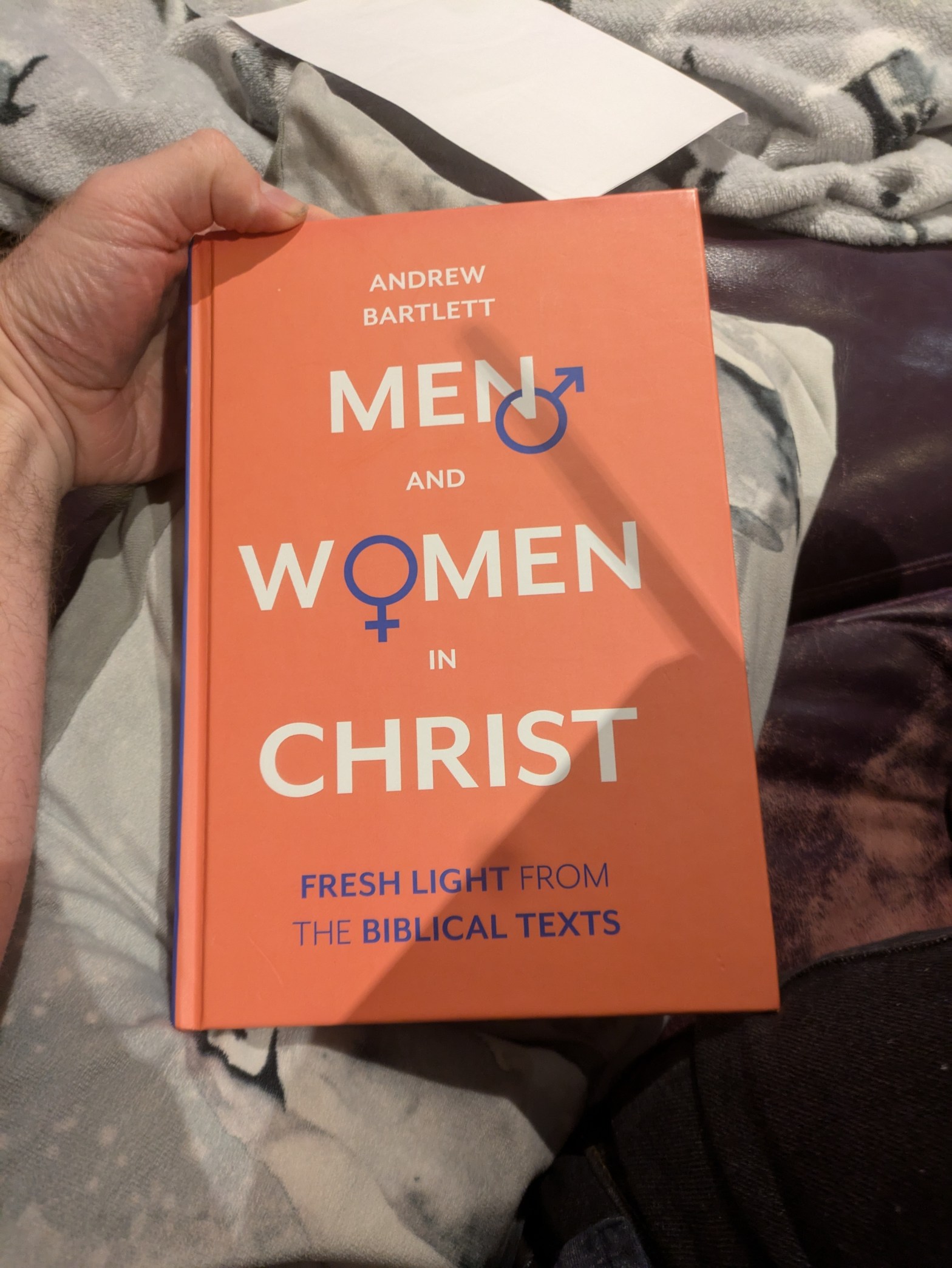
Here is a guest post with Andrew Bartlett’s thoughts on my piece titled ‘Hierarchies, submission and love’.
[1] HIERARCHY/UNILATERAL AUTHORITY?
Since the phrase ‘unilateral authority’, is unfamiliar, it may help if I quote my explanation of it, from page 10 of my book: “By ‘unilateral’, I mean that the authority is one-way only, the husband being in a superior position.” This is in contrast to mutual authority, as taught by Paul in 1 Corinthians 7:4, where he says that each spouse has authority over the other’s body.
So, the issue is not accurately to be expressed as: “Does the husband have authority over his wife?” Rather, we need to ask: “Does the husband have unilateral authority over his wife – or is their authority mutual?”
In my view, the latter answer is correct. In the first century AD this was massively countercultural. A majority of complementarians believe that a husband should exercise authority over his wife (as taught by, for example, Wayne Grudem, Kevin DeYoung, and Mike Winger). A minority of complementarians disagree (for example, Sam Storms).
Here is a straightforward question, which I haven’t seen answered: If God intends that a husband ought to exercise authority over his wife, why is there no statement in Scripture that he ought to do so? It seems extraordinary to me that there are many complementarians who believe and teach that this is a husband’s duty, laid down by God, and yet they do not point to any statement in Scripture which says that this is a husband’s duty.
In Genesis 3:16, rule by the man over the woman is presented not as an obligation but as a consequence of the fall.
[2] WHAT VIEWS COUNT AS ‘EGALITARIAN’?
Dave considers that the four positions I identify in my book don’t reflect the full complexity on both the complementarian and egalitarian sides. I don’t really understand why he makes that point. I wrote: “These four positions do not exhaustively represent the full range of commentators’ differing opinions, but they are sufficient to provide a useful basis for our discussion.”
He considers that I conflate soft complementarianism with soft egalitarianism. I don’t see it that
way. On the topic of marriage, my book received pushback from egalitarians. They didn’t regard my position on marriage as falling within egalitarianism, because I acknowledged that Paul does not give identical instructions to husband and wife, and that the head-and-body Christ-and-church comparison is asymmetrical.
[3] ‘HEAD’ AS A METAPHOR
Dave says: “in so far as we talk about head/kephale [as] a metaphor, this shouldn’t be taken to mean that the metaphor works narrowly so that head either means authority or source. Rather, the point is that the word can either be used to refer technically to the part of the human body which contains the brain or to a geographical position on a river.”
I think this is not a clear statement of what the discussion is about. When kephalē refers to the part of the body that contains the brain, that is a literal use. When it refers to something else, that is a
metaphorical use. It is only metaphorical uses that we are concerned with in the present context. In regard to possible metaphorical meanings, the picture is much more complex than a choice between (1) authority over (2) source (3) both authority over and source. (And, for the record, I don’t know of any example where kephalē is used in the singular to refer to what we would call in English the head of a river.)
Paul is free to use metaphors as he wishes. There is no requirement that he must use them the same way as other people. Nor is there any requirement to use them consistently. For example, he uses the ‘temple’ metaphor in more than one way within a single letter (1 Corinthians). Provided he makes his meaning plain, he can use kephalē as a metaphor as he wishes.
[4] ‘HEAD’ IN EPHESIANS 4:15-16
Dave refers to Ephesians 4:15-16, but it is not yet clear to me what his view is on it. I don’t think he discussed it in his M Th. Does he agree that Paul is there using ‘head’ to mean something like ‘source of nutrition and growth’? That’s a strange metaphor for us, but readily understandable by first- century Greeks, given some of their assumptions about how the body worked.
[5] ‘HEAD’ IN EPHESIANS 1:22
Dave refers to Ephesians 1:22, but he doesn’t acknowledge that the authority of the ‘head’ in that sentence is an authority over ‘all things’, and this is ‘for the church, which is his body’. As I comment in a footnote, one could get to an idea of authority over the body by including the body in the ‘all things’. But that isn’t what Paul is actually saying. Ephesians 1:22 does not show ‘head’ = ‘authority over the body’.
[6] PERTINENT MEANING OF ‘AUTHORITY’
Dave writes: “I think that people shy away from “authority” because they associate it with power. However, the point about the word is that it reflects legitimacy and what someone is authorised or has the authority to do. Authority therefore can be positional when held by someone in the hierarchy but can be process authority when it reflects a person’s responsibility, there may also be expert authority and a kind of charismatic authority which is to do with someone’s ability to influence through personality.”
In English, the term ‘authority’ can be used in a wide variety of ways. But most of them are not of
interest in this discussion. The major exegetical issue that divides people is whether Paul is or is not meaning that the husband has unilateral authority over his wife. In my view, that is not Paul’s meaning, and there are many indications in Ephesians to that effect, which I discuss in chapter 4 of my book. I’m unsure to what extent Dave agrees on that point.
[7] COLOSSIANS 3 AND SUBMISSION
The argument based on what is not said in Colossians (compared with Ephesians) is a fragile one. The letter-carrier would have been expected to explain Paul’s meaning more fully, as necessary. And we do not know which of the two letters was written first.
[8] ‘HEAD’ IN EPHESIANS 5
Dave has not yet engaged to any significant extent with what I say in chapter 4 about Ephesians 5. It sounds like that may come in his next post. Since he says that he agrees that submission in marriage is mutual, it may be that we have partly overlapping understandings of what Paul is teaching in Ephesians 5 – especially because I expressly acknowledge that Paul’s instructions for wives and for husbands are not the same.
But when Dave writes: “The submission is in the context of a kind of order where the husband is
head”, this does not convey a clear meaning to me, because I haven’t gathered clearly yet from his blog pieces what he means by ‘head’. I hope he will engage with the multiple difficulties in understanding ‘head’ as meaning ‘unilateral authority over’ – difficulties which arise from Paul’s express words in Ephesians 5.
[9] 1 CORINTHIANS 7 AGAIN
Dave writes: “Fascinatingly, we find on the first pages of chapter 3 an example of how ordering his material starting with 1 Corinthians unavoidably shapes the argument.” Sorry, Dave, but this is simply wrong. The shape of the argument concerning Ephesians 5 and Colossians 3 is driven by what Grudem and others have said on one side, and what Payne and others have said on the other side. It is not shaped anywhere in chapter 3 or chapter 4 by the fact that I have already considered 1 Corinthians 7. The first paragraph of chapter 3 is simply an introductory bridge.
I’m also still wondering what possible objection there could be to considering 1 Corinthians 7 (probably about AD 55) before Ephesians and Colossians (which were written later, maybe AD 57- 59).
 Faithroots