This is likely to be the final part of my engagement with Robert Gagnon and this is where we turn our attention to the specific question.* Can and should we regard the present Democratic Party in the United States as demonic whilst the Republicans are merely non-Christian?
It is important at this point to be clear about what I am saying and not saying again. Throughout the exchange, Gagnon has attempted to define the position of those of us that he is disagreeing with. In his last article, he wrote:
“Those who say that there is no specialized sense in which a political party can be called demonic, no matter how evil, are stuck in a position that makes it impossible for Christians to single out the Nazi Party in 1932 as demonic because they could argue that Hindenburg had his own demons (having commanded Germany’s military in WWI). Or the Democratic Party in 1860 for its obsession in preserving and spreading slavery, as if the Republican Party under Lincoln was also demonic for its errors and insufficiencies. I do not think that this is a workable option””
Yet, this isn’t what I have argued at any point. I don’t think it is what John Steven’s has argued either. I think Gagnon is confusing a disagreement with the arguments he has put forward with a commitment to the position he outlines above, as though to be against x you must hold y, without allowing for the possibility of option z existing.
As I argued in my last article, we can see how different “empires”, institutions and individuals may descend into greater evil, that there can be better or worse. I am not convinced though that we should automatically describe those we consider to be worse as “demonic” or “Satanic” because that kind of language seems to specifically describe those who are demonically possessed. And yes, I’m open to the possibility that an institution may in effect be demonic in that kind of sense too.
I’m not convinced that either the Democratic of the Republican Party would be described as “demonic” in that kind of way. As I’ve noted before, it does raise questions that I’m still waiting for Gagnon to answer. Does it mean that he would label those individuals who experience the specific temptations he identifies as “demonic”, what about those who are members of, have voted for and agree with those views?
In terms of how we assess the Republican and Democratic Parties, I think it is worth considering three questions.
- Do the particular policies that Gagnon identifies as demonic hold the central position in Democratic policy that Gagnon claims?
- Are those policies egregiously sinful to the point where we would consider them demonic?
- Are the Republicans free from any positions that might equally be considered egregious to the point of being demonic.
To answer the first question, the best place to start is the Democratic Party’s policy platform as voted on at their convention in 2024.[1]There are nine chapters that cover everything from “strengthening American leadership worldwide” through to “securing the border and fixing the broken immigration system.” Just a reminder, this is the Democratic Party’s policy platform. The document starts with the economy and moves on to “rewarding work” and “lowering costs.” It’s not until chapter 6 that the issues of LGBT rights and abortion come up. Even the, they are well down the list in a chapter about democracy, freedom and equality. It’s important to understand why those positions are being taken, even if we disagree with the policies. Those who criticise Trump’s supporters are often told that they are making lazy assumptions without taking the time to understand the motives and reasoning of those supporters. But if we just attack the Democrats as being determined in a demonic kind of way to kill babies and in effect sterilise the population to prevent multiplication, aren’t we at risk of being just as guilty. It seems to me that the Democrats are being driven by what they believe will contribute to liberty and freedom. Now, of course, both of those things may also become idolatrous themselves but we may be in danger of completely missing the mark and identifying the wrong idols.
Now, it is certainly the case that during the presidential election, those specific issues were pushed up the agenda in terms of campaign rhetoric. I wonder to what extent this was because the rhetoric was seen as more effective than other bread and butter issues in terms of getting the base and activists motivated. We saw the same kind of thing in the UK for a long time with the Conservatives’ rhetoric on immigration and Europe.
The identification of a couple of specific policies as demonic and therefore making the political party advocating them demonic/Satan begs an important question. You see, those particularly policies have been enshrined in US law for many years. Surely,, this would make the US itself, and many other nations, “demonic/satanic” within Gagnon’s specialised use of those words. Is that the position Gagnon would advocate and if so, how has that shaped his attitude to the United States for most (if not all) of his lifetime? We might add in the additional example of Segregation. When that was the policy and culture did that under Gagnon’s definitions make the US demonic? If not, why not?
Furthermore, Gagnon asked me on Facebook, the following question:
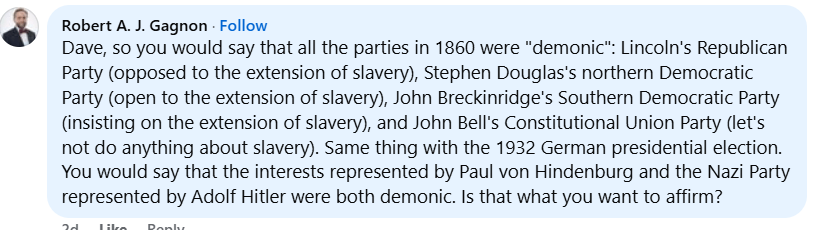
Yesterday, I observed that such “give me a yes/no” answer is a well known debating ploy, it’s of the “So how long have you been beating your wife” kind. As well as being a well known debating ploy, it’s also based on a well known form of logical fallacy “The loaded question fallacy.”
There is also an additional logical fallacy at work, “the complex question fallacy” this relies on the assumption that a prior question has been answered when it hasn’t. As I’ve observed several times, Gagnon has represented my own position wrongly and his “yes/no” formula presumes my agreement with his representation of my position.
As I’ve made clear previously. First, I am not convinced that the word “demonic” is the right one to describe what we are observing. That word is best kept to those contexts where we would also use the label “demon possession.” I have not argued that we should describe all parities and all entities as “demonic.” I have argued that we should see all empires and institutions as under Satan’s rule, in his kingdom. I have also disagreed with Gagnon’s claim that we don’t regard most human beings as demonic, we regard them as imperfect. Again, I would not use the word demonic and that links to a point further down. However, Scripture is clear that we do not refer to people outside of Christ as imperfect, rather, they do belong to Satan’s kingdom (c.f. Ephesians 2).
However, my own position is that whilst this world is under Satan’s rule, we can see ways in which that rule is evidenced to a greater or lesser extent in different people and different institutions. So, I would not say that “all the parties in 1860 were demonic” because that’s not the language I would use. The same applies to the other examples Gagnon gives.
I would argue and consistently have that in so far as those politicians and parties at the time were not under Christ, they were under Satan’s rule. Common Grace means that they still could do much good. Because I’ve argued that there can be different degrees and intensity of wrong, I can distinguish and say that there may be cases where one option is the better choice. I have not studied the specific examples in US history to make that analysis. I have however offered examples from the UK context which should help.
The second question to consider is whether those policies promote sin and evil of a uniquely egregious kind as to be demonic. This is why I’ve asked Gagnon what his position is on individuals in those contexts. I think we need to be careful about singling out one or two specific issues when there isn’t evidence that Scripture itself does.
Rather, we can see how Scripture sees all sin and idolatry as a turning away from the true and living God. As we’ve observed before, Scripture identifies lies as particularly associated with Satan. It also identifies murder in the same manner. Further, it is worth then considering the numerous ways in which we can and do think, speak, act in a way that is deceitful, or dehumanising.
However, crucially, the key thing about sin is that it is idolatry. It replaces God with other things, including ourselves and it is that which distorts God’s image within us. So, death comes into the world because Adam and Eve choose to eat the fruit of The Tree of Knowledge and Evil in the
This leads us to the third question. What about the Republicans. It is worth starting by looking at what their/Trump’s position is on Abortion. Here is one quote cited by CBS
“My view is now that we have abortion where everybody wanted it from a legal standpoint, the states will determine by vote or legislation, or perhaps both, and whatever they decide must be the law of the land,” [2]
The same article adds:
“”My administration will be great for women and their reproductive rights,” he declared on social media on Aug. 23, the morning after Harris delivered a speech accepting the Democratic presidential nomination that claimed Trump’s second-term agenda includes limiting access to birth control, outlawing medication abortion and banning abortion nationwide.”[3]
So, it is important to be clear about what Trump’s concern really is and this perhaps reflects a wider Republican agenda. It’s not about ending or even limiting abortion. Rather. It is about who has primary authority, States and specifically State legislatures or Federal Authorities and specifically Federal judges.
Then there are the things that Donald Trump and his Republican Party have encouraged in words and actions. I would be specifically concerned about three things. First of all, there is the approach to truth, the idea of fake news and alternative facts/truth. Surely this interesting relationship with truth takes us back to the roots in Genesis 3. Remember that the Serpent’s starting point is “Did God really say?” It’s about questioning truth.
Secondly, whilst there may be different views about immigration controls, the kind of language and rhetoric we have seen both in Trump[‘s first term and the run up to the second encourages a dehumanising view of others. This combines with the approach to foreign policy, specifically relationships with Greenland, Panama where the language of aggressive acquisition is used. I have noted previously, the echoes of God’s rebuke to Edom in Obadiah in how Trump has engaged with Ukraine.
The third example of concern is ironic at the point where many Trump supporters would see a strength, it relates to his attitude to Christian faith itself. Supporters argue that Trump has, for whatever reason allied himself with Christian values, belief and people. However, there is a thin dividing line between alliance and appropriation. One significant concern that many Evangelicals outside of the US would have is the so called “Trump Bible.” This is a version the bible branded with his name and including key US national documents such as the constitution.
Mark 13:14 says:
14 “When you see ‘the abomination that causes desolation’[a] standing where it[b] does not belong—let the reader understand—then let those who are in Judea flee to the mountains.
There has been much speculation about what Jesus was referring to here. It is most likely that he was alluding back to the actions of Antiochus Epiphanes who in AD176 invaded Jeruslame and set up an idol to Zeus in the Temple whilst prophesying forward to the events building up to AD70 including an incident around about 68AD when a mock priesthood was set up causing great offense and bloodshed. I want to suggest that these big Bible events are often reflected in minor versions, a kind of reverse typology. The language of something being placed where it does not belong, seems to me highly appropriate to the placing of political/national documents into the Word of God, itself reflecting an insertion of party/national political interests into Christianity and the appropriation of Christianity for the political cause.
For the reasons I’ve outlined above, I do not see specific reasons to identify one political party as demonic in the US and the other as not.
[2] “he said in a video posted to social media in April” cited Trump and Harris’ views on abortion and IVF access, explained – CBS News
[3] Trump and Harris’ views on abortion and IVF access, explained – CBS News
*Unless Gagnon wishes to respond further.
 Faithroots