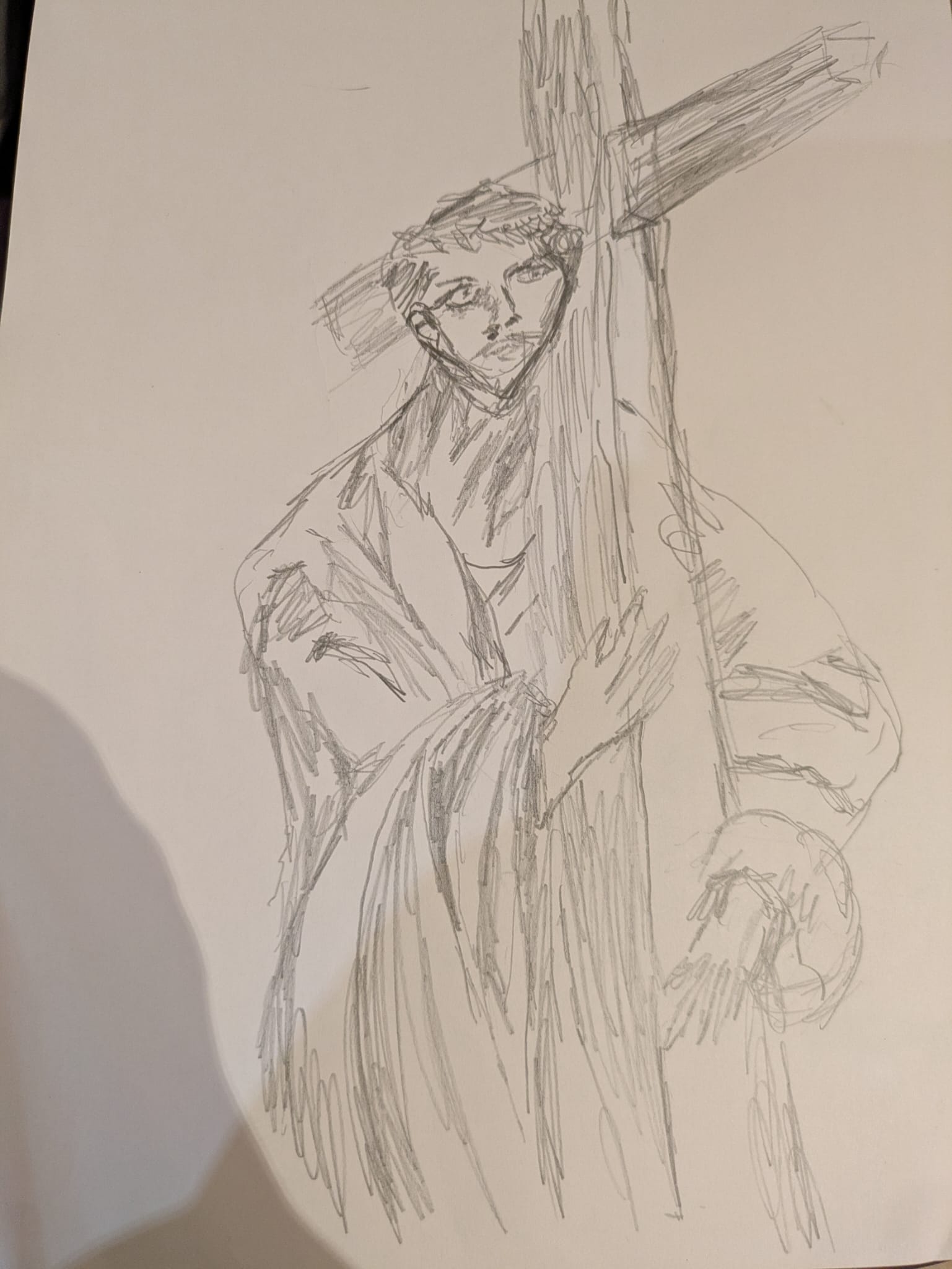
We are now moving into the account of those last hours of Jesus life, a night facing inquisition, accusation, mockery and beatings that will continue into the final morning. All of the Gospels give significant attention to those events. Luke does not give us the detail of Jesus’ night time appearances before the High Priests but focuses on Peter’s denial and moves quickly to the early morning decision to hand Jesus over to Pilate. Mark 15:53-64 fleshes out the appearance before the Sanhedrin. Where Luke focuses specifically on the question as to whether Jesus claims to be the Christ, Mark also brings in accusations relating to Jesus stating he could rebuild the temple if destroyed, within three days. This would be seen as a Messianic claim. Mark also makes explicit Jesus’ positive response to the question “Are you the Messiah?”[1] Matthew closely follows the text of Mark (Matthew 26:57-68). John provides additional detail telling us that Jesus is brought to the house of the previous High Priest first. As Caiaphas’ father-in-law, it seems that Annas still carried some clout.
Read Luke 22:63-71
Whilst Peter is outside denying his Lord, Jesus has been taken into the house under guard. The temple guard mock and beat Jesus (v63-65). At daybreak, Jesus is brought before the ruling council, the Sanhedrin. They question him “are you the Messiah?” Jesus points out that whatever he says, they won’t believe him and they can’t offer straight answers to such questions themselves (v66-68). However, Jesus tells them that he is going to be exalted to the right hand of God. They recognise that this is a claim to special authority “does this make you the Son of God” and his response is to the effect of “those are your words”. They treat this as a confession.
What exactly were they accusing Jesus of?
It’s important to remember that those questioning Jesus did not have a fully fledged doctrine of the Trinity. So, we should not read this through our own lens as simply as Jesus being accused of claiming to be God, though he is. We know from John’s Gospel that they understood his claim to sonship to indicate some form of equality with God but exactly what that entailed may not have been thought through. Rather, the focus on Messiahship and sonship may well have been political because sonship and messiahship both meant kingship and that gave them a reason to go to Pilate.
Read Luke 23:1-24
Jesus is taken by the Sanhedrin to appear before Pilate. They accuse him of rebellion and treason by claiming to be King and encouraging people not to pay tax to Caesar. Given Luke 20:20-26, this is fascinating. They are either outright lying or they considered his answer there to be negative towards taxes. This would suggest that his comments were taken as along the lines of “Sure give Caesar back what is his but you shouldn’t really be under his rule” (v1-2). Pilate asks Jesus if he is King of the Jews and he responds with the same “you have said so” formula (v3). Pilate however does not see this as an out and out claim and so tells the leaders that he has nothing to actually charge Jesus with (v4). The Sanhedrin are insistent that Jesus is stirring up trouble but let out that Jesus is from Galilee. Pilate sees this as an opportunity to get Jesus off of his hands since Galilee is Harod’s jurisdiction, so he sends Jesus over to him as he was in Jerusalem at that moment (v5-7).
Herod was keen to see Jesus having heard a lot about him already. He plies him with questions but his main aim is to get Jesius to do a miracle for him. Jesus refuses to answer (v8-9). The priests and scribes bring their accusations before Herod. Provoked by Jesus’ silence, Herod’s response moves from intrigue to mockery. He joins with his soldiers in mocking and sneering Jesus by dressing him up as a pretend king and sending him back to Pilate. Herod and Pilare had been enemies in the past but something about this encounter unites them, perhaps the sense that they are on the same side in dealing with a difficult people with Caesar’s eye on them (v10-12).
Herod sends Jesus back to Pilate who summons the priests, rulers and representatives of the people. He tells them that he hasn’t found any truth in accusations that Jesus is guilty of inciting an insurrection and nor has Herod. All the same, Pilate says that he will punish Jesus. He will then release him (v13-16).
This compromise proves unacceptable. The crowd demand the release of Barrabas, a man who ironically is imprisoned, awaiting punishment for insurrection and murder. Pilate appeals to them but they shout “crucify him” (v18-20). [2] Pilate appeals to them a third time (notice the parallel with Peter’s denials). A three part response rhetorically suggests completeness. He has exhausted all efforts. The crowds shouts prevail. Pilate accepts that they will not be persuaded. Barrabas is released to them and Jesus “surrendered to their will (v21-24).
Read Luke 23:26-43
We know from the other Gospels that Jesus was subjected to intense torture and beating by the Romans whilst in their custody. Luke cuts out much of the detail, although he tells us that it is another, Simon of Cyrene who is required to carry the Cross for a much weakened Jesus (v26). A crowd follow Jesus including many women, mourning him. However, he turns and tells them to mourn for themselves not for him because of the coming destruction on Jerusalem. A day will come when they would prefer to be buried alive than to witness the horrors that are coming. He observes that if people can do cruel deeds at this time, then as the days grow darker, worse is to come (v26-31).
They reach Golgotha, or the Place of the Skull and prepare him for crucifixion. He is stripped of his clothes and they cast lots, gambling for them. There are two others crucified with them, sometimes referred to as thieves but more likely bandits or insurrectionists like Barrabas. Jesus prays forgiveness for those crucifying him. They are ignorant as to the full implication of their actions (v32-34).
As he is crucified, Jesus is mocked by the people and their leaders who cast doubt on his claims to be Messiah, he cannot even save himself. The soldiers also mock him, serving him wine vinegar as a drink, again questioning his claim to kingship and challenging him to save himself. Pilate has a notice hung above Jesus declaring him “King of the Jews”. This is who he is being crucified as, this is his offence (v35-38).
One of those being executed with Jesus joins in the insults. However, the other rebukes him and points out that they are there justly whereas Jesus is not. He then acknowledges Jesus as King, and specifically the King who will conquer death because he asks to be remembered by Jesus when he comes into his kingdom, or receives authority. Jesus tells him that he will not have to wait for some future eschatological point. “You will be with me in paradise today” (v29-43).
Today you will be with me
Jesus’ response to the man on the other cross settles an important question. There was to be no delay between the man being with Jesus. Whether we hold to a form of “soul sleep” or presume consciousness after death, this removes the possibility that we cease to exist until the day of resurrection.
Read Luke 23:44-56
There is an eclipse of the Sun bringing darkness in the middle of the day. Jesus commits his spirit to his father and dies. Something else significant happens, the curtain dividing of f the Holy of holies is ripped in two. The Centurian overseeing proceedings seems struck by something about the way Jesus dies and so declares him righteous. The crowds mocking turns to mourning. His followers observe at a distance (v44-49).
A man called Joseph who was a member of the Sanhedrin but had dissented from the judgement comes and asks for the body. Joseph seems to have, like Nicodemus been at least favourable to Jesus. He was one like Simeon and Anna who had been looking for the coming kingdom (v50-52). He takes the body and has it wrapped in lined cloth then buried in a new, unused tomb, cut into the rock. It was the day before the Sabbath which would officially start at sundown (v53-54). The women from Galilee observe where the body has been buried and return to where they are staying planning to bring back spices and ointments to anoint the body. They rest on the next day in keeping with sabbath law (v55-56).
The perfect sacrifice
The focus in the accounts of the Last Supper is away from the lamb and on bread and wine. This may well be to emphasise that Jesus is the one being presented as the sacrificial lamb. The eclipse and darkness echo the imagery of 2 Chronicles 7 where the dedicated Temple is overpowered by the Glory of God. Whilst we tend to think of darkness as negative, 1 Kings 8:12 tells us that God dwells in thick darkness. The imagery here is less to be seen as evidence of divine grief as it is a pointer to divine satisfaction with the sacrifice.[3] The tearing of the veil in the temple also points to the affect of Christ’s sacrifice. The divide between the holy and profane is removed. Through Jesus’ death, we are granted access into his presence at the very place where forgiveness and atonement are provided for. Whilst this is not the actual destruction of the Temple, it does indicate that its role is now redundant. God has accomplished atonement through different means in another place.[4]
Whilst the accounts of Jesus’ trial, mocking and beating do not shy away from the facts of the crucifixion, the text in all the Gospels is terse. Unlike Mel Gibson’s “The Passion of the Christ”, the focus is not on gory detail but on bare facts. Our focus is meant to be less on how much suffering Christ experienced, though the suffering was very real. Rather, our focus is meant to be on the atonement that Christ makes as the one given for us, or on our behalf.
[1] Mark 15:62.
[2] Nolland suggests that the people were already expecting Barrabas to be released as part of a traditional pardoning. Barrabas would have been popular with the people and so it is possible that they feared that Pilate intended to use Jesus as an excuse to swap around the planned pardon and release. Nolland, Luke 1835=24:53,1133.
[3] Green also picks up on the eschatological significance of darkness and the last days (c.f. Amos 8:9 and Zephaniah 1:15). Green, Luke, 825.
[4] Green, Luke, 825.
 Faithroots