Sometimes accidental admin errors can be our best help in seeing what God might have to say to us. Through a bit of an admin error on my part in terms of planning out teaching I managed to give myself two whole chapters of Luke that I wouldn’t have naturally put together. Yet here we are looking at them. So we find ourselves asking “what has the destruction of Jerusalem, the end of days and the last supper got to do with each other?
You might remember that at the start of our look at the book, we saw that Luke intentionally puts things together not just for chronological but there is a logical reasoning to the book as well. We are meant to see connections between the things that are placed side by side. I think Luke would have quite liked us to be asking that question. And so that’s what we will be doing. We’ll be asking “What have the last days prophecies got to do with the Last Supper?” And even more importantly, “what has all of this got to do with us?”
Don’t be deceived or distracted (Luke 21:5-33)
Jesus has come into Jerusalem riding on a donkey, fulfilling Scripture. He has driven the money changers and sacrifice merchants out of the Temple, disrupting daily worship. Then there in the Temple he has been confronted by the religious leaders but instead of just playing a defensive game, avoiding being caught out, Jesus takes the game to them. He tells them that they shouldn’t be dilly dallying between this world and God’s kingdom “stop playing with Ceasars money and instead through everything you have all in with the God who you belong to. He rebukes the leaders who exploit the vulnerable and commends a vulnerable widow who is giving everything back to God. She doesn’t have enough money for there to be that dilemma over what to give to the taxman and what to give in the offering.
As the disciples are coming out of the Temple following this, they look around in awe at the structure. In the days of Ezra, Haggai and Nehemiah, it had been a pitifully small affair but Herod the Great had enlarged and beautified it to turn it into one of the wonders of the ancient world.
“Yes it’s impressive isn’t it.” Jesus may well have said “but make the most of it because all of this is going to get flattened.”
This shocks the disciples the building seemed to have a permanence about it, they associated it with their national identity, their religious identity, it was their world and to think of it as gone was too much, like asking a Man City fan to image the Etihad flattened or to be told that someone is going to bulldoze Buckingham Palace. It was unthinkable, world shattering, world ending news. So they want to know when all of this will come to pass and it seems that this must merge together with the actual end of days for them.
So Jesus tells them two things. First, that they should be ready for lots of trouble and upheaval in the world. There will be “wars and rumours of wars”. There will be signs in the heavens, possibly a reference to cosmic events, possibly the heavenly bodies representing earthly rulers, possibly both. The other thing he tells them is that there will be people coming claiming either to be from him, or claiming to be him, themselves, returning as the Messiah. They are not to be taken in.
But there will be two important markers, concrete events in the middle of this and they are distinct. First, a horrific calamity will strike. An enemy will surround and lay siege to Jerusalem. He warns them to flee, to get out whilst they can. The city will be destroyed. This came to pass in Ad70. That’s when the Temple was flattened.
The other event is one when he, the Son of Man will appear, visibly, undeniably him “coming with the clouds” echoing the language of Daniel 7:13 where the prophet saw “one like the son of man, coming with the clouds” to receive authority and dominion from “the ancient of days”. Jesus will return to judge and to rule, putting everything right and making all things new.
What has this got to do with us? Well lets go back to those wars and calamities, and those “false Christs”. We kno w from Acts 2 that the Last Days covers everything from when Jesus died and rose again to when he returns. We are already in the last days. This means that we don’t need to be anxious about what is happening in Gaza, Iran, Ukraine, Nigeria or Venezuela. These situations are horrific but they are not in and of themselves signs of the very end of days. They are part of the reality of living in a fallen world, waiting Christ’s return. They remind us that we need Jesus to come back.
Secondly, whilst some people do turn up claiming to be some kind of reincarnation of Jesus and start weird cults, this isn’t what is likely to catch us out. However, there are people who try to be what I would call ”mini-Christs” They turn up promising us that they have some spiritual secrets, some way to success and prosperity. I think its true of every generation. I remember at University that each week a speaker would come to our CU and tell us that we were a generation of history makers, we were going to do great things and we were going to see a revival starting in our city that would sweep across the nation. I suspect those speakers would say the same thing in every city they went to. I think there is a need at times for us to feel that we’ve been inspired that we have been summoned to do great things. And there will be people today with books and YouTube talks telling teens and twenties that they are the generation, so long as they do everything the books and talks tell them.
Just as with the wars and tragedies we are not be distracted by them. We are to keep our eyes fixed on Christ. We don’t need to find out status in being history makers. We find it in being loved and forgiven by the one who is the world changing history maker.
Don’t give in to despair and the devil (Luke 21:34-22:6)
As wells as the danger of distraction and deception, Jesus warns them that they may become overwhelmed by events and despair. In fact, it seems that Judas instead of heeding the warnings, gives in to the very dangers Jesus speaks about.
You see, his response to what Jesus says is to go the leaders and offer to betray Jesus. They want to get rid of him but dare not go against him during daylight hours, nor do they have a reason to really get him. Judas knows where Jesus camps at night and he now has information of revolutionary talk about the temple falling too.
People speculate a lot about why Judas betrayed Jesus but I don’t think we have to speculate. We are told explicitly that he loved money and the devil took hold of him. But also, I think that there is a big clue here in that Judas’ betrayal is in response to Jesus teaching about the last days and fall of Jerusalem. If you were looking for Jesus to lead an uprising against the Romans then talk of a lengthy history of false dawns and many wars plus advice to flee instead of a call to arms was probably not what you were looking for.
He is disappointed and that leads to discouragement and despair. This gives Satan the opportunity to use him. Now, looking back, I think that too often, those of us who have lived through those false promises found that the result was that our generations became discouraged and cynical and so if some have stoked up false hope with big inspirational speeches, others can be quick to come along to put out the fires and dump a whole load of discouragement on people. Don’t be like that. Don’t give into despair. It might be tempting to sniff at things like the “Quiet Revival”, especially if we aren’t seeing the same things. I don’t personally know if there is something we should call a revival. I do believe that we should rejoice when we hear about the way God is at work in different places.
Instead of giving in to despair, we keep our eyes fixed on Christ, enjoying what he is doing in oujr lives right now.
So…
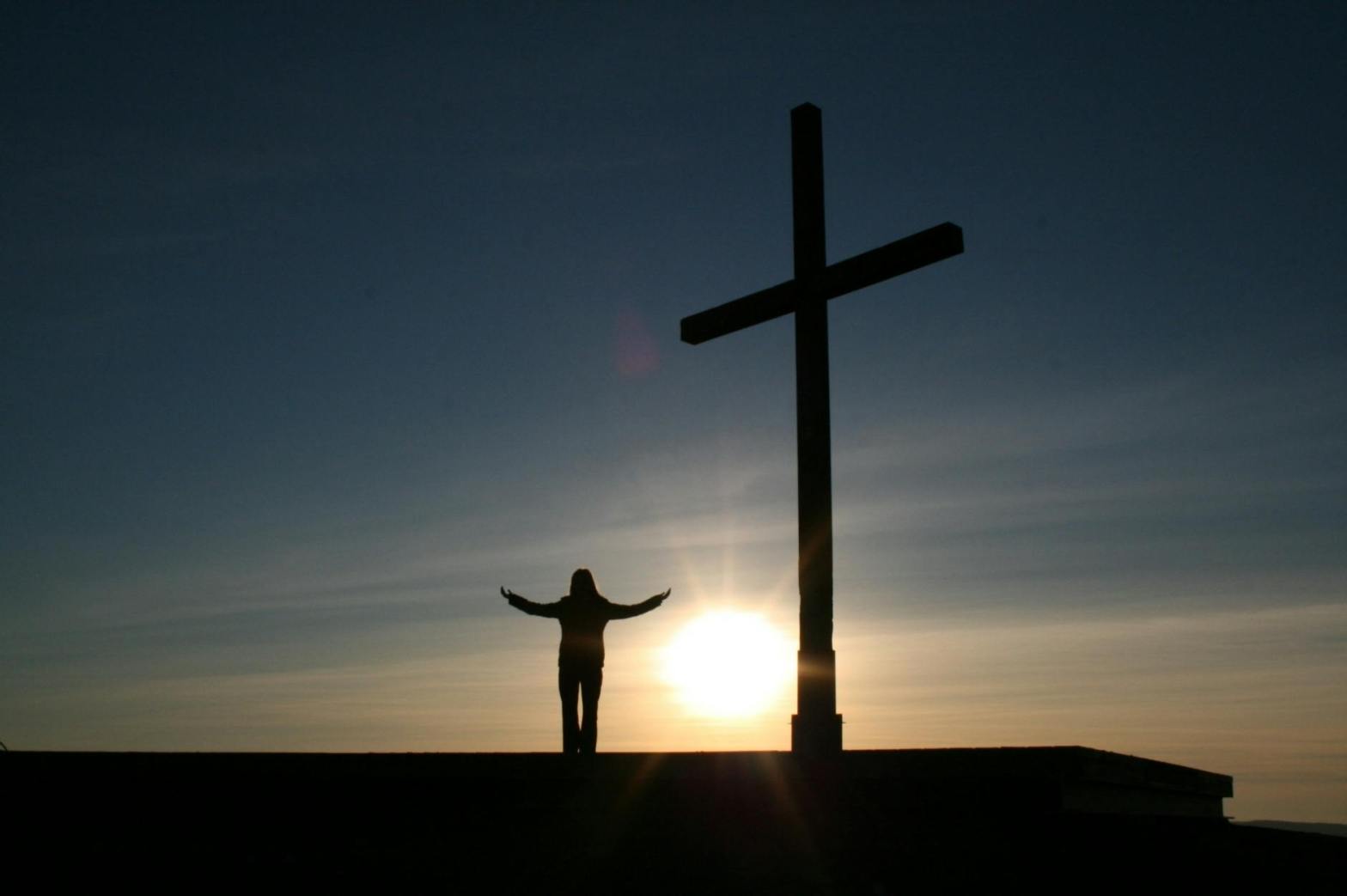
Do keep near to the Cross of Jesus (Luke 22:7-48)
It’s in this context that Jesus will share a last supper with his disciples before going out to the garden of Gethsemane to pray “not my will but yours”
Jesus plans for the disciples to eat the Passover meal together. But he turns the whole thing on its head. The Passover was when Jews remembered their rescue from Egypt, the death of Egyptian firstborns, their protection through sprinkling blood on the doorposts and a night flight to the Red Sea which God parts so they walk across on dry land.
By taking the elements and saying “this is my body” and “this is the covenant through my blood”, he is saying that the whole meal is about him, he is the one whose shed blood will salve, he is the one who brings his people out of slavery, out of death. That’s what his death on the Cross was going to achieve.
And that’s what these things have to do with each other. What do we need to be reminded of as we live in a world where the inspirational talks are not enough to motivate us in face of disappointment, destruction and disaster? We need the rock solid certainty of the Gospel. Jesus’ death on the Cross and his resurrection which means that he is coming back and not just that he is coming back but that he is coming back for us.
Keep near the Cross
I don’t know whether these current conflicts will usher in the very final days. Whether Jesus will return in our life time, though he could. I don’t know If we are on the cusp of a great revival. I cannot tell you that you are going to achieve great things in business, politics, the arts or the church. Maybe you will, maybe you won’t. What I can tell you is that if you have put your trust inn Jesus that what ever life holds, you are eternally secure in him. I can tell you that whatever circumstances you find yourself in, you have a good news message to tell, a reason for the hope that you have.
 Faithroots