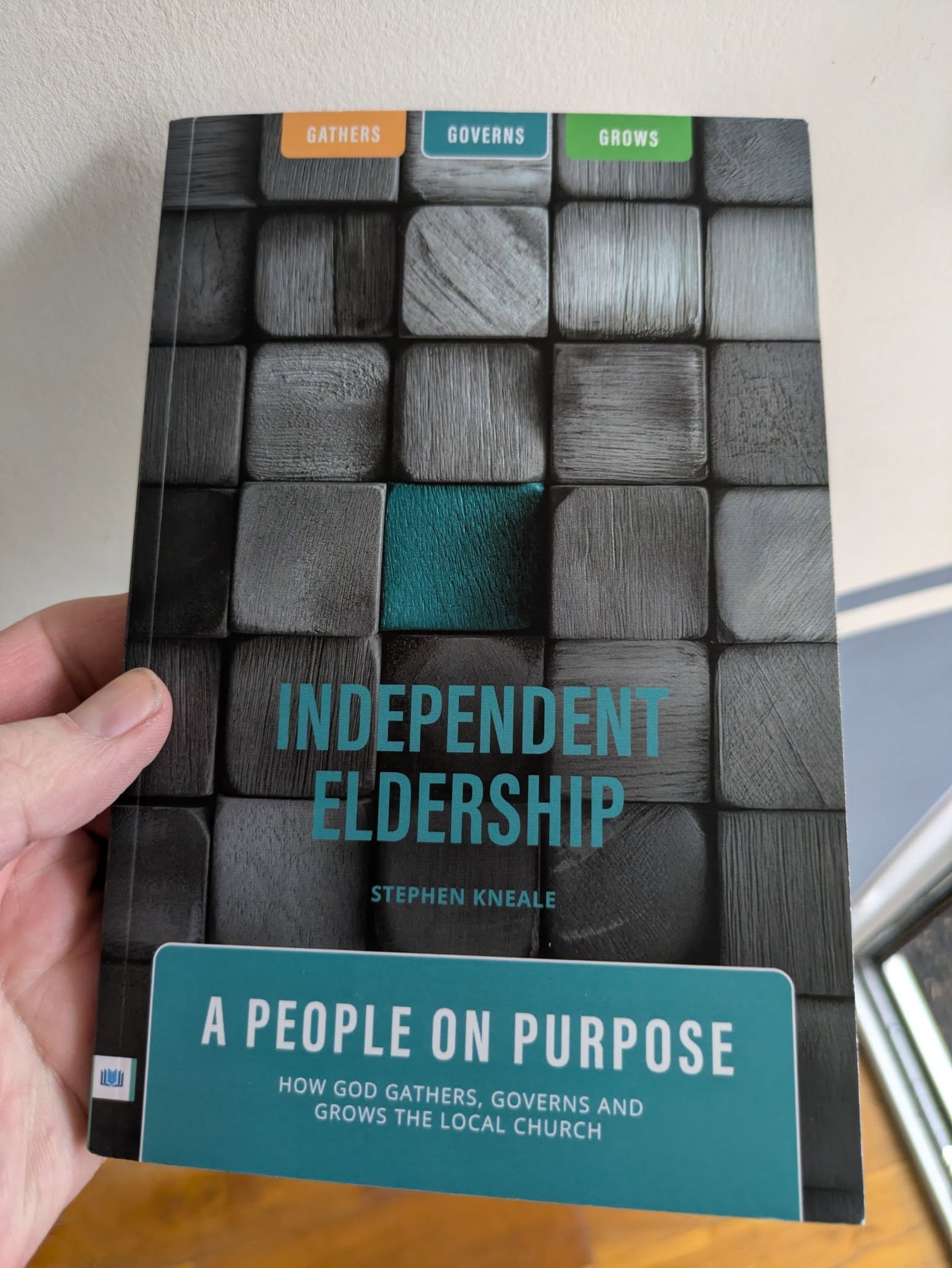
I’ve been looking forward to getting my hands on my friend, Steve Kneale’s book “Independent Leadership” ever since he mentioned a little while back that he was working on something – and it hasn’t disappointed.
What is the book about?
Independent Leadership is part of a book series from Grace Publications called A people on purpose. The aim is to provide resources that encourage local healthy churches engaging in mission, evangelism and discipleship.
In this volume, Steve makes the case for plural eldership in independent churches with a congregational polity.[1] Steve also happens to be Baptist, specifically Particular Baptist.[2] He also holds to the Strict Baptist position of a closed table at communion.[3] Finally, I should add that Steve is complementarian and so believes that husbands and wives are equal but with different responsibilities and that eldership in the church is male. It is helpful to set out those foundational presuppositions as they to a greater or lesser extent shape how Steve approaches particular issues as he goes along. I do not mean by this that you should not bother with the book if you do not hold to those views, though you should be ready to have your thinking challenged on them, but rather that it will help you to understand where Steve is coming from and this may help you better apply the advice given into your context.
In the first part of the book, Steve sets out the argument first that churches need a polity. They need to think through the issues of structure and governance. He notes that a lot of churches don’t want to think about these things but that it is necessary. He goes on to set out the case for his position. He argues that in Scripture, the focus is on local independent churches and that is where authority sits, with the congregation. Elders are appointed by and accountable to congregations. This should not result in isolationism; there is an interdependence to independency.
In Kneale’s opinion, elders are not a necessary mark of the church in that a church may be a church without any elders and indeed, the New Testament churches were in practice elderless until Paul, Timothy and Titus had appointed the first elders. However, healthy churches will want to appoint elders as soon as there are suitable men to take on the responsibility. In that sense they are necessary for the healthy functioning of a church. Better though to not appoint elders than to appoint men who are not suitable on the mistaken belief that there is an office to fill. These elders are equal. Steve rejects the idea of a senior pastor, of a distinction between ruling and teaching elders and of the principle of first amongst equals. A church may choose to pay one or more men to be full time, working hard in the word but this does not set them out as distinct.
The second part of the book focuses in more practically on who elders are, how they are called, their role and how they relate to each other, the local church members, with a specific chapter focusing on relating to women and to their wives. He also gives time to thinking about how they take responsibility for aspects of their own walk with God and practically about their health and fitness.
Elders are responsible for equipping the saints for works of service. This means that we should not look to them to be the ones exercising every gift, rather the aim is that all church members are engaged in one another ministry. This is reflected in how Kneale views the approach of Richard Baxter in his famous, landmark work, the Reformed Pastor. Baxter, famously took an approach of visiting each family to teach and catechise them. Kneale acknowledges the benefits of an approach that focuses on discipleship but sees the risk of the pastor as one man becoming responsible for everything. Kneale prefers the approach of Marshall and Payne in The Trellis and the Vine whereby elders equip all members to be discipling each other.
The focus of elders is on teaching (whether one to one, in small groups or preaching) and on church discipline, correcting errant members (though it is the church members who in fact are together responsible for both discerning who should be a church member and who should be removed from membership).
Kneale is sceptical about elders and pastors seeking to take on the role of counsellor. He reflects that elders are not omnicompetent and that most will not have the expertise, skill or experience to suit them to counselling. Kneale does see a place for counselling if it means offering Biblical counselling. However, he understands counselling to be primarily about helping the counselee to reflect on the challenge they face for themselves in order to come to a decision and resolve a problem.
What do I like about the book?
This book is a fantastic primer both for elders and for church members. It is a short and accessible read. I was able to read it in detail within two days. At the same time it is worth reading more slowly and reflectively over time. This might be worth doing as a group of elders but I also wonder about the benefits of an elder taking it and reading it and discussing with a group of non-elders, perhaps as part of a life group’s programme or such like.
It is well written and engaging and for the most part uses easy to use, accessible language. My own quibble is that there are some terms and concepts that may be alien to many potential readers who would benefit from it. For example, there is a tendency for reformed Baptist pastors to talk about “polity” but this is not a word widely in use. Many readers may also benefit from an introduction to Particular Baptists. Indeed, at times, it feels like the book is written with those who are primarily particular Baptists and get the culture and polity (there’s that word again) of that world. This even extends to the kind of authors that Kneale relies heavily upon. It may make sense in that culture to rely on Clifford Pond but this is someone who is practically unknown outside of quite a narrow circle. This does not mean that his opinions are valid but I’m not sure they were particularly unique or added much to the book. Personally I would drop the quotes and add in some explanations of terms, perhaps even a glossary.
However, I’m being distracted by one minor criticism here! The other big positive is how much the book is rooted in Scripture and relies on straightforward exposition. This is the teaching authority that Kneale advocates for and so it is fantastic to see it modelled so well.
What questions does it raise?
In an earlier article, when I mentioned that I was looking forward to this book I observed that I expected there to be significant portions of this book that I agreed with, that encouraged me and parts that I might disagree with, that might challenge my thinking. This proves correct. Therefore, this section is not intended as criticism. Here I want to pick on a few areas where Kneale’s argument challenged me or provoked further thinking on my part because I wasn’t sure that I completely agreed with him. The book was not intended to offer a full discussion and attempt to persuade on those points. So, I’m highlighting them here because I think they are worthy of further exploration. Indeed, it is not that we are on completely different pages on most of the points where we might differ.
So, I would highlight particularly first that whilst Kneale insists on a form of interdependency, I wonder if more thinking needs to be done here. Kneale’s argument is based on the presumption that the local church itself is the sole sphere of authority. I’m not sure in that context that he has given enough attention for arguments in favour of greater inter-relations between churches and the roles of those who have a kind of invited in authority. Kneale observes that the apostolic age is over and in the sense of the 12 plus Paul as foundational gifts to the church, that is right. However, I’m not convinced that someone like Junia can be so quickly written off as having merely a good reputation among the apostles. Further, James, Titus, Timothy and Barnabas all seem to have responsibilities that go beyond the local church and indeed beyond mere advice. Further, it is striking that whilst the so called Jerusalem Council was not an ecumenical church council in the sense properly understood, the church at Antioch did seek outside input and indeed that it was James, not one of the 12 who took a lead in the response. Now, we may balk at the idea of formal presbyteries or episcopacy and some may prefer not to use the title “apostle” because of its potential confusion with the twelve but it does seem to me that most networks and even indeed, independents within the FIEC would recognise and indeed always have recognised the place of such people.
Secondly, whilst I agree with Steve that we do not want a consumer type relationship with pastor as therapist, I am perhaps a little more optimist about the role of pastors/elders and indeed church members in a form of counselling. Partly, that’s because in fact to study theology a seminary context as opposed to a secular university often does include consideration of pastoral counselling (what we make of the quality of such training is a different question). If we find that elders are unsuited to the kind of responsibilities involved may tell us more about the criteria we have opted for when looking out for potential (especially full time, paid) elders. Partly, it’s because my experience has been that once you engage evangelistically with the world around you, then you tend to find that the people coming to you are at the end of their tether and have, like the woman who came to Jesus for healing, exhausted all options. Partly though it’s because I think that Kneale picks up on one aspect and one model of counselling and assumes then that counselling is about simply reflecting back to people. However, multiple approaches rely on an underpinning philosophy and so it isn’t simply, a case of asking questions and reflecting back answers. Rather, often, a counsellor may seek to equip the counselee to resolve problems by teaching them the very foundation and framework by which they believe they can resolve it. This is I think particularly so with CBT which is perhaps the closest relation to Christian/Biblical Counselling. It is even more overly the case that Transactional Analysis relies on a teaching model to equip, dare we say disciple (?) the counselee. Finally, I am more optimist about pastoral counselling because I believe that our primary responsibility is to take people to God’s Word.
Now, this does not mean that anyone can just start counselling as they please. Nor, does it mean that pastoral counselling in the church resolves all things. That’s in part a recognition that talk therapies may not resolve complex disorders. It’s also in recognition that there is a different focus. The therapist is focused on healing or managing a condition. The pastor/elder is focused on helping the believer learn how to be content and holy through their suffering and to make godly decisions.
Thirdly, I am not fully convinced that a church is a church without elders. This boils down to two crucial arguments made in the book. First, that eldership is a gift of grace, not an office to be filled.[4] Secondly the point that eldership is about teaching and correcting. It strikes me then, first that all of those early churches did have that particular gift present within them, how otherwise would it be possible for them to survive? Now, it might be possible to suggest that the gift is shared among churches, particularly when the apostles were engaged by in person ministry or letter writing. Alternatively, we might suggest that the churches concerned were not truly independent churches until they had elders in place. However, it does seem to me that there were no gathered believers without the benefit of that gift.
Recommendation
This is a book that I would encourage to be widely read. Whilst, as noted above, it may seem to most immediately speak into the world of independency and particular Baptists, it has much to offer to those from outside of those worlds, especially if it encourages them to pay heed to the strengths within those movements and to think more deeply about their own approach.
It’s also a book that should be deeply read. By which I mean that I would encourage eldership teams, staff teams and indeed whole churches to be working through it. Take time to make notes, go back to the Scriptures relied on and indeed follow up the sources cited. Then make sure you discuss it as a team or in small groups.
Finally, I believe that there is much to be applied to local churches. There is much wisdom to be found here.
Independent Eldership by Steve Kneale is available to pre-order from Grace Publications for the 28/02/26. It is currently available at a discounted price of £12.99 with the full price being £14.99.
I received a free review copy of this book. I hope and am confident though that this has not influenced my review.
[1] Polity is about the processes, systems, structures and constitution by which an entity is governed.
[2] Baptists tend to divide between General Baptists and Particular Baptists, the latter hold to a the Reformed doctrine of Particular Redemption, sometimes referred to as either Limited or Definite Atonement.
[3] Open Communion involves a general invitation to all who love the Lord whereas closed table communion tends to restrict communion to church members so that the table is “fenced” or “hedged” with elders taking active responsibility for who participates rather than leaving it up to individual consciences.
[4] Kneale, Independent Elders, 68.
 Faithroots