I am returning to a subject that I’ve talked about a few times, the issue of antisemitism especially when it creeps into public life. I’m returning to it now because it has remained a significant issue and because it particularly related to what happened in the Labour Party between 2016-2019. When there’s a change of party leader, there are often those who can never really accept the change. This was true for the Conservatives when Margaret Thatcher resigned. It took probably 20 years, at least for many to get over that. Similarly, many have struggled to reconcile themselves to Jeremy Corbyn’s exit from Labour’s leadership believing that he was forced out by the right wing press and Blairites within the Labour Party. The result is that this has been conflated with the antisemitism issue with many people frequently taking to social media to denounce the antisemitism issue as a smear and a scam.
I do not believe it was a scam and am concerned that the response is preventing many people from recognising what went wrong why it was so serious, especially for the Jewish community but also for wider issues of racism and discrimination and learning how to prevent something like this from happening again. Because, in my opinion, and that of many, what we saw was a situation where antisemitism was not just present in and on the fringes of UK politics but found its way right into the heart of our political culture. It’s important, with the benefit of the passage of time to look back and understand what happened.
A lot of the focus has been on Jeremy Corbyn himself. Is he antisemitic? This arises out of a number of incidents in which he was involved. These include him:
- Supporting an artist regarding a mural that included apparent antisemitic depictions.[1]
- Attending a wreath laying ceremony at a cemetery where terrorists involved in the murder of Israeli athletes at the Munich Olympics were buried.[2]
- Providing a forward for a new edition of a book which contained significant antisemitic tropes[3]
- In a speech, referring to “Zionists” -a substitute word for Jews as failing to grasp English humour.[4]
Now, as I’ve argued elsewhere, attempting to read back from a person’s words and actions to their heart motives can be risky. I think most people would be rightly cautious about stating that Jeremy Corbyn is himself antisemitic. The comedian David Badiel has acknowledged this. However, what we can be alert to are two things. First, that it is possible to have an unconscious bias so that we simply do not see the consequences of our actions and behaviours or recognise where they come from. Secondly, that in some respects, Corbyn’s personal attitudes are a bit of a red-herring. We are much more alert to the issues of structural, systemic and institutional racism in society now. It is possible for us to allow those systems and institutions to develop in a way that means specific groups in society suffer.
In that regard, the EHRC’s investigation and report into allegations of antisemitism in the Labour Party under Corbyn’s leadership is particularly important. I’ve seen a number of claims that the report did not support the serious allegations. So, it is important to look at what the report actually says.
First, the central conclusion was that:
“We have concluded that there were unlawful acts of harassment and discrimination for which the Labour Party is responsible.”[5]
This is explicitly clear that Jews experienced harassment and discrimination and that this was unlawful. The report does not see this as a fringe matter, purely concerning a few individuals but insists that the Labour Party itself -and by implication its leadership at the time -bore responsibility. Why were they responsible? Well, it’s because they allowed a culture to develop on their watch. Their responsibility concerned a failure to act to protect Jewish party members. This included that:
“We found that the complaints process was not properly resourced and those responsible for it were not trained to the necessary standard”[6]
The consequence of this was that:
“We found evidence of a significant number of complaints relating to antisemitism that were not investigated at all; this is especially true for complaints about social media activity where the Labour Party previously adopted a policy of not investigating mere ‘likes’” [7]
And that:
“Where matters were investigated, the guidance on appropriate sanctions was unclear and inconsistent”[8]
Worse still, they say:
“We found evidence of political interference in the handling of antisemitism complaints throughout the period of the investigation.” [9]
The result being:
“We have concluded that this practice of political interference was unlawful. The evidence shows that staff from the Leader of the Opposition’s Office (LOTO) were able to influence decisions on complaints.” [10]
In other words, there was a situation where Jewish party members were subjected to harassment and discrimination specifically because of their Jewishness and that the Labour Party leadership at the time allowed this to happen. When members sought justice through the party’s own process, those responsible for ensuring protection and justice at best failed to act and at worst, they interfered in a way that disrupted and prevented protection and justice. This is exactly what we mean when we talk about institutional, systemic and structural racism.
A second defence brought by those insisting that it was all a fraud is that Corbyn’s Labour Party were exonerated by the Forde report.[11] So the narrative goes, antisemitism was weaponised for factional purposes as the party descended into infighting. Corbyn was the victim of this factionalism. It’s important therefore to understand the nature of this report, what it is and what it isn’t. First, the Forde report was commissioned in response to the leaking of a Labour Party report which was originally intended as an annex to their submission to the EHRC.[12] In other words, it was not commissioned it cannot have been specifically intended to answer the question of whether antisemitism was present in the party. Such an approach would have been itself ethically questionable, in effect it would amount to the Labour Party choosing to find their own person to compete with the EHRC investigation. The report covers a lot of ground though with a focus on questions of factionalism. Further, It would also have been questionable as to whether Forde had specific competency in this area. His own area of legal expertise as a Kc is around Health.
Given the background and constraints’ the panel claim quite a wide ad extensive brief.
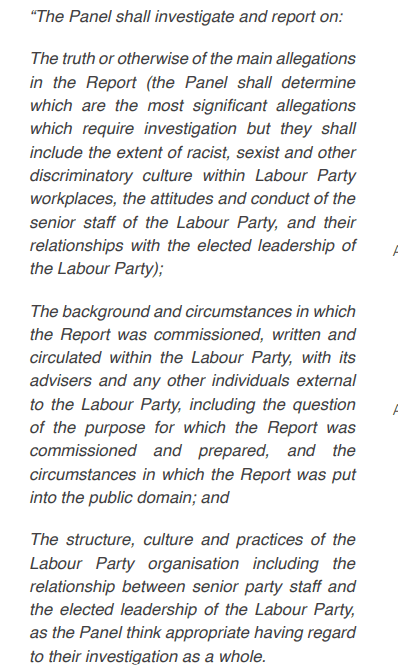
This is in fact quite a peculiar statement. First, as stated, it seems highly concerning that those involved seemed to be seeking to revisit things covered by a genuinely independent organisation with a panel made up of Labour Party members of the House of Lords was peculiar in the firs place. Secondly, it seems to conflate together different tasks, an investigation into a leak, an investigation into the reasons for a report being written, when those reasons were a matter of public knowledge and finally the issues concerning publication and leaking of the report. A tighter scope would have been helpful.
Given all of that, there is in fact only one short section in the report focusing specifically on the question of discrimination, when the types of discrimination under consideration had also been broadened out to include all forms of racism. The report gives most of its attention in four out of six sections to allegations of factionalism.
However, what the report does have to say when it touches on discrimination and harassment is telling. First, in a small section on “denialism” the chair in his forward says:

Notice, that Forde here both personally recognises the significant problem of antisemitism in the party whilst also pointing out that even those involved in the leaked report who supported Corbyn acknowledged the findings of the EHRC report and appeared to accept them in regards to the point that antisemitism was a problem in the party at the time and that those raising the issue were not involved in a smear campaign. Clearly Forde does not believe that “it was a scam” nor does he think that those involved in producing the leaked report did.
Forde goes on:
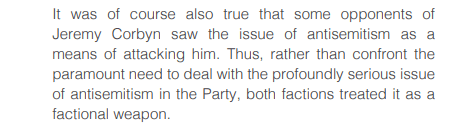
This seems to repeat the age old mistake I warned about earlier of seeking to second guess motives. Did opponents of Corbyn use the use of antisemitism to attack him or were they his opponents specifically because of issues like this? Note, that whilst Forde believes that antisemitism was being weaponised, he considers that this was happening within both factions.
In the section on discrimination, Forde does not really engage with the specific question of whether antisemitism was an issue. He cites complaints from people who thought that this type of racism was getting too much attention and argues that other forms of racism in the party should cause the same levels of outrage that antisemitism had. This again is a serious weakness in the report’s methodology but does not support the claims that Forde exonerates the Corbynite faction.[13]
So, in my assessment, the Forde report is weak and confused. Even still, it is worth noting two things. First, that its finding of factionalism and focus on this does not tell us whether or not a particular form of racism was absent or minimal and weaponised by factions or whether that racism was itself a significant element in the factionalism. Secondly, that whatever the Forde report does say, it certainly does not exonerate the Corbyn era Labour party on the issue of antisemitism. This is primarily because it simply does not focus on that question.
What is concerning is that this factionalism seems to have continued, whether within the Labour Party, or more broadly on the left of British politics. So long as this is the case, and so long as people are simply unable to engage with the issues of structural and systemic forms of antisemitism within the mainstream then we cannot be certain that the danger has gone away.
Furthermore, it is concerning that if anything has been weaponised, then it has been the reports themselves, particularly the Forde report. It is ironic that a report criticising factionalism and denialism is being used by one faction exactly for those purposes.
Whilst it is tempting to treat this as an internal matter for the Labour Party, I don’t think we can do this. First, because it should concern us all, it is everyone’s problem if there is a danger of antisemitism at the heart of our public life and culture. Secondly, because there are important lessons for us to learn in our own contexts both about antisemitism and about discrimination more broadly.
[1] Corbyn in antisemitism row after backing artist behind ‘offensive’ mural | Jeremy Corbyn | The Guardian
[2] Jeremy Corbyn wreath row explained – BBC News
[3] Jewish leaders demand explanation over Corbyn book foreword | Antisemitism | The Guardian
[4] Jeremy Corbyn: ‘Zionists’ have ‘no sense of English irony’ – The Jewish Chronicle (thejc.com)
[5] EHRC,6.
[6] EHRC, 7.
[7] EHRC, 7.
[8] EHRC, 7.
[9] EHRC, 7.
[10] EHRC, 7.
[11] The-Forde-Report.pdf (labour.org.uk)
[12] Forde, 10.
[13] Forde, 81.
 Faithroots