I promised that I’d pick up on the substance of a couple of recent social media debates. Here’s the secind one.
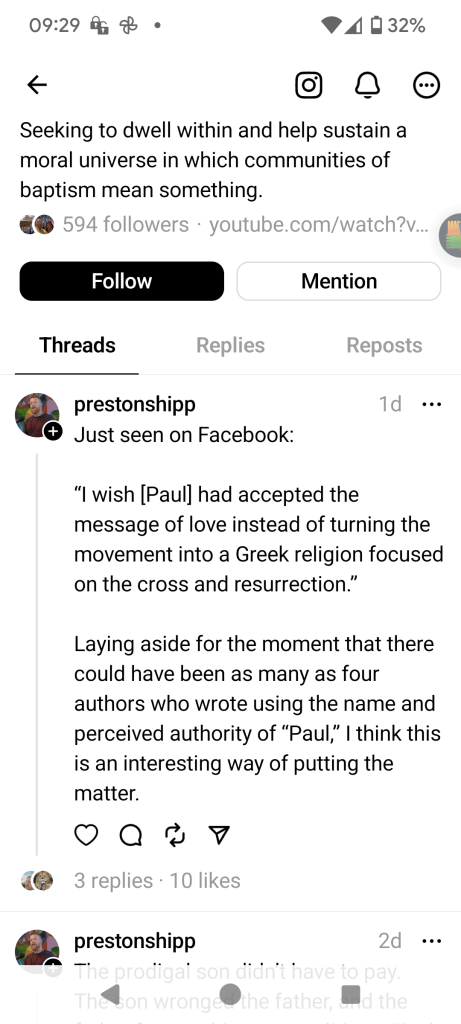
Readers will recognise immediately that this is a pretty old misconception. It’s been doing the rounds as long as I can remember. Some of my readers are significantly older than I am and I suspect this one has been around for longer than you can remember too.
The basic claim that you may have come across is that the Jesus movement was essentially one thing, a particular Jewish sect focused on the teachings and example of Jesus concerning love. Then along came Paul with his desire to export the message and widen the movement to bring in the Gentiles and so he set about changing the message and movement to make it compatible with Greek thinking. Part of that approach included an emphasis on Jesus’ death and resurrection with atonement theology beyond what the original movement understood. One of the things this allegedly did was build on the beliefs and practices of mystery cults.
Now, I don’t know how much this particular author would go with that. Not everyone goes the whole hog but certainly they are drawing a distinction between the Jesus movement/Jesus and Paul.
So, we have two questions to deal with. First, is it true that Paul rejected or was disinterested in the Gospel of Love. Secondly, was a heavy emphasis on Jesus’ death and resurrection unique to Paul.
Let’s deal with these in turn. First of all, it might seem strange to talk about Paul given those great prayers such as we find in Ephesians 3:14-19 where he says:
14 For this reason I kneel before the Father, 15 from whom every family[a] in heaven and on earth derives its name. 16 I pray that out of his glorious riches he may strengthen you with power through his Spirit in your inner being, 17 so that Christ may dwell in your hearts through faith. And I pray that you, being rooted and established in love, 18 may have power, together with all the Lord’s holy people, to grasp how wide and long and high and deep is the love of Christ, 19 and to know this love that surpasses knowledge—that you may be filled to the measure of all the fullness of God.
Note that in context, Paul writes stating that he has heard of the existing love in the church. His readers are recognised as being loving people. They are commended because they grasp “the message of love.”[1]Paul’s concern then is for a them to have a deeper, fuller experience of God’s love in their lives, so that they will be filled with the fullness of God, in other words, so they will be filled with his character, in this context, specifically love. The outflow of that will be a greater love for others.
Now, of course, the rejoinder may come that this is the book of Ephesians and that we don’t know if Paul wrote this. Now as it happens, I don’t believe there are any good reasosn to doubt Pauline authorship. However, it is worth looking at those letters that are undisputed. In them we find that talk of love, from God, for God and for neighbour saturates his letters, particularly in terms of application, just as much as any other theme. Romans 5:5 describes God’s love as poured into our hearts whilst chapter 8 focuses in on the certain reliability of God’s inseparable love. Romans 12 meanwhile offers direct teaching on what it means to “love your neighbour.”
Galatians is considered by many to be the earliest of Paul’s letters and one of the earliest New Testament books. There is no serious dispute over its authorship. There, Paul states:
“For the whole law is fulfilled in one word: “You shall love your neighbor as yourself.”[2]
He then goes on to talk about the fruit of the Spirit beginning with love. It is clear that the message of love, God’s love for us and the call on Christ’s followers to love one another was central to Paul’s message.
Secondly, was a heavy focus on the Cross and the resurrection unique to Paul? Well, the best place to go for the answer to that question is the Gospels. I’m aware that there are some who would quibble that these were written later than Paul’s letters and so could have been influenced by him. However, I note that the data pushes us towards accepting earlydating of the Gospels and that even if they were written later, it is broadly accepted that they would be dependent upon oral and written sources going back to Jesus’’ earliest followers.
When you look at the Gospels you find that from the halfway point of Matthew, Luke and John, the focus is on the journey to Jerusalem, the final week, the crucifixion and resurrection. It isn’t just Paul that puts his focus on Jesus’ death and resurrection, the other New Testament writers and early leaders of the church did too.
There should be no surprise there. The death and resurrection of Jesus is central to the message of love.
[1] Ephesians 1:!5.
[2] Galatians 5:14.
 Faithroots