There is now an interruption to the instructions that YHWH is giving to Moses on Sinai. Whilst Moses was meeting with God on the mountain, trouble was brewing in the camp below. Aaron would be tested, how would he respond?
“Make us gods”
The people observe that Moses is taking time to return from Sinai. They assemble before Aaron. The language of assembling is significant. “Assembly” language was associated with assembling before YHWH to hear him speak “(Exodus 32:1). Here, instead they assemble before a man, YHWH’s high priest in order to instruct him. They say that they don’t know what has become of Moses, they distance themselves from “the man who brought us up out of Egypt” but also distance their Exodus from YHWH, the one who had brough them out of the land, led, provided for them and protected them in the desert. They ask Aaron to make gods for them (v2).
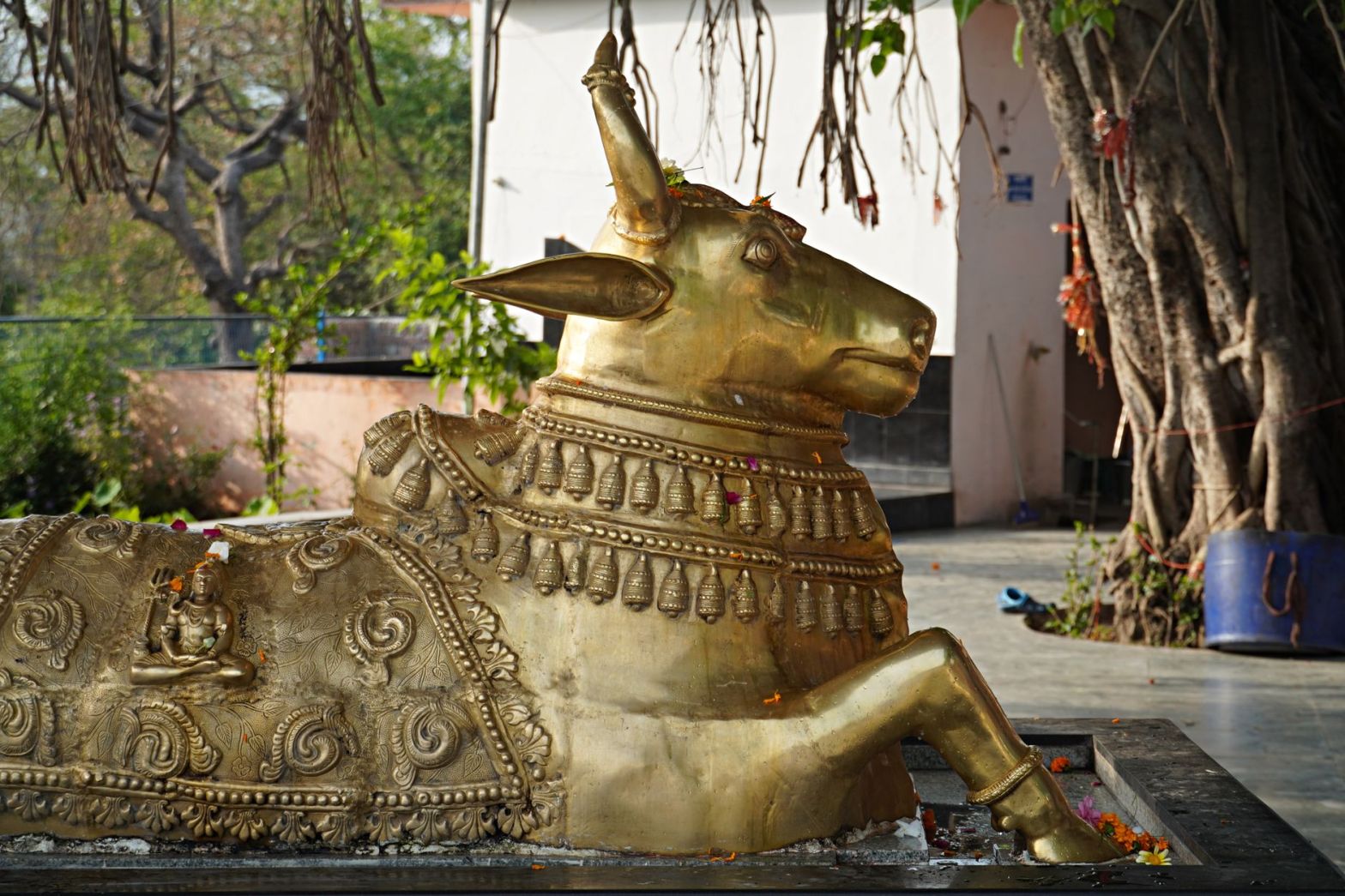
Aaron, instead of declining their request and reminding them of God’s laws acquiesces. He instructs them to bring their gold jewellery to him. This would be jewellery given, at God’s prompting, by the Egyptians. It would also have been ear marked (apologies for the unintended pun) presumably for the Tabernacle and Ark of the Covenant. Aaron himself disobeys Yahweh by handcrafting graven images. He makes a golden bull[1] that would have aligned with the gods of other ancient near eastern peoples.[2] They announce together in a parody of their existing God given liturgy, , “these are the gods that brought you out of Egypt”. Note the pluralisation here. Not just of el to Elohim but of “these” leaving some ambiguity,. Alexander renders it as “These are your deity” but whilst the focus is on one idol there are hints of polytheistic thinking.[3] YHWH’s role as saviour is usurped. The people see the god behind this idol as th one who brought them out of Egypt (v3-4).[4]
Aaron builds an altar and calls a feast. There is some ambiguity as to whether these are considered alternative gods in his mind or images of YHWH as he invites the people to “feast before the Lord.” The offering of sacrifices soon descends into an orgy (v5-6).
Judgement and intercession
God now speaks. He tells Moses to go down to “your people, who you brought out of Egypt.” It is now his turn to distance himself from a people who have rejected him. His observation is that the people have been so quick to turn away and disobey his commands. He condemns them as “stiff-necked” or stubborn, a label that will become familiar and he vows to destroy them and make a new covenant people from Moses, or his descendants (Exodus 32:7-10).
Moses pleads with God. He insists that it is YHWH who rescued the people. He points out that if God destroys Israel then it will appear to vindicate the Egyptians and they will mock him. He argues that God will be breaking his covenant promises to Abraham, Isaac and Jacob. YHWH relents and shows mercy (v11-14).
Moses now returns to the people with the stone tablets. He meets Joshua who has waited faithfully for him. Joshua says that it sounds like war has broken out but Moses responds that it is singing not war that they can hear. Perhaps he had not been fully alert to how far the people had descended into depravity, maybe too there is shock at seeing his own brother and tribe leading the rebellion but Moses becomes very angry. He destroys the stone tablets and then the idol. He burns it and grinds it down into powder and mixes it with water, forcing the people to consume their own idol. Aaron tries to absolve himself by blaming the people and lying, claiming that he threw the gold into the fire and the image came out. Even that claim to superstitious magic would not realty be enough to take away his culpability of course(v15-30).[5]
Moses sees the full state of things. The people have “broken loose” -implicitly of all restraint, the euphemistic language suggests full scale depravity and sexual immorality. He asks “who is on YHWH’s side?” The Levites come to him and he orders them to go through the camp and execute those in rebellion. Three thousand are killed. Moses tells them that their faithful obedience will be rewarded with blessing (v25-29).
Moses now returns to YHWH. He confesses the sin of the people and offers to stand in their place and be punished, to be wiped out from God’s record of his people. YHWH says that the people must pay for their own sin. He will not “blot out” Moses but those who rebelled. He sends Moses back to lead the people to the land, accompanied by his angel (v30-34). Then he sends a plague into the camp bringing further death and desolation (v35).
Abandoned?
YHWH tells Moses to take the people away from Sinai. He will send his angel ahead to defeat their enemies in the land but he will withhold his own presence from them. He tells Moses to announce his judgement, the people are stiff necked, they are to remove all remaining jewellery and prepare for his verdict on them.
This causes the people to lament and grieve (Exodus 33:1-6). In the camp, Moses would meet YHWH in “the tent of meeting” to receive instruction “face to face”. The people would wait outside for him to bring instruction from YHWH (7-11). Presumably it is as the tent of meeting, rather than on the mountain that Moses first intercedes. He again pleads with YHWH not to remove his presence from the people. YHWH must go with them and own them as his people again (v12-16). YHWH agrees (v17).
Now, Moses asks one further request. To give evidence of his promise, Moses asks YHWH to show him his full glory, to let him meet him face to face in a manner which seems to go beyond the description of face-to-face meeting in v11 (v18). YHWH says that this is not possible without killing Moses. Instead he tells him to go to a certain place and to hide in the cleft of the rock. YHWH will allow his glory to pass by and Moses will be granted a view of his back but whilst his glory is passing immediately by. The Lord will proclaim his name over Moses. WHWH will shield Moses’ eyes from a full revelation of his glory (v19).
Echoes of Eden’s rebellion
There are echoes of Eden here. There is a pause to YHWH’s speech, a distancing of the people from Him just as in Genesis 3 we see the serpent interrupt God’s creation speech. The people’s assembly before Aaron imitates the way in which Adam and Eve assemble at the Tree of Knowledge of Good and Evil. Here the call upon Aaron to make gods for them, there, Adam and Eve accepted the invitation from the Serpent to make them into gods. They seek beauty, glory and hope in something false, just as Adam and Even had sought those things from the tree. Aaron’s taking of the jewellery echoes the first humans’ taking of the fruit. Whilst not left naked, the people are symbolically stripped of adornment.
Aaron’s attempt to deflect blame echoes that of Adam and Eve. If Sinai is a mediated Eden, then YHWH’s sending the people away early (of course at some point Adam and Eve would have left the Garden to subdue the earth), especially if without his presence echoes the driving out from the Garden.
When God requires our worship, we are filled, clothed, renewed. When Satan demands our worship, we are emptied, robbed, stripped, debased and exiled.
New Tablets
God instructs Moses to cut two new stone tablets. The first two had been given to him by THWH. That Moses has to provide the new ones perhaps indicates a small rebuke, just as Moses later in anger smote his rod against the rock, here his anger had caused him to act in destructive rage against the very covenant documents upon which his appeal to God was based. However, note that it is still God who takes responsibility for engraving the commandments on the stones (Exodus 34:1).[6] Moses is to come alone to the mountain with the tablets which he does the next morning (v2-4). The Lord comes down to meet him in the cloud, stands with Moses and proclaims his name. Notice the foreshadowing of Jesus, the Son of Man who comes with the clouds and ascends into them. The anthropomorphic language we have seen already of God’s hand and face now here pointing to God standing with him may point toward a theophany, YHWH appearing in human form as he meets with and speaks to Moses (v4-5).
The Lord passes in front of Moses as promised and pronounces his name, notice that this goes beyond YHWH and extends to a full descriptive paragraph emphasising his faithfulness, love, compassion and justice. His name is tied to his attributes and those attributes are the foundation for our own moral values (v6-7). Moses’ response to this is first to bow in worship and now, on the basis of God’s own character to intercede again for the people, pleading that YHWH will go with them and not withhold his presence (v8-9).
Hands, feet and faces
We know that God is spirit and therefore without body parts. However, at times in Scripture we find references to his body, to him seeing with his eyes, to him rescuing with a strong arm or to the breath in his nostrils. In most cases, this anthropomorphic language is metaphorical to indicate an aspect of his character such as his power to save and his justice. However, there are moments when we see God make his presence manifest in a specific place so that people see something or someone visible. This might include the fiery pillar as a good example. We refer to these appearances as theophanies.
Hebrews 2:2 indicates that the Mosaic covenant as mediated through angels. We see moments when there is a clear distinction between an angel and the Lord as in this section of Exodus when YHWH says that he will send an angel but not go up with Israel. At other times though, there seems to be a blurring between “the Lord” and “the angel of the Lord.” In those contexts I would suggest that we are seeing examples of the angel “mediating YHWH’s presence”. Angels, although spirit seem to appear in human form. This is of course distinct from The Son, incarnate as fully man. There is though a strong tradition of assuming that these theophanies such as here in Exodus 34, especially with the emphasis on covenant compassion and redemption or in Genesis 2-3 where the Lord walks in the garden primarily involve the Son, Christ in a pr-incarnate appearing.
Renewing the Covenant
Now YHWH renews his covenant with God’s people. YHWH will drive out the Canaanite tribes from the land, he will go before the people (Exodus 34:11). The Israelites are to be careful not to get into covenants with the inhabitants but rather are to destroy their idols and altars (v11-16). They are not to cast any gods out of metal themselves (v17).
They are to keep the festivals and sabbaths, a reminder that they are dependent on YHWH, that he is the one defeating their enemies, he gave them the land and he is the one who brought them up out of Egypt (v21-26).
YHWH tells Moses to write the words. So, whilst it is YHWH who is engraving them, it seems to be through Moses that he acts to fulfil this. Moses spends 40 days and 40 nights there on the mountain writing out the covenant commands with the Lord (v27-28).
Shiny
Moses returns from the mountain and from seeing something of YHWH’s glory and his own face reflects this, shining with a transferred radiance making it difficult for the people to look at him. They fear him. He addresses them with the covenant commands and then covers his face with a veil (Exodus 34:29-33).
Moses followed this pattern of unveiling to meet with YHWH and report His Words to the people afterwards. His shining countenance offered evidence that he had been in the Lord’s presence and brought his word to them (v34-35).
The unveiling of our faces: three stages of application
This incident in Israel’s history would first of all applied to God’s people in the land. We see that they continued to be a stiff-necked people. YHWH remained faithful to his covenant and compassionate but Israel was the rebellious son. They could not presume to rely on his compassion and therefore his manifest presence with them, overlooking his righteousness and justice. They experienced exile from the land when he handed them over to enemies. Even on their return from exile, the later prophets and writings suggest that it was not in the same way that they had gone up from Egypt. The Shekinah presence of God never returned to the Temple and so one view is that the return from exile was never seen as complete.
We should apply Scripture through Christ to us. If Israel proved to be the rebellious son, then Christ is the obedient and faithful son. Jesus is also the true and better Moses who fasted in the wilderness for forty days and nights. Rather than destroying the law as Moses did the tablets, Christ fulfilled it so that the Law is not written on stone or hearts of stone but on hearts of flesh. In Jesus, fully God and fully man, we see God manifest, present with his people.
For Christians, this part of Exodus warns us against idolatry. We can become quickly forgetful about God’s faithfulness and goodness, prone to blame him for when things go wrong and to see our own actions and those of others as the cause of good in our lives. I noted in an earlier footnote that the Israelites may have believed they were only making an image of YHWH and convinced themselves of this. However, the reality was that they ended up with a very different god. We may not believe that the things we put our hope in or that we fear are rivalling god and yet whether it be personal prosperity, liberation theology or a baptised nationalism, we find that those things by becoming alternative saviours and telling a different Gospel distort our understanding of God so that we end up with a different god entirely.
In Christ we see God’s compassionate mercy and his justice at work. Sin is judged and we are forgiven. He promises his presence with us. The veil is removed and Christ is present permanently with us through the Holy Spirit. There is a greater day to come when we will see him face to face.[7]
“12 Since we have such a hope, we are very bold, 13 not like Moses, who would put a veil over his face so that the Israelites might not gaze at the outcome of what was being brought to an end. 14 But their minds were hardened. For to this day, when they read the old covenant, that same veil remains unlifted, because only through Christ is it taken away. 15 Yes, to this day whenever Moses is read a veil lies over their hearts. 16 But when one[c] turns to the Lord, the veil is removed. 17 Now the Lord[d] is the Spirit, and where the Spirit of the Lord is, there is freedom. 18 And we all, with unveiled face, beholding the glory of the Lord,[e] are being transformed into the same image from one degree of glory to another.[f] For this comes from the Lord who is the Spirit.”[8]
[1][1] Whilst often referred to as a golden calf, Alexander notes that “The Hebr term “egel” denotes ‘a young bull’ in its prime, possibly up to 3 years of age (c.f. Gen 15:9), not a vulnerable calf.” Alexander, Exodus, 622.
[2] Alexander, Exodus, 622.
[3] Alexander, Exodus, 622.
[4] Note, commentators believe that the people primarily saw the idol as a representation of YHWH rather than alternative or rival gods, though still a serious breach of the commandments. C.f. Enns, Exodus, 570. However, the introduction of an idol the request for gods to be made is at best ambiguous. Furthert, the very making of an idol with its focus on a limited set of attributes and in defiance of the claim that God cannot be represented in such form does mean that whatever they may have believed and convinced themselves of, this was a very different god.
[5] The method of destruction may suggest that it was a wooden structure overlaid with gold rather than a cast gold object. C.f. Alexander, Exodus, 622.
[6] C.f. Exodus 24:12.
[7] 1 John 3:1-2.
[8] 2 Corinthians 3:12-18.

